they/them Associate Professor @ Lusófona University www.danielscardoso.net
they/them Associate Professor @ Lusófona University www.danielscardoso.net
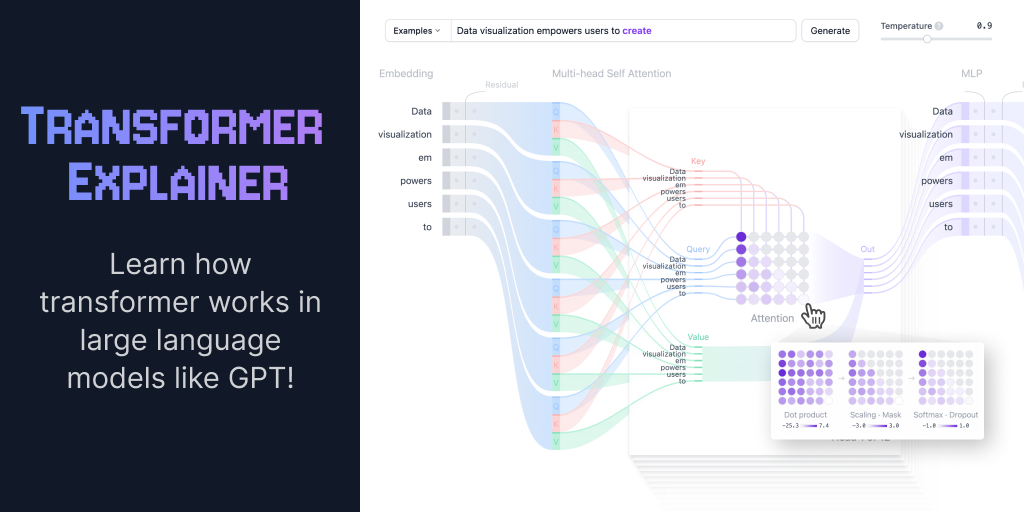
Transformer Explainer: LLM Transformer Model Visually Explained
An interactive visualization tool showing you how transformer models work in large language models (LLM) like GPT.
OpenSanctions: Supreme Data on Supreme Leaders
The open-source database of sanctions, watchlists, and politically exposed persons — aggregating hundreds of sources and relied on by compliance teams, investigators, and journalists.
OPEN (Organization for Polyamory and Ethical Non-monogamy)
OPEN is a grassroots advocacy nonprofit working to advance legal rights and cultural acceptance for non-monogamous families and relationships of all varieties.
Digitalization
Abstract “Digitization” and “digitalization” are two conceptual terms that are closely associated and often used interchangeably in a broad range of literatures. This entry considers each term in detail and argues that there is analytical value in explicitly making a clear distinction between them. The entry defines digitization as the material process of converting analog streams of information into digital bits. It defines digitalization as the way many domains of social life are restructured around digital communication and media infrastructures.
Digitalisation in Europe – 2025 edition - Interactive publications - Eurostat
Digital technologies are transforming the world we live and work in. They touch many different aspects of our lives, from everyday tasks like making phone calls and shopping to how businesses and public services operate. Digital transformation is one of the key priorities for the EU. The digital decade initiative sets out the EU targets that will guide digital transformation until 2030.
Horizon Europe
The EU's research and innovation funding programme 2021-2027
:: Página em manutenção ::
Devido a uma intervenção em nosso sistema, este serviço encontra-se temporariamente indisponível, sendo normalizado em breve.
Zotero | Your personal research assistant

Yes: Affirmative Consent as a Theoretical Framework for Understanding and Imagining Social Platforms | Proceedings of the 2021 CHI Conference on Human Factors in Computing Systems
As part of the Digital Library's transition to Open Access, new features for researchers are available in the Premium Edition. Click here to learn more.

A Nonideal Theory of Sexual Consent
Our autonomy can be compromised by limitations in our capacities, or by the power relationships within which we are embedded. If we insist that real consent requires full autonomy, then virtually no sex will turn out to be consensual. I argue that under conditions of compromised autonomy, consent must be socially and interpersonally scaffolded. To understand consent as an ethically crucial but nonideal concept, we need to think about how it is related to other requirements for ethical sex, such as the ability to exit a situation, trust, safety, broader social support, epistemic standing in the community, and more.
Beyond Equality—Non-Monogamy and the Necropolitics of Marriage
‘Marriage equality’ has been a widely used slogan and mobilizing concept for LGBTQ+ rights’ movements across the globe striving for formal recognition for ‘same-sex’ or ‘same-gender’ marriages. In this article, we critically interrogate the terminology and political rationality that have given shape to ‘marriage equality’ campaigns. We demonstrate the structural erasure of non-monogamous relations and populations from the changes hoped for and envisioned in these mobilizations. The lack of any genuine and substantial concern with consensual non-monogamies (CNMs) from most of the literature in the field highlights the close entanglement of marriage with monogamy. As a result, ideas are scarce about how meaningful and adequate legal recognition and social policy provisions for a wide range of intimate, sexual, familial, and/or caring bonds or constellations on the CNM continuum could look like. We argue that the critique of the mononormativity inherent to marriage is fundamental to understanding the role of this in the 21st century. We identify the roots of the mononormativity of marriage in its governmental role as a necropolitical and biopolitical technology, evidenced by its ‘civilizing’ function in white settler colonial projects. Because of this, an expansion of the call for equality to include non-monogamous populations does not resolve but rather aggravates the problem. We conclude that any truly queer politics of CNM consequently needs to be anti-marriage.