
On Close and Distant Reading in Digital Humanities: A Survey and Future Challenges
We present an overview of the last ten years of research on visualizations that support close and distant reading of textual data in the digital humanities. We look at various works published within both the visualization and digital humanities

Culture on the Ground - Tim Ingold, 2004
Classical accounts of human evolution posit a progressive differentiation between the hands as instruments of rational intelligence and feet as ...

Links between the discovery of primates and anatomical comparisons with humans, the chain of being, our place in nature, and racism
- For more than a millennium humans knew more about the internal anatomy of a single monkey species than about that of their own bodies, because Galen used monkeys to infer human anatomy, in line wit...

The New Wounded
This book addresses the issue of trauma and psychic wounds to stage a confrontation between psychoanalysis and contemporary neurobiology. In so doing, it reevaluates the brain as an organ that is not separated from psychic life but rather appears as its very locus. A philosophical approach of the “new wounded” (brain lesion patients) forms the matter of the confrontation.
Ontology of the Accident: An Essay on Destructive Plasticity
In the usual order of things, lives run their course and eventually one becomes who one is. Bodily and psychic transformations do nothing but reinforce the permanence of identity. But as a result of serious trauma, or sometimes for no reason at all, a subject’s history splits and a new, unprecedented persona comes to live with the former person - an unrecognizable persona whose present comes from no past and whose future harbors nothing to come; an existential improvisation, a form born of the accident and by accident. Out of a deep cut opened in a biography, a new being comes into the world for a second time. <br /> <br /> What is this form? A face? A psychological profile? What ontology can it account for, if ontology has always been attached to the essential, forever blind to the <i>aléa</i> of transformations? What history of being can the plastic power of destruction explain? What can it tell us about the explosive tendency of existence that secretly threatens each one of us?<br /> <br /> Continuing her reflections on destructive plasticity, split identities and the psychic consequences experienced by those who have suffered brain injury or have been traumatized by war and other catastrophes, Catherine Malabou invites us to join her in a philosophic and literary adventure in which Spinoza, Deleuze and Freud cross paths with Proust and Duras.
What Are Psychedelic Entities?
The beings people often meet while using psychedelics resist tidy explanations.
Run, Spot, Run: The Ethics of Keeping Pets
A life shared with pets brings many emotions. We feel love for our companions, certainly, and happiness at the thought that we’re providing them with a safe, healthy life. But there’s another emotion, less often acknowledged, that can be nearly as powerful: guilt. When we see our cats gazing wistfully out the window, or watch a goldfish swim lazy circles in a bowl, we can’t help but wonder: are we doing the right thing, keeping these independent beings locked up, subject to our control? Is keeping pets actually good for the pets themselves? That’s the question that animates Jessica Pierce’s powerful Run, Spot, Run. A lover of pets herself (including, over the years, dogs, cats, fish, rats, hermit crabs, and more), Pierce understands the joys that pets bring us. But she also refuses to deny the ambiguous ethics at the heart of the relationship, and through a mix of personal stories, philosophical reflections, and scientifically informed analyses of animal behavior and natural history, she puts pet-keeping to the test. Is it ethical to keep pets at all? Are some species more suited to the relationship than others? Are there species one should never attempt to own? And are there ways that we can improve our pets’ lives, so that we can be confident that we are giving them as much as they give us? Deeply empathetic, yet rigorous and unflinching in her thinking, Pierce has written a book that is sure to help any pet owner, unsettling assumptions but also giving them the knowledge to build deeper, better relationships with the animals with whom they’ve chosen to share their lives.
Extinctiopolitics: Existential Risk Studies, the Extinctiopolitical Unconscious, and the Billionaires’ Exodus from Earth
One of the most prominent intellectual attempts to grapple with human extinction in recent decades is existential risk studies.
Calamity Theory
What are the implications of how we talk about apocalypse? A new philosophical field has emerged. “Existential risk” studies any real or hypothetical hum...
L'animal est l'avenir de l'homme
La vie partagée avec l’animal constitue un enjeu politique, philosophique et éthique majeur de notre temps. Pour Dominique Lestel, cette question métabolise quelques-unes des caractéristiques les plus pathologiques de la civilisation occidentale, qui s’expriment en particulier à travers la thèse de l’animal-machine ou le mépris dont font encore trop souvent l’objet les défenseurs des animaux.Dans cet essai enlevé et engagé, l’auteur affirme au contraire que le souci des animaux fait partie intégrante de notre humanité. Il montre dans quelle mesure l’animal est pour nous un interlocuteur à part entière, et parfois un partenaire, auprès duquel nous avons contracté une dette infinie. Analysant notamment les problèmes posés par l’expérimentation animale – dont il révèle toute la complexité –, il plaide pour le développement d’une bioéthique de la réciprocité : si nous pouvons prendre beaucoup à l’animal, nous devons aussi lui donner beaucoup.Ce livre de philosophie pratique est destiné à donner des munitions à tous ceux qui persistent à défendre la cause animale, mais aussi à tous ceux qui souhaitent penser l’humain au-delà de l’idée d’une barrière hygiénique qui le préserverait d’une contamination suspecte par les autres animaux.Dominique Lestel construit depuis plus de quinze ans une anthropologie philosophique qui s’appuie sur une épistémologie critique de l’éthologie et qui refuse de penser l’humain comme une citadelle menacée par l’inquiétante proximité des autres animaux. Son travail suscite un intérêt croissant aux quatre coins du monde, y compris en dehors des milieux universitaires. Il est l’auteur de nombreux ouvrages, dont Paroles de singes. L’impossible dialogue hommes-primates (La Découverte, 1995), Les Origines animales de la culture (Flammarion, 2001)et L’Animal singulier (Seuil, 2004).
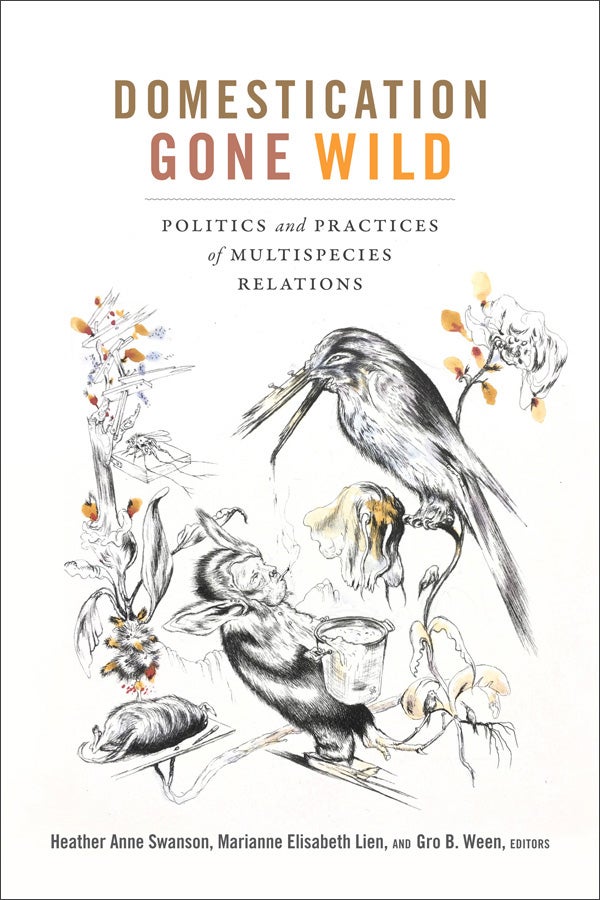
Domestication Gone Wild: Politics and Practices of Multispecies Relations
“What do Pacific salmon, British falcons, pine trees everywhere, Ifugao pigs and spirits, and Norwegian apples have in common? They perform ‘domestication’ in ways certain to change the narratives and politics of domestication for scholars of whatever discipline and for critter people all over the earth. Read this book for up-to-the-minute, deeply researched, very smart, contentious takes on the shapes of conjoined humans and nonhumans living and dying together in diverse histories of civilization, colonialism, capitalism, times-past, and times-yet-to-come. Perhaps what opens up in this book are real possibilities for caring more materially in urgent times.” - Donna J. Haraway, author of Staying with the Trouble: Making Kin in the Chthulucene
(PDF) Hunters and Guides: Multispecies Encounters between Humans, Honeyguide Birds and Honeybees
PDF | This paper discusses the relationship between humans and honeyguide birds (Indicator indicator) in the Adamaoua Region of Cameroon. Throughout... | Find, read and cite all the research you need on ResearchGate

To Bees or Not to Bees: Greater Honeyguides Sometimes Guide Humans to Animals Other Than Bees, but Likely Not as Punishment
We show that greater honeyguides guide humans to nonbee destinations (snakes and a dead mammal); yet this is a rare occurrence, happening in only 3.7% of human-honeyguide interactions in 1 year and 0...

Reciprocal signaling in honeyguide-human mutualism
Honeyguide birds recognize human honey-hunters calls and help them find wild bees’ nests.


