Integrative experiments identify how punishment affects welfare in public goods games
Despite decades of research, the conditions under which punishment promotes cooperation remain unclear. Through an integrative experiment varying 14 design parameters of public goods games across 360 experimental conditions (147,618 decisions from 7100 participants), we reveal substantial heterogeneity in punishment effectiveness: Its impact on welfare ranges from 43% improvement to 44% reduction depending on the game parameters. To characterize these patterns, we developed models that outperformed human forecasters in predicting punishment effectiveness in new experiments. Communication emerges as the most important factor, followed by contribution framing (opt out versus opt in), contribution type (variable versus all-or-nothing), game length, and outcome visibility, though these factors often interact. The results reframe the debate from whether punishment works to when it does, demonstrating how integrative experiments enable discovery of generalizable patterns in social phenomena. , Editor’s summary People face conflicts between maximizing personal gain versus supporting collective interests. If we cooperatively recycle or donate to charities, it benefits society, but it also costs us time and resources that could be selfishly preserved for ourselves. We impose penalties to deter those undesirable or selfish behaviors, but under what conditions do punishments or penalties effectively modify behavior to benefit group welfare? Alsobay et al . systematically and simultaneously varied 14 factors together instead of in isolation. Punishment was unequivocally most effective when paired with consistent communication, particularly over time. Another effective factor was “opting out” or withdrawing some, but not all, endowments already in the public fund. These methodological advances revealed when, rather than whether, punishment works. —Ekeoma Uzogara , INTRODUCTION Human societies face many situations where individual and collective interests conflict, often referred to as social dilemmas. Costly peer punishment has been studied for more than 25 years in public goods games (stylized behavioral experiments in which individuals decide how much to contribute to a shared pool that benefits everyone) as a mechanism to promote cooperation. Prior research has identified many contextual factors that moderate punishment’s effectiveness, including game length, communication, group size, punishment cost, and so on. However, the specific conditions under which punishment improves group welfare remain unclear. RATIONALE We argue that this lack of clarity derives from the dominant experimental paradigm, in which any given study manipulates only one or a few theoretically informed factors. Because such studies differ in many ways (different experimental procedures, populations), their results are often difficult to compare or integrate. Consequently, one can list many factors that have some effect, but cannot say how much each matters relative to the others, or how they work together, and as a result, cannot predict when punishment will help or harm welfare in new settings. To address this fundamental knowledge gap, we use an integrative experimental design and systematically vary 14 parameters across 360 conditions (147,618 decisions from 7100 participants) to elucidate when punishment improves versus undermines welfare in public goods games, which factors matter most, and how they interact. RESULTS The effect of punishment on welfare ranged from 43% improvement to 44% reduction depending on the specific combination of game parameters. To characterize this heterogeneity, we trained a model that outperformed all 553 human forecasters (laypeople and experts) in predicting whether punishment would help or harm welfare in new experiments. Communication emerged as roughly three times more important than any other factor, followed by contribution framing (opt in versus opt out), contribution type (variable versus all-or-nothing), game length, and peer outcome visibility (whether participants can see others’ earnings). These factors often interact. For example, longer games enhance punishment’s effectiveness only when communication is available, and contribution framing effects depend on both contribution type and outcome visibility. CONCLUSION Many phenomena in social science are shaped by many factors whose interactions are consequential, yet the dominant experimental paradigm often limits its inquiry to “does a given effect exist?” and examines hypothesized factors in isolation. As a result, research programs can accumulate many partial explanations without a clear picture of how they combine to determine outcomes across settings. Knowing that factors matter individually is fundamentally different from knowing how much each matters and how they interact. The integrative approach implemented here offers one way forward. It varies many factors simultaneously within a shared design space, evaluates models by their predictive accuracy on new experiments, and probes those models to constrain and develop theory. Our hope is that integrative experiment designs, combined with models that integrate prediction and explanation, represent a path toward more cumulative social science. Integrative experiment reveals when punishment helps versus harms. We systematically varied 14 design parameters across 360 experimental conditions. The effect of punishment on cooperation efficiency ranged from −44% to +43% depending on the specific game parameters. Communication emerged as three times more important than any other factor, followed by contribution framing, contribution type, and game length.

Inside Baseball: The Automated Ball-Strike System as an Object Lesson in Technological Rule Enforcement
Clearly-defined rules are often assumed to be straightforward to automate and evaluate. We challenge this assumption through an in-depth study of Major League Baseball's (MLB) seven-year experimentation with the Automated Ball-Strike System (ABS). ABS is envisioned to call balls and strikes accurately: a seemingly straightforward use of technology to objectively determine the distance between a pitch and the strike zone. Although the strike zone is an area clearly defined in the rulebook, it took MLB seven years to figure out how to automate calling balls and strikes with ABS, showing how even seemingly straightforward rules require a complex translation process to operationalize via technological systems. In this paper, we trace the design decisions that led to the current implementation of ABS. Our case study reveals that "distance" exists even between a clear rule and its technological implementation. Using analytic frameworks from Science and Technology Studies (STS), we show that such distance exists because (1) historically, the "ground truth" of the strike zone is contested: the rule in practice has always reflected a hybrid between the rulebook definition and umpires' enforcement decisions; and (2) the use of ABS is embedded in an existing eco-system, where the implementation of a technological enforcement system needs to balance multiple stakeholder values. This perspective challenges conventional evaluation paradigms that center on the distance between a formalized rule and its technological implementation, and instead calls for evaluating how such systems are experienced in practice. Addressing this question requires in-depth social science approaches, contributing to ongoing conversations in FAccT about the implementation and evaluation of sociotechnical systems.

Exposure to ideologically diverse news and opinion on Facebook
Won’t Stop ’Til You Get Enough? Determinants of Disengaging From Mobile Media Apps in Daily Life - Alicia Ernst, Anna Schnauber-Stockmann, 2025
While permanent connectivity has made media use ubiquitous and apps have become engagement optimized, little research has focused on the termination of (mobile)...

Modeling the Engagement-Disengagement Cycle of Compulsive Phone Use | Proceedings of the 2019 CHI Conference on Human Factors in Computing Systems
As part of the Digital Library's transition to Open Access, new features for researchers are available in the Premium Edition. Click here to learn more.

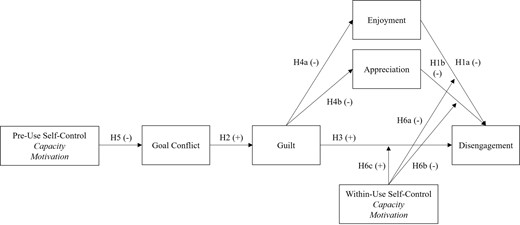
Too amused to stop? Self-control and the disengagement process on Netflix
Abstract. Consuming media entertainment often challenges recipients’ self-control. While past research related self-control almost exclusively to whether i
Reflective smartphone disengagement: Conceptualization, measurement, and validation
The present paper develops a new concept, called Reflective Smartphone Disengagement (RSD), defined as individuals’ deliberate efforts to control and restrict smartphone use. Based on the reflective-impulsive model, we examined the RSD concept in four studies, using cross-sectional data of adolescents (Study 1, N = 453, Study 3, N = 760) and adults (Study 4, N = 672), as well as panel data of adults (Study 2, N = 461). In Study 1, findings from exploratory and confirmatory factor analyses supported the one-dimensionality of the RSD scale. In Study 2, we found evidence for high test–retest reliability as well as discriminant validity, and in terms of predictive validity, RSD negatively predicted excessive smartphone use, information overload, and the social availability norm over time. Study 3 demonstrated convergent validity with a negative relationship with trait nomophobia and a positive one with trait self-reflection. Study 4 confirms the structural validity of a shorter version of the scale. We discuss avenues for future research and broader implications of the RSD concept for the field.
Distinguishing Person-Specific from Situation-Specific Variation in Media Use: A Meta-Analysis - Anna Schnauber-Stockmann, Michael Scharkow, Veronika Karnowski, Teresa K. Naab, Daniela Schlütz, Paul Pressmann, 2025
Media use varies between persons (person-specific variation) and within persons (situation-specific variation, that is, the same individual uses media different...
(PDF) The Loop and Reasons to Break It: Investigating Infinite Scrolling Behaviour in Social Media Applications and Reasons to Stop
PDF | Today's social media (SM) platforms are toolkits consisting of features with different use cases, some strongly related to habitual and regretful... | Find, read and cite all the research you need on ResearchGate

Smartphones and Cognition: A Review of Research Exploring the Links between Mobile Technology Habits and Cognitive Functioning
While smartphones and related mobile technologies are recognized as flexible and powerful tools that, when used prudently, can augment human cognition, there is also a growing perception that habitual involvement with these devices may have a negative and lasting impact on users’ ability to think, remember, pay attention, and regulate emotion. The present review considers an intensifying, though still limited, area of research exploring the potential cognitive impacts of smartphone-related habits, and seeks to determine in which domains of functioning there is accruing evidence of a significant relationship between smartphone technology and cognitive performance, and in which domains the scientific literature is not yet mature enough to endorse any firm conclusions. We focus our review primarily on three facets of cognition that are clearly implicated in public discourse regarding the impacts of mobile technology – attention, memory, and delay of gratification – and then consider evidence regarding the broader relationships between smartphone habits and everyday cognitive functioning. Along the way, we highlight compelling findings, discuss limitations with respect to empirical methodology and interpretation, and offer suggestions for how the field might progress toward a more coherent and robust area of scientific inquiry.

Opinion | The Starving Artist vs. A.I.: Guess Who Is Winning?
What A.I. imperils is not human creativity itself but the ability to make a living from creative endeavor.

Agency Among Agents: Designing with Hypertextual Friction in the Algorithmic Web
Today's algorithm-driven interfaces, from recommendation feeds to GenAI tools, often prioritize engagement and efficiency at the expense of user agency. As systems take on more decision-making, users have less control over what they see and how meaning or relationships between content are constructed. This paper introduces "Hypertextual Friction," a conceptual design stance that repositions classical hypertext principles--friction, traceability, and structure--as actionable values for reclaiming agency in algorithmically mediated environments. Through a comparative analysis of real-world interfaces--Wikipedia vs. Instagram Explore, and Are.na vs. GenAI image tools--we examine how different systems structure user experience, navigation, and authorship. We show that hypertext systems emphasize provenance, associative thinking, and user-driven meaning-making, while algorithmic systems tend to obscure process and flatten participation. We contribute: (1) a comparative analysis of how interface structures shape agency in user-driven versus agent-driven systems, and (2) a conceptual stance that offers hypertextual values as design commitments for reclaiming agency in an increasingly algorithmic web.
Reranking partisan animosity in algorithmic social media feeds alters affective polarization
Today, social media platforms hold the sole power to study the effects of feed-ranking algorithms. We developed a platform-independent method that reranks participants’ feeds in real time and used this method to conduct a preregistered 10-day field ...


