Open source software powers the world’s technology. In the past decade, there has been an inexorable adoption of open source in most aspects of computing. Without open source, Facebook, Google, Amazon, and nearly every other modern technology company would not exist. Thanks to an amazing community of innovative, top-notch programmers, open source has become the...
What makes us Red Hat
Open source software is, in fact, eating the world. It is a de facto model for innovation, and technology as we know it would look vastly different without it. On a few occasions, over the past several years, software industry observers have asked whether there will ever be another Red Hat. Others have speculated that due to the economics of open source software, there will never be another Red Hat. Having just concluded another outstanding fiscal year, and with the perspective of more than 15 years leading Red Hat’s Products and Technologies division, I thought it might be a good time to provide my own views on what actually makes Red Hat Red Hat.Commitment to open sourceRed Hat is the world’s leading provider of open source software solutions. Red Hat’s deep commitment to the open source community and open source development model is the key to our success. We don’t just sell open source software, we are leading contributors to hundreds of open source projects that drive these solutions. While open source was once viewed as a driver for commoditization and driving down costs, today open source is literally the source of innovation in every area of technology, including cloud computing, containers, big data, mobile, IoT and more.Red Hat is best known for our leadership in the Linux communities that drive our flagship product, Red Hat Enterprise Linux, including our role as a top contributor to the Linux kernel. While the kernel is the core of any Linux distribution, there are literally thousands of other open source components that make up a Linux distribution like Red Hat Enterprise Linux, and you will find Red Hatters, as well as non-Red Hatters, leading and contributing across many of these projects. It’s also important to note that Red Hat’s contributions to Linux don’t just power Red Hat Enterprise Linux, but also every single Linux distribution on the planet - including those of our biggest competitors. This is the beauty of the open source development model, where collaboration drives innovation even among competitors.Today, Red Hat doesn’t just lead in Linux, we are leaders in many different communities. This includes well-known projects like the Docker container engine, Kubernetes and OpenStack, which are among the fastest growing open source projects of the last several years. Red Hat has been a top contributor to all of these projects since their inception and brings them to market in products like Red Hat Enterprise Linux, Red Hat OpenShift Container Platform and Red Hat OpenStack Platform. Red Hat’s contributions also power competing solutions from the likes of SUSE, Canonical, Mirantis, Docker Inc., CoreOS and more.The list of communities Red Hat contributes to includes many more projects like Fedora, OpenJDK, Wildfly, Hibernate, Apache ActiveMQ, Apache Camel, Ansible, Gluster, Ceph, ManageIQ and many, many more. These power Red Hat’s entire enterprise software portfolio. This represents thousands of developers and millions of man-hours per year that Red Hat commits to the open source community. Red Hat also commits to keeping our commercial products 100% pure open source. Even when we acquire a proprietary software company, we commit to releasing all of its code as open source. We don’t believe in open core models, or in being just consumers but not contributors to the projects we depend on. We do this because we still believe in our core that the open source development model is THE best model to foster innovation, faster.As I told one reporter last week, some companies have endeavored to only embrace 'open' where it benefits them, such as open core models. Half open is half closed, limiting the benefits of a fully open source model. This is not the Red Hat way.This commitment to contribution translates to knowledge, leadership and influence in the communities we participate in. This then translates directly to the value we are able to provide to customers. When customers encounter a critical issue, we are as likely as anyone to employ the developers who can fix it. When customers request new features or identify new use cases, we work with the relevant communities to drive and champion those requests. When customers or partners want to become contributors themselves, we even encourage and help guide their contributions. This is how we gain credibility and create value for ourselves and the customers we serve. This is what makes Red Hat Red Hat.Products not projectsOpen source is a development model, not a business model. Red Hat is in the enterprise software business and is a leading provider to the Global 500. Enterprise customers need products, not projects and it’s incumbent on vendors to know the difference. Open source projects are hotbeds of innovation and thrive on constant change. These projects are where sometimes constant change happens, where the development is done. Enterprise customers value this innovation, but they also rely on stability and long-term support that a product can give. The stable, supported foundation of a product is what then enables those customers to deliver their own innovations and serve their own customers.Too often, we see open source companies who don’t understand the difference between projects and products. In fact, many go out of their way to conflate the two. In a rush to deliver the latest and greatest innovations, as packaged software or public cloud services, these companies end up delivering solutions that lack the stability, reliability, scalability, compatibility and all the other “ilities” or non-functional requirements that enterprise customers rely on to run their mission-critical applications.Red Hat understands the difference between projects and products. When we first launched Red Hat Enterprise Linux, open source was a novelty in the enterprise. Some even viewed it as a cancer. In its earliest days, few believed that Linux and open source software would one day power everything from hospitals, banks and stock exchanges, to airplanes, ships and submarines. Today open source is the default choice for these and many other critical systems. And while these systems thrive on the innovation that open source delivers, they rely on vendors like Red Hat to deliver the quality that these systems demand.Collaborating for community and customer successRed Hat’s customers are our lifeblood. Their success is our success. Just like we thrive on collaboration in open source communities, that same spirit of collaboration drives our relationships with our customers. By using open source innovation, we help customers drive innovation in their own business. We help customers consume the innovation of open source-developed software. Customers appreciate our willingness to work with them to solve their most difficult challenges. They value the open source ethos of transparency, community and collaboration. They trust Red Hat to work in their best interests and the best interests of the open source community.Too often open source vendors are forced to put commercial concerns over the interests of customers and the open source communities that enable their solutions. This doesn’t serve them or their customers well. It can lead to poor decision making in the best case and fractured communities in the worst case. Sometimes these fractures are repaired and the community emerges stronger, as we saw recently with Node.js. Other times, when fractures are beyond repair, new communities take the place of existing ones, as we have seen with Jenkins and MariaDB. Usually, we see that open source innovation marches forward, but this fragmentation only serves to put vendors and their customers at risk.Red Hat believes in collaborating openly with both customers and the open source community. It’s that collaboration that brings forward new ideas and creative solutions to the most difficult problems. We work with the community to identify solutions and find common ground to avoid fragmentation. Through the newly launched Red Hat Open Innovation Labs we are bringing that knowledge and experience directly to our customers.The next Red HatWill there be another Red Hat? I hope and expect that there will be several. Open source is now the proven methodology for developing software. The days of enterprises relying strictly on proprietary software has ended. The problems that we have to solve in the complexities of today’s world are too big for just one company. Vendors may deliver solutions in different ways, address different market needs and/or serve different customers - but I believe that open source will be at the heart of what they do. We see open source at the core of leading solutions from both the major cloud providers and leading independent software vendors. But, open source is a commitment, not a convenience, and innovative open source projects do not always lead to successful open source software companies.Today, we strive not only to be the Red Hat of Linux, but also the Red Hat of containers, the Red Hat of OpenStack, the Red Hat of middleware, virtualization, storage and a whole lot more. Many of these businesses, taken independently, would be among the fastest growing technology companies in the world. They are succeeding because of the strong foundation we’ve built with Red Hat Enterprise Linux, but also because we’ve followed the same Red Hat Enterprise Linux playbook of commitment to the open source community, knowing the difference between products and projects, and collaborating for community and customer success - across all of our businesses. That’s what makes us Red Hat.

The $70B Open Source Software Paradox
It’s no news that over the last 10-15 years, particularly noticeable in the last 5 years, the enterprise software industry has gradually transformed from complex, expensive, closed-source (proprietary) software stacks to extensible/configurable,...

Embrace Open Source, For the Good of Nerdmanity | Fortune
More businesses are willing to use open source software for key projects.

More Money For Better Open-Source Software
Roadmap: Open Source
After years of investing in open source software, we’re releasing our thinking on what positions these companies as emerging technology giants.
How to Make Money from Open Source Platforms - Linux.com
John Mark Walker is the Open Source Ecosystems Manager at Red Hat. I never thought I’d have to write this article in 2015. By now, I thought it would be self-evident how to derive revenue from open source software platforms. But alas, no. Despite the fact that the success of open source software is unparalleled and […]
Open Source Is Eating The Software World
It's been said software is eating the world. This year’s Future of Open Source survey points to the fact that open source is eating the software world.

The Money In Open-Source Software | TechCrunch
It’s no secret that open-source technology -- once the province of radicals, hippies and granola eaters -- has gone mainstream. According to industry estimates, more than 180 young companies that give away their software raised roughly $3.2 billion in financing from 2011 to 2014. Despite the growing popularity of open-source software, though, many open-source companies are not financially healthy.

Time for Net Giants to Pay Fairly for the Open Source on Which They Depend | Linux Journal
Licensing lies at the heart of open source. Arguably, free software began with the publication of the GNU GPL in 1989. And since then, open-source projects are defined as such by virtue of the licenses they adopt and whether the latter meet the Open Source Definition. The continuing importance of licensing is shown by the periodic flame wars that erupt in this area. Recently, there have been two such flarings of strong feelings, both of which raise important issues.
It’s actually open source software that's eating the world
At Lightspeed we’ve been investing aggressively in open source software (OSS) businesses for the past 10 years. Recently, we’ve seen a significant increase in entrepreneurs pitching open source startups, and we’ve also seen greater competition for these deals. We pulled together some numbers in an attempt to measure the acceleration in interest in and funding for OSS businesses in the last few years. The results were staggering even to us.
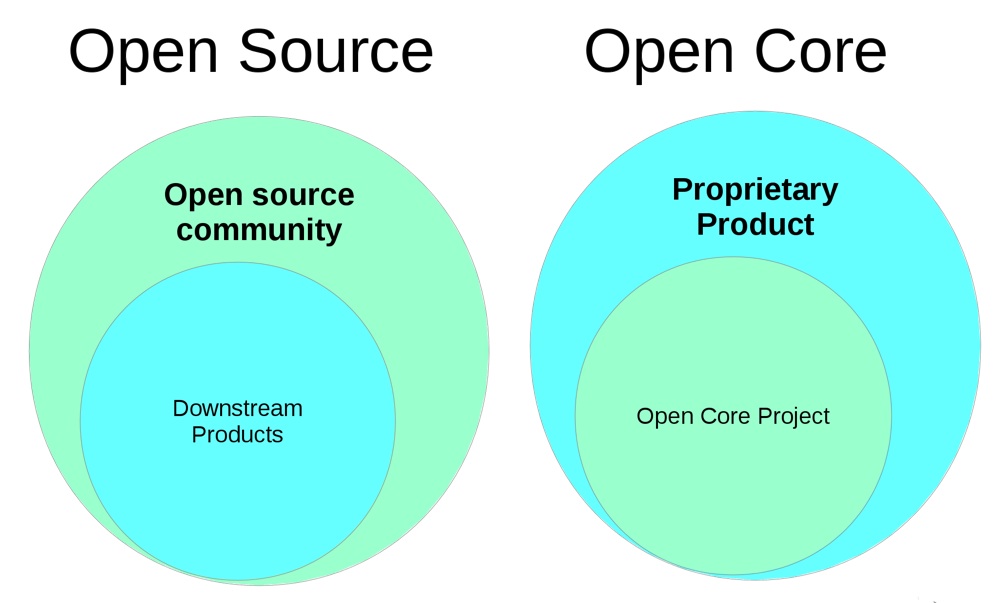
Open Source or Open Core: Why Should You Care?
Open source software has gained its significant foothold because the community development model works everywhere. Its momentum has moved it into the underlying infrastructure of some of the most sophisticated web scale companies, like Facebook and Google. Open source underpinnings now drive many of the most significant advances in the worlds of cloud and big data.
The Rise of OPEN Innovation: The 3P’s for Building a Durable Open Software Company
Accel recently hosted more than 100 of the top open source executives and thought leaders for a full-day event covering the next wave of…

Its Time for the Open Source Community to Get Real | Blog | InfluxData
Like many open source developers, Ive been reading the commentary around Redis Common Clause Licensing with great interest (HN thread).
Red Hat + IBM: Creating the leading hybrid cloud provider
Editor’s note: A few moments ago, Red Hat president and CEO Jim Whitehurst shared this email with Red Hat associates. A few minutes ago, we announced that Red Hat has signed an agreement to combine forces with IBM in the largest software company acquisition to date. Red Hat will remain a distinct unit in IBM.Tomorrow (Oct. 29, 2018), we will have a company all-hands meeting where you will hear from me, Paul, and IBM chair, president, and CEO Ginni Rometty. I hope you can make it. Details on logistics follow this note.In the meantime, I want to explain why I am excited and believe today’s news presents a tremendous opportunity for Red Hat and open source.The first time I stepped foot on Red Hat’s former headquarters at North Carolina State University was a Sunday. I was there to meet with Matthew Szulik, Red Hat’s then CEO. The lights inside the building were off and the doors were locked. I didn’t know what to think. Matthew eventually showed up and we had a refreshingly different interview at a coffee shop, talking for a long time about Red Hat and open source. Everything Matthew told me about Red Hat made me more and more excited about the company and its opportunity. After our conversation, I knew that Red Hat was special and I wanted to be a part of it. As it turns out, that was the best cup of coffee I ever had. This is the best job I’ve ever had.Like many of you, I joined Red Hat because it shares my values. I need a mission to fuel my work and Red Hat’s - “To be the catalyst in communities of partners and customers and contributors building better technology the open-source way.” - still drives me.When I joined in January 2008, Red Hat was about 2,200 associates and the first open source software company to earn more than $500 million in revenues. Our portfolio was “just” Red Hat Enterprise Linux, Red Hat JBoss Middleware, and technologies to manage both. Today, there are approximately 12,600 Red Hatters and we have a portfolio that now spans hybrid cloud infrastructure, cloud-native app platforms, and management and automation.We have barely scratched the surface of the opportunity that is ahead of us. Open source is the future of enterprise IT. We believe our total addressable market to be $73 billion by 2021. If software is eating the world - and with digital transformation occurring across industries, it truly is - open source is the key ingredient.Powered by IBM, we can dramatically scale and accelerate what we are doing today. Imagine Red Hat with greater resources to grow into the opportunity ahead of us. Imagine Red Hat with the ability to invest even more and faster to accelerate open source innovation in emerging areas. Imagine Red Hat reaching all corners of the world, with even deeper customer and partner relationships than we have today. Imagine us helping even more customers benefit from the choice and flexibility afforded by hybrid and multi-cloud. Joining forces with IBM offers all of that, years ahead of when we could have achieved it alone. Together we can become *the* leading hybrid cloud solutions provider.Importantly, Red Hat is still Red Hat. When the transaction closes, as I noted above, we will be a distinct unit within IBM and I will report directly to Ginni. Our unwavering commitment to open source innovation remains unchanged. The independence IBM has committed to will allow Red Hat to continue building the broad ecosystem that enables customer choice and has been integral to open source’s success in the enterprise. IBM is acquiring Red Hat for our amazing people and our incredibly special culture and approach to making better software. They understand and value how and why we are different and they are committed to allowing us to remain Red Hat while scaling and accelerating all that makes us great with their resources.I appreciate that everyone will experience a range of emotions as a result of this news. Excited, anxious, surprised, fear of the unknown, including new challenges and working relationships - these are all ways I would describe my emotions. What I know is that we will continue to focus on growing our culture as part of a new organization. We will continue to focus on the success of our customers. We will continue to nurture our relationships with partners. Collaboration, transparency, participation, and meritocracy - these values make us Red Hat and they are not changing. In fact, I hope we will help bring this culture across all of IBM. Together we can.I’d be remiss if I ended this email without saying thank you. Thank you to the original pioneers of open source and of Red Hat, to the Red Hatters who have contributed to this amazing company’s success throughout the last 25+ years, to our loyal customers and partners, and to the open source communities that are delivering innovation that is advancing technology at once unimaginable paces.Open source, open formats, and open standards have not only changed technology; they have also changed our society for the good. Red Hat’s role in all of that cannot be understated. With IBM, we have the opportunity to accelerate this work at a greater scale and show everyone that open really does unlock the world’s potential.Regards,Jim --Important Additional Information and Where to Find ItIn connection with the proposed merger, Red Hat, Inc. (the “Company”) intends to file relevant materials with the Securities and Exchange Commission (the “SEC”), including a preliminary proxy statement on Schedule 14A. Following the filing of the definitive proxy statement with the SEC, the Company will mail the definitive proxy statement and a proxy card to each stockholder entitled to vote at the special meeting relating to the proposed merger. STOCKHOLDERS ARE URGED TO CAREFULLY READ THESE MATERIALS IN THEIR ENTIRETY (INCLUDING ANY AMENDMENTS OR SUPPLEMENTS THERETO) AND ANY OTHER RELEVANT DOCUMENTS THAT THE COMPANY WILL FILE WITH THE SEC WHEN THEY BECOME AVAILABLE BECAUSE THEY WILL CONTAIN IMPORTANT INFORMATION. The proxy statement and other relevant materials (when available), and any and all documents filed by the Company with the SEC, may be obtained for free at the SEC’s website at www.sec.gov. In addition, stockholders may obtain free copies of the documents filed with the SEC by the Company via the Company’s Investor Relations section of its website at www.redhat.com or by contacting Investor Relations by directing a request to the Company, Attention: Investor Relations, 100 East Davie Street, Raleigh, North Carolina 27601, or by calling (919) 754-3700.Participants in the Merger SolicitationThis document does not constitute a solicitation of proxy, an offer to purchase or a solicitation of an offer to sell any securities, nor shall there be any sale of securities in any jurisdiction in which such offer, solicitation or sale would be unlawful prior to registration or qualification under the securities laws of any such jurisdiction. No offer of securities shall be made except by means of a prospectus meeting the requirements of Section 10 of the Securities Act of 1933, as amended. The Company, its directors, executive officers and certain employees may be deemed to be participants in the solicitation of proxies from the stockholders of the Company in connection with the proposed merger. Information about the persons who may, under the rules of the SEC, be considered to be participants in the solicitation of the Company’s stockholders in connection with the proposed merger, and any interest they have in the proposed merger, will be set forth in the definitive proxy statement when it is filed with the SEC. Additional information regarding these individuals is set forth in the Company’s proxy statement for its 2018 Annual Meeting of Stockholders, which was filed with the SEC on June 25, 2018, and its Annual Report on Form 10-K for the fiscal year ended February 28, 2018, which was filed with the SEC on April 26, 2018. These documents may be obtained for free at the SEC’s website at www.sec.gov, and via the Company’s Investor Relations section of its website at www.redhat.com.Cautionary Statement Regarding Forward-Looking StatementsThis document may include “forward-looking” statements within the meaning of the Private Securities Litigation Reform Act of 1995, including, without limitation, statements relating to the completion of the merger. In this context, forward-looking statements often address expected future business and financial performance and financial condition, and often contain words such as “expect,” “anticipate,” “intend,” “plan,” “believe,” “seek,” “see,” “will,” “would,” “target,” similar expressions, and variations or negatives of these words. Forward-looking statements by their nature address matters that are, to different degrees, uncertain, such as statements about the consummation of the proposed merger and the anticipated benefits thereof. These and other forward-looking statements are not guarantees of future results and are subject to risks, uncertainties and assumptions that could cause actual results to differ materially from those expressed in any forward-looking statements, including the failure to consummate the proposed merger or to make any filing or take other action required to consummate such merger in a timely matter or at all. The inclusion of such statements should not be regarded as a representation that any plans, estimates or expectations will be achieved. You should not place undue reliance on such statements. Important factors that could cause actual results to differ materially from such plans, estimates or expectations include, among others, that: (1) the Company may be unable to obtain stockholder approval as required for the merger; (2) conditions to the closing of the merger, including obtaining required regulatory approvals, may not be satisfied or waived on a timely basis or otherwise; (3) a governmental entity or a regulatory body may prohibit, delay or refuse to grant approval for the consummation of the merger and may require conditions, limitations or restrictions in connection with such approvals that can adversely affect the anticipated benefits of the proposed merger or cause the parties to abandon the proposed merger; (4) the merger may involve unexpected costs, liabilities or delays; (5) the business of the Company may suffer as a result of uncertainty surrounding the merger or the potential adverse changes to business relationships resulting from the proposed merger; (6) legal proceedings may be initiated related to the merger and the outcome of any legal proceedings related to the merger may be adverse to the Company; (7) the Company may be adversely affected by other general industry, economic, business, and/or competitive factors; (8) there may be unforeseen events, changes or other circumstances that could give rise to the termination of the merger agreement or affect the ability to recognize benefits of the merger; (9) risks that the proposed merger may disrupt current plans and operations and present potential difficulties in employee retention as a result of the merger; (10) risks related to diverting management’s attention from the Company’s ongoing business operations; (11) there may be other risks to consummation of the merger, including the risk that the merger will not be consummated within the expected time period or at all which may affect the Company’s business and the price of the common stock of the Company; and (12) the risks described from time to time in the Company’s reports filed with the SEC under the heading “Risk Factors,” including the Annual Report on Form 10-K for the fiscal year ended February 28, 2018, Quarterly Reports on Form 10-Q and Current Reports on Form 8-K and in other of the Company’s filings with the SEC. Such risks include, without limitation: the effects of competition in the businesses in which the Company operates; the Company’s ability to adapt to a rapidly changing industry and maintain strategic relationships with industry leading companies; and the impacts of security breaches and data loss and our vulnerability to technology infrastructure failures. Consequences of material differences in results as compared with those anticipated in the forward-looking statements could include, among other things, business disruption, operational problems, financial loss, legal liability to third parties and similar risks, any of which could have a material adverse effect on the Company’s financial condition, results of operations, credit rating or liquidity. These risks, as well as other risks associated with the proposed merger, will be more fully discussed in the proxy statement that will be filed with the SEC in connection with the proposed merger. There can be no assurance that the merger will be completed, or if it is completed, that it will close within the anticipated time period or that the expected benefits of the merger will be realized. Readers are cautioned not to place undue reliance on these forward-looking statements, which speak only as of the date on which such statements were made. Except as required by applicable law, the Company undertakes no obligation to update forward-looking statements to reflect events or circumstances arising after such date.
Open Source Endowment — World's First Endowment Fund for OSS
The Open Source Endowment provides truly sustainable funding for critical open source software through a community-driven endowment model.