Human-Centered AI (HCAI) is a promising direction for designing AI systems that support human self-efficacy, promote creativity, clarify responsibility, and facilitate social participation. These human aspirations also encourage consideration of privacy, security, environmental protection, social justice, and human rights. This commentary reverses the current emphasis on algorithms and AI methods, by putting humans at the center of systems design thinking, in effect, a second Copernican Revolution. It offers three ideas: (1) a two-dimensional HCAI framework, which shows how it is possible to have both high levels of human control AND high levels of automation, (2) a shift from emulating humans to empowering people with a plea to shift language, imagery, and metaphors away from portrayals of intelligent autonomous teammates towards descriptions of powerful tool-like appliances and tele-operated devices, and (3) a three-level governance structure that describes how software engineering teams can develop more reliable systems, how managers can emphasize a safety culture across an organization, and how industry-wide certification can promote trustworthy HCAI systems. These ideas will be challenged by some, refined by others, extended to accommodate new technologies, and validated with quantitative and qualitative research. They offer a reframe -- a chance to restart design discussions for products and services -- which could bring greater benefits to individuals, families, communities, businesses, and society.
What Does 'Human-Centred AI' Mean?
While it seems sensible that human-centred artificial intelligence (AI) means centring "human behaviour and experience," it cannot be any other way. AI, I argue, is usefully seen as a relationship between technology and humans where it appears that artifacts can perform, to a greater or lesser extent, human cognitive labour. This is evinced using examples that juxtapose technology with cognition, inter alia: abacus versus mental arithmetic; alarm clock versus knocker-upper; camera versus vision; and sweatshop versus tailor. Using novel definitions and analyses, sociotechnical relationships can be analysed into varying types of: displacement (harmful), enhancement (beneficial), and/or replacement (neutral) of human cognitive labour. Ultimately, all AI implicates human cognition; no matter what. Obfuscation of cognition in the AI context -- from clocks to artificial neural networks -- results in distortion, in slowing critical engagement, perverting cognitive science, and indeed in limiting our ability to truly centre humans and humanity in the engineering of AI systems. To even begin to de-fetishise AI, we must look the human-in-the-loop in the eyes.

What Does 'Human-Centred AI' Mean?
While it seems sensible that human-centred artificial intelligence (AI) means centring "human behaviour and experience," it cannot be any other way. AI, I argue, is usefully seen as a relationship between technology and humans where it appears that artifacts can perform, to a greater or lesser extent, human cognitive labour. This is evinced using examples that juxtapose technology with cognition, inter alia: abacus versus mental arithmetic; alarm clock versus knocker-upper; camera versus vision; and sweatshop versus tailor. Using novel definitions and analyses, sociotechnical relationships can be analysed into varying types of: displacement (harmful), enhancement (beneficial), and/or replacement (neutral) of human cognitive labour. Ultimately, all AI implicates human cognition; no matter what. Obfuscation of cognition in the AI context -- from clocks to artificial neural networks -- results in distortion, in slowing critical engagement, perverting cognitive science, and indeed in limiting our ability to truly centre humans and humanity in the engineering of AI systems. To even begin to de-fetishise AI, we must look the human-in-the-loop in the eyes.
From chatbots to assistants: governance is key for AI agents
AI's shift into agentic technology ushers in a new set of governance and security challenges that will mean defining to what extent they should be autonomous

We build AI that works for humans
Imbue builds AI to help people think, create, and build. We share our tools openly because we believe progress in AI should be collaborative and developer-driven

AI Agents Push Humans Out of the Loop
AI agents pose significant risks as they are granted increasing autonomy. A commonly proposed solution is human oversight and keeping a ''human in the loop'', but this is not a simple solution: Not only do current approaches to AI agent design impede effective human oversight, but the cognitive capacities required for it are also themselves degraded by extended use of AI systems. This position paper argues that current approaches to the development and deployment of AI agent systems do not support effective human oversight -- they contribute to its degradation. To address this, a top priority in the advancement of AI agents should be supporting the situated goals and cognitive requirements of effective human oversight, treating the human needs of overseers at the same level of importance as AI agent capability. To put this idea into practice, we connect work on automation and human-computer interaction to AI agent processes, outlining design-level affordances and organizational protocols that (1) support overseers in exercising critical judgement and (2) counteract the skill atrophy that arises from extended use of automation. We urge developers and deployers to adopt these or similar approaches. Without explicit support for the cognitive demands of effective human-agent interaction, AI agent systems will continue to passively incentivize the degradation of the very human skills they rely on.
AI Agents Push Humans Out of the Loop
AI agents pose significant risks as they are granted increasing autonomy. A commonly proposed solution is human oversight and keeping a ''human in the loop'', but this is not a simple solution: Not only do current approaches to AI agent design impede effective human oversight, but the cognitive capacities required for it are also themselves degraded by extended use of AI systems. This position paper argues that current approaches to the development and deployment of AI agent systems do not support effective human oversight -- they contribute to its degradation. To address this, a top priority in the advancement of AI agents should be supporting the situated goals and cognitive requirements of effective human oversight, treating the human needs of overseers at the same level of importance as AI agent capability. To put this idea into practice, we connect work on automation and human-computer interaction to AI agent processes, outlining design-level affordances and organizational protocols that (1) support overseers in exercising critical judgement and (2) counteract the skill atrophy that arises from extended use of automation. We urge developers and deployers to adopt these or similar approaches. Without explicit support for the cognitive demands of effective human-agent interaction, AI agent systems will continue to passively incentivize the degradation of the very human skills they rely on.
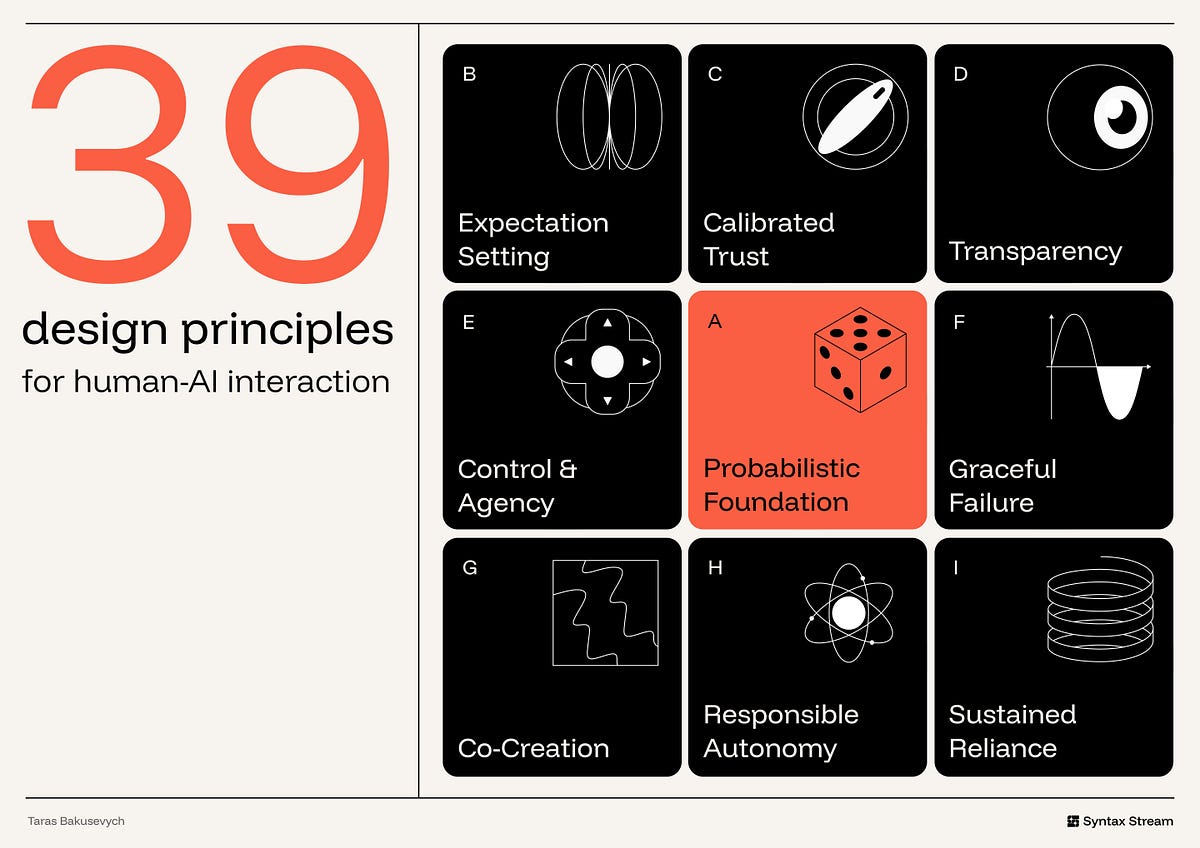
39 principles for designing human-AI interaction
An applied framework for designing AI interfaces that support appropriate reliance, user control, transparency, and responsible autonomy.
The Impact of Artificial Intelligence on Human Thought
This research paper examines, from a multidimensional perspective (cognitive, social, ethical, and philosophical), how AI is transforming human thought. It highlights a cognitive offloading effect: the externalization of mental functions to AI can reduce intellectual engagement and weaken critical thinking. On the social level, algorithmic personalization creates filter bubbles that limit the diversity of opinions and can lead to the homogenization of thought and polarization. This research also describes the mechanisms of algorithmic manipulation (exploitation of cognitive biases, automated disinformation, etc.) that amplify AI's power of influence. Finally, the question of potential artificial consciousness is discussed, along with its ethical implications. The report as a whole underscores the risks that AI poses to human intellectual autonomy and creativity, while proposing avenues (education, transparency, governance) to align AI development with the interests of humanity.
Agency plus automation: Designing artificial intelligence into interactive systems
Much contemporary rhetoric regards the prospects and pitfalls of using artificial intelligence techniques to automate an increasing range of tasks, especially those once considered the purview of people alone. These accounts are often wildly optimistic, understating outstanding challenges while turning a blind eye to the human labor that undergirds and sustains ostensibly “automated” services. This long-standing focus on purely automated methods unnecessarily cedes a promising design space: one in which computational assistance augments and enriches, rather than replaces, people’s intellectual work. This tension between human agency and machine automation poses vital challenges for design and engineering. In this work, we consider the design of systems that enable rich, adaptive interaction between people and algorithms. We seek to balance the often-complementary strengths and weaknesses of each, while promoting human control and skillful action. We share case studies of interactive systems we have developed in three arenas—data wrangling, exploratory analysis, and natural language translation—that integrate proactive computational support into interactive systems. To improve outcomes and support learning by both people and machines, we describe the use of shared representations of tasks augmented with predictive models of human capabilities and actions. We conclude with a discussion of future prospects and scientific frontiers for intelligence augmentation research.

Mapping Citizen Science through the Lens of Human-Centered AI
Artificial Intelligence (AI) can augment and sometimes even replace human cognition. Inspired by efforts to value human agency alongside productivity, we discuss and categorize the potential of solving Citizen Science (CS) tasks with Hybrid Intelligence (HI), a synergetic mixture of human and artificial intelligence. Due to the unique participant-centered set of values and the abundance of tasks drawing upon both human common sense and complex 21st century skills, we believe that the field of CS offers an invaluable testbed for the development of human-centered AI including HI, while also benefiting CS. In order to investigate this potential, we first relate CS to adjacent computational disciplines. Then, we demonstrate that CS projects can be grouped according to their potential for HI-enhancement by examining two key dimensions: the level of digitization and the amount of knowledge or experience required for participation. Finally, we propose a framework for types of human-AI interaction in CS based on established criteria of HI. This “HI lens” provides the CS community with an overview of ways to utilize the combination of AI and human intelligence in their projects. For AI researchers, this work highlights the opportunity CS presents to engage with real-world data sets and explore new AI methods and applications.
AI experienced through AI co-created tools
AI co-created tools and social spaces as a new medium

What Does 'Human-Centred AI' Mean?
While it seems sensible that human-centred artificial intelligence (AI) means centring "human behaviour and experience," it cannot be any other way. AI, I argue, is usefully seen as a relationship...
Agentic AI Governance: A Strategic Framework for Autonomous Systems
Agentic AI is moving from chat to action. Learn how to govern autonomous systems using the "Digital Contractor" framework and the 3-Tiered Guardrail system.

Society-in-the-loop: programming the algorithmic social contract
Recent rapid advances in Artificial Intelligence (AI) and Machine Learning have raised many questions about the regulatory and governance mechanisms for autonomous machines. Many commentators, scholars, and policy-makers now call for ensuring that algorithms governing our lives are transparent, fair, and accountable. Here, I propose a conceptual framework for the regulation of AI and algorithmic systems. I argue that we need tools to program, debug and maintain an algorithmic social contract, a pact between various human stakeholders, mediated by machines. To achieve this, we can adapt the concept of human-in-the-loop (HITL) from the fields of modeling and simulation, and interactive machine learning. In particular, I propose an agenda I call society-in-the-loop (SITL), which combines the HITL control paradigm with mechanisms for negotiating the values of various stakeholders affected by AI systems, and monitoring compliance with the agreement. In short, ‘SITL = HITL + Social Contract.’

2026 Cosmos HAI Lab Lecture with Jack Clark, Co-founder of Anthropic
How building software is changing at Anthropic
A deepdive on what’s changed in how the leading AI lab makes software. Ever more code review and testing is done by AI, two-pizza teams very much alive, and more. Details from inside of Anthropic