


Here's how we geeked out in the era before the World Wide Web came to be.
A Lament For The LAN Party
Before broadband and the connected world of information, we found different ways to mix our social life and our games. …

How One 1990s Browser Decision Created Big Tech’s Data Monopolies (And How We Might Finally Fix It)
There’s a fundamental architectural flaw in how the internet works that most people have never heard of, but it explains nearly every frustration you have with modern technology. Why your pho…

jazware/vlpds
Very Large PDS, a world-scale, incredibly efficient, incredibly resilient, atproto personal data server
The Fathers of the Internet Revolution Urge Today’s Software Engineers to Reinvent the Web
Tim Berners-Lee, Vint Cerf, and other Internet pioneers issue a challenge on a day that just might go down in tech history

Reclaim the internet: Mozilla’s rebrand for the next era of tech | The Mozilla Blog
Mozilla isn’t just another tech company — we’re a global crew of activists, technologists and builders, all working to keep the internet free, op

The AT Protocol's interesting design - LittleBit
Bluesky's backend was made to be more than a social network
100% Utilization
Since the end of the Second World War, we have come to expect continual growth in computing power and the rapid development of digital technology. This dynam...

Sandisk and high-bandwidth flash efforts
Analysis: Sandisk has published a blog about an interview with high bandwidth memory (HBM) pioneer Professor Joung-ho Kim from KAIST’s Department of Electrical and Electronic Engineering. KAIST is Korea’s Advanced Institute of Science and Technology, a national research university and Joung-ho Kim was instrumental in HBM development. He’s now involved with high bandwidth flash (HBF) […]

PL Series|Mini PCs|ASUS Global
Ultraslim and reliable Mini PCs with rich I/O connectivity, designed for vertical markets

Anniversary
Blacksky Algorithms turns one. Announcing blacksky.cash for private payments and blacksky.tech for one-click server hosting on AT Protocol. Launching 2026.

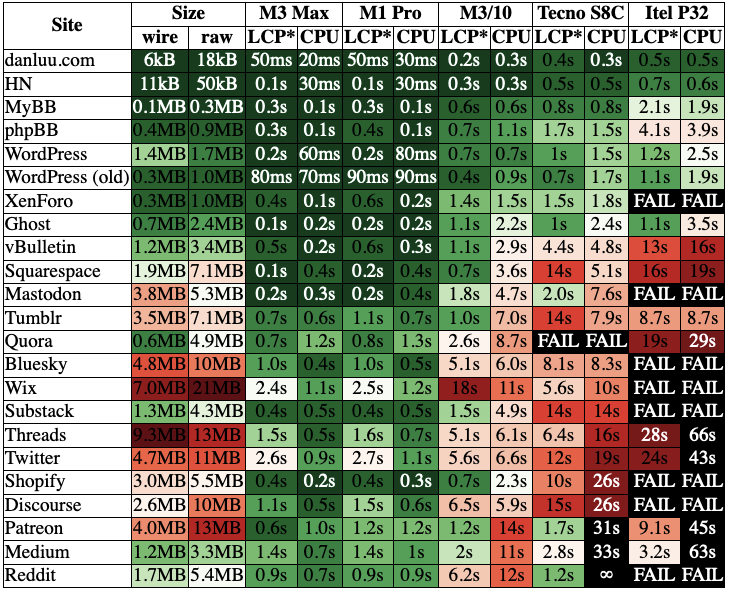
How web bloat impacts users with slow devices
In 2017, we looked at how web bloat affects users with slow connections. Even in the U.S., many users didn't have broadband speeds, making much of the web difficult to use. It's still the case that many users don't have broadband speeds, both inside and outside of the U.S. and that much of the modern web isn't usable for people with slow internet, but the exponential increase in bandwidth (Nielsen suggests this is 50% per year for high-end connections) has outpaced web bloat for typical sites, making this less of a problem than it was in 2017, although it's still a serious problem for people with poor connections.
ybzeek/The-Loom
A high-throughput, database-free ingestion engine for the AT Protocol (Bluesky) Firehose, engineered for consumer hardware constraints.
Competitive Compatibility: Let's Fix the Internet, Not the Tech Giants
Tech's market concentration—summed up brilliantly by Tom Eastman, a New Zealand software developer, as the transformation of the Internet into "a group of five websites, each consisting of screenshots of text from the other four"—has aroused concern from regulators around the world.


ISP Column - November 2019
NANOG is now quite an institution in the Internet, particularly in the North American Internet community. It was an offshoot of the Regional Techs meetings, which were part of the NSFNET framework of the late 80s and early 90s. NANOG has thrived since then and is certainly one of the major network operational forums in today’s Internet, if not the preeminent forum for network operators for the entire Internet.
An unordered / non-exhaustive list of things that helped scale Bluesky's infra efficiently: + Exiting the cloud (colocation) + HAProxy w/many Node backends + Go w/clever code + ScyllaDB + SQLite w/per user databases + Redis w/many instances + AMD servers w/many cores + Purchasing bandwidth directly
