


The Open Badges team has returned from Mozfest in London and is now going through the process of taking in and digesting all the amazing conversations, brainstorms, hacks that transpired during the festival to extend our work. One of those insightful conversations took place during the BadgeKit session that Jess Klein and I facilitated with the support of Erin Knight and Chris McAvoy.[You can read more background information about BadgeKit from the following blog posts written by Jess Klein, Erin Knight and myself.] We are still at the inception stages of BadgeKit, defining and honing its features, utility and priorities. Things are still in motion at the moment. As we do in typical Mozilla fashion, we wanted to get our thinking out to the community as soon as we could in order to make sure it resonated with key stakeholders and to have a gut check on our assumptions. The session was designed such that Jess and I, as facilitators, did exactly that; facilitate rather than present or dictate the conversation. Truth be told, the intention was to get as much information from the session participants as possible so that we could incorporate that feedback into the evolving BadgeKit design thinking. We wanted answers to some of the following questions;
BadgeKit: The Why || Erin Knight
Just back from MozFest, where we announced BadgeKit, an Open Badges tool stack that will support the key pieces of the badging experience. This includes defining/designing, assessing, issuing, collecting/managing, sharing and using. BadgeKit will consist of open, lightweight tools that can snap together or be used alongside or within other sites or systems. Sunny and Jess both respectively wrote about it in more detail, but I wanted to dig into the “why”.

BadgeKit: Pathways and Paving the Path to Playful Design
It has been a while since I wrote anything on this blog. The truth is that a ton of things have kept me busy these past months so buckle up for a series of posts; there are lots of things to say :)

BadgeKit: An Invitation to Innovation
Have you ever read an article, listened to a podcast or heard a speech that motivated you to perform some kind of action - only to realize t...
The Participatory Design Culture and Terms of Badges
As we all know, t he Badges project seeks to provide users with a mechanism to shape their online identities: showcasing the skills that ...
Chicago Summer of Learning 2013: thoughts on developing a citywide badge system
For the last few months we, the Mozilla Open Badges team, have been working together with a number of other groups and the City of Chicago to launch an amazing and exciting learning campaign: the C…

From Badgecamp to Mozfest 2013

Badge Design Lab for the #openbadgesMOOC
Greetings! Today we have a few important updates for those participating in the Open Badges MOOC, the Badge Design Lab information, a new course badge to achieve, and a mid-course survey! Badge Design Labs Start This Week - See Course Activities AreaTo support you in your work toward implementing badge systems, we are offering additional weekly activities dedicated to practical application/ making badges / beginning a badge system. Live sessions will be offered at the dates and times below, so please mark your calendars.
Open Badges at the Mozilla Festival
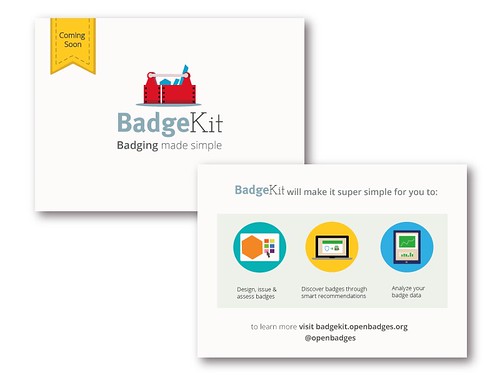
BadgeKit is coming!
This past summer, the Open Badges team had the great opportunity of introducing digital badges at a citywide scale through the Chicago Summer of Learning (CSOL). We worked in collaboration with the city and on the ground organizations like Hive Chicago and Digital Youth Network with the support of the MacArthur foundation to reach out to more than 100 Chicago-based organizations to create an end-to-end badging system.As mentioned in my previous blogpost, to support this initiative, we created a set of tools and services to help the 100+ Chicago based organizations to design, define, assess, and issue badges and for participating learners to collect, manage, share and discover badges. Following a successful summer of learning, we’ve been getting increased interest from other cities and organizations who would like to replicate the badging model initiated in Chicago. We’re thrilled about this interest and would like to facilitate the adoption of other CSOL like initiatives in a scalable way. This would entail us going back to the tools and services we built for CSOL and for the ecosystem, modularizing them, and making them readily implementable for organizations in a light-weight, open-source way. The idea is to make it as simple as possible for organizations to pick up the specific tool they need for their badge system development and implement it into their environments. Time and time again, we’ve heard that the barrier to entry is still too high. We want to lower that barrier. With that in mind, we started writing down the requirements and goals for what this collection of tools might be. The key verbs that we kept using over and over again when trying to get crisp about this tool collection were as follows:
Making Connections @ MozFest 2012
Is it even possible to describe the beautiful maelstrom of joy and creativity we experienced at the Mozilla Festival last weekend? Three ...
Open Badges launch + Web literacy badges underway
Mozilla Open Badges: the launch approaches Good news, everyone! Mozilla is preparing to launch Open Badges 1.0 at the DML Conference in Chicago next week. We’ve been operating in public beta …

Mozilla to co-host MOOC exploring Open Badges as credentials
On September 9, Mozilla will co-host a MOOC exploring the growing interest in using badges to document and showcase knowledge, skills and competencies for those pursuing professional credentials.


Badge Vision Summit
This week kicked off with a meeting of badge minds in Toronto. Around 30 of us packed into the lovely Centre for Social Innovation to discuss the emerging badge ecosystem and how to drive the next era of the badge work together. We were, you know, socially innovating. :)

Open Badges Research & System Design Call, Jan. 8, 2014