For the past 2 years, ~90% of my coding time has been spent working on a large scale Backbone.js app. In February 2014, the Backbone community was in a fairly good place. The core library had reached 1.0 the previous year and had a strong team around it. Marionette had emerged as a de-facto standard for web applications 1. There were Backbone specific plugins for many tasks, and generally gaps could be filled using the jQuery plugin ecosystem, or a framework agnostic library.
Everything you need to know about: Svelte
Everything you need to know about the world’s most loved JS framework
I Built the Same App 10 Times: Evaluating Frameworks for Mobile Performance | Loren Stewart
I needed to choose a framework for a mobile-first app at work. I started comparing Next.js, SolidStart, and SvelteKit, then expanded to 10 frameworks. The measurements revealed dramatic differences in bundle sizes, performance, and the real cost of framework choices.
Frameworks without the framework: why didn’t we think of this sooner?
You can’t write serious applications in vanilla JavaScript without hitting a complexity wall. But a compiler can do it for you.
Next.js — The Perpetual Beta Framework
Exploring 6 years of Next.js, from early days to App Router & RSC, with migrations, performance tweaks, and framework insights

State of JS 2020
The annual survey about the latest trends in the JavaScript ecosystem.
State of the Art JavaScript in 2016
State of the Art JavaScript in 2016 So, you’re starting a brand new JavaScript front end project or overhauling an old one, and maybe you haven’t kept up with the breakneck pace of the ecosystem …

Introducing Bare: Actually run Javascript Everywhere - Pears
The Holepunch team has introduced Bare, a groundbreaking minimal JavaScript runtime designed for both desktop and mobile. Built to be fast, modular, and efficient, Bare revisits the original vision of Node.js by embracing modularity and universal compatibility.

The viability of JS frameworks on mobile
Whether I like it or not, not everyone using my web apps will be running iOS 9 on an iPhone 6S or a Nexus 6P and connecting via super-speedy wifi.
JavaScript Frameworks - Heading into 2026
I suppose after three years, we can consider my review of JavaScript Frameworks an annual event now....

Stop learning frameworks
We are developers. We need to stay up to date with technology. Every day, we learn programming languages, frameworks, and libraries. The more modern tools we know — the better. Keeping up to date with Angular, React, Vue, Riot, Ember, Knockout is fun. But we are wasting our time.
Fresh - The simple, approachable, productive web framework.
Fresh features just-in-time edge rendering, island based interactivity, and zero-configuration TypeScript support. Fast to write; fast to run.
The Architecture Of Local-First Web Development — Smashing Magazine
An honest perspective on building local-first web apps in 2026, written for developers who’ve been doing this long enough to be skeptical of silver bullets.
Elanis/web-to-desktop-framework-comparison
An objective comparison of multiple frameworks that allow us to "transform" our web apps to desktop applications.
Making the Jump: How Desktop-Era Frameworks Can Thrive on Mobile
How do tools that grew up on the desktop, like Ember, Angular and React, make the jump to the mobile future?
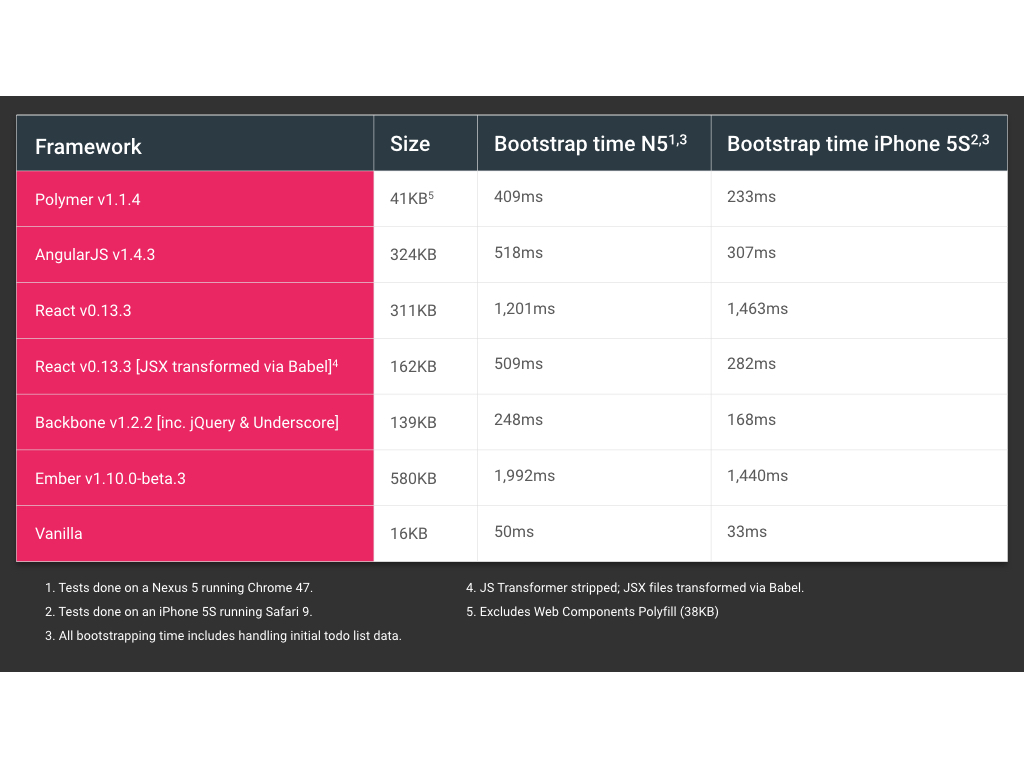
The Cost of Frameworks
I recently delivered a talk at FFConf in Brighton, called "You should use <insert library / framework here>, it's the bestestest!". I wanted to do a write-up of the presentation's content here, hopefully so it can start a broader conversation that I think we need to have, mainly around the cost of modern frameworks on mobile devices.
Payload: The Next.js Headless CMS and App Framework
Built with TypeScript and React, Payload is an open-source headless CMS and application framework. Build anything.