

Tags: Programming Languages, Resugaring, Semantics, Visualization
Resugaring | Proceedings of the 35th ACM SIGPLAN Conference on Programming Language Design and Implementation
Syntactic sugar plays a crucial role in engineering programming languages. It offers convenient syntax and higher-level of abstractions, as witnessed by its pervasive use in both general-purpose and domain-specific contexts. Unfortunately, the ...

Coeffects: a calculus of context-dependent computation
The notion of context in functional languages no longer refers just to variables in scope. Context can capture additional properties of variables (usage patterns in linear logics; caching requirements in dataflow languages) as well as additional resources or properties of the execution environment (rebindable resources; platform version in a cross-platform application). The recently introduced notion of coeffects captures the latter, whole-context properties, but it failed to capture fine-grained per-variable properties.We remedy this by developing a generalized coeffect system with annotations indexed by a coeffect shape. By instantiating a concrete shape, our system captures previously studied flat (whole-context) coeffects, but also structural (per-variable) coeffects, making coeffect analyses more useful. We show that the structural system enjoys desirable syntactic properties and we give a categorical semantics using extended notions of indexed comonad.The examples presented in this paper are based on analysis of established language features (liveness, linear logics, dataflow, dynamic scoping) and we argue that such context-aware properties will also be useful for future development of languages for increasingly heterogeneous and distributed platforms.

Bidirectional Programming Languages
The need to edit source data through a view arises in a host of applications across many different areas of computing. Unfortunately, few existing systems provide support for updatable views. In practice, when they are needed, updatable views are usually implemented using two separate programs: one that computes the view from the source and another that handles updates. This rudimentary design is tedious for programmers, difficult to reason about, and a nightmare to maintain. This dissertation presents bidirectional programming languages, which provide an elegant and effective mechanism for describing updatable views. Unlike programs written in an ordinary language, which only work in one direction, programs in a bidirectional language can be run both forwards and backwards: from left to right, they describe functions that map sources to views, and from right to left, they describe functions that map updated views back to updated sources. Besides eliminating redundancy, these languages can be designed to ensure correctness, guaranteeing by construction that the two functions work well together. Starting from the foundations, we define a general semantic space of well-behaved bidirectional transformations called lenses. Then, building on this foundation, we describe a particular language for defining lenses on strings with syntax based on the familiar regular operators (union, concatenation, and Kleene star). We present extensions to the basic framework that address the subtle complications that arise when lenses are used to manipulate, data containing unimportant details, ordered data, and confidential data.
Boomerang | Proceedings of the 35th annual ACM SIGPLAN-SIGACT symposium on Principles of programming languages
Bidirectional programming languages are a practical approach to the view update problem. Programs in these languages, called lenses, define both a view and an update policy - i.e., every program can be read as a function mapping sources to views as well ...

Packrat parsing: | Proceedings of the seventh ACM SIGPLAN international conference on Functional programming
For decades we have been using Chomsky's generative system of grammars, particularly context-free grammars (CFGs) and regular expressions (REs), to express the syntax of programming languages and protocols. The power of generative grammars to express ...

Semantic Compression
An introduction to the idea that code should be approached with a mindset towards compressing it semantically, rather than orienting it around objects.

Coding After Coders: The End of Computer Programming as We Know It - …
archived 16 Mar 2026 15:14:04 UTC

Its Time for a New Programming Language
Today, when compared to any other point in programming history, we find ourselves spoiled for choice when it comes to programming…
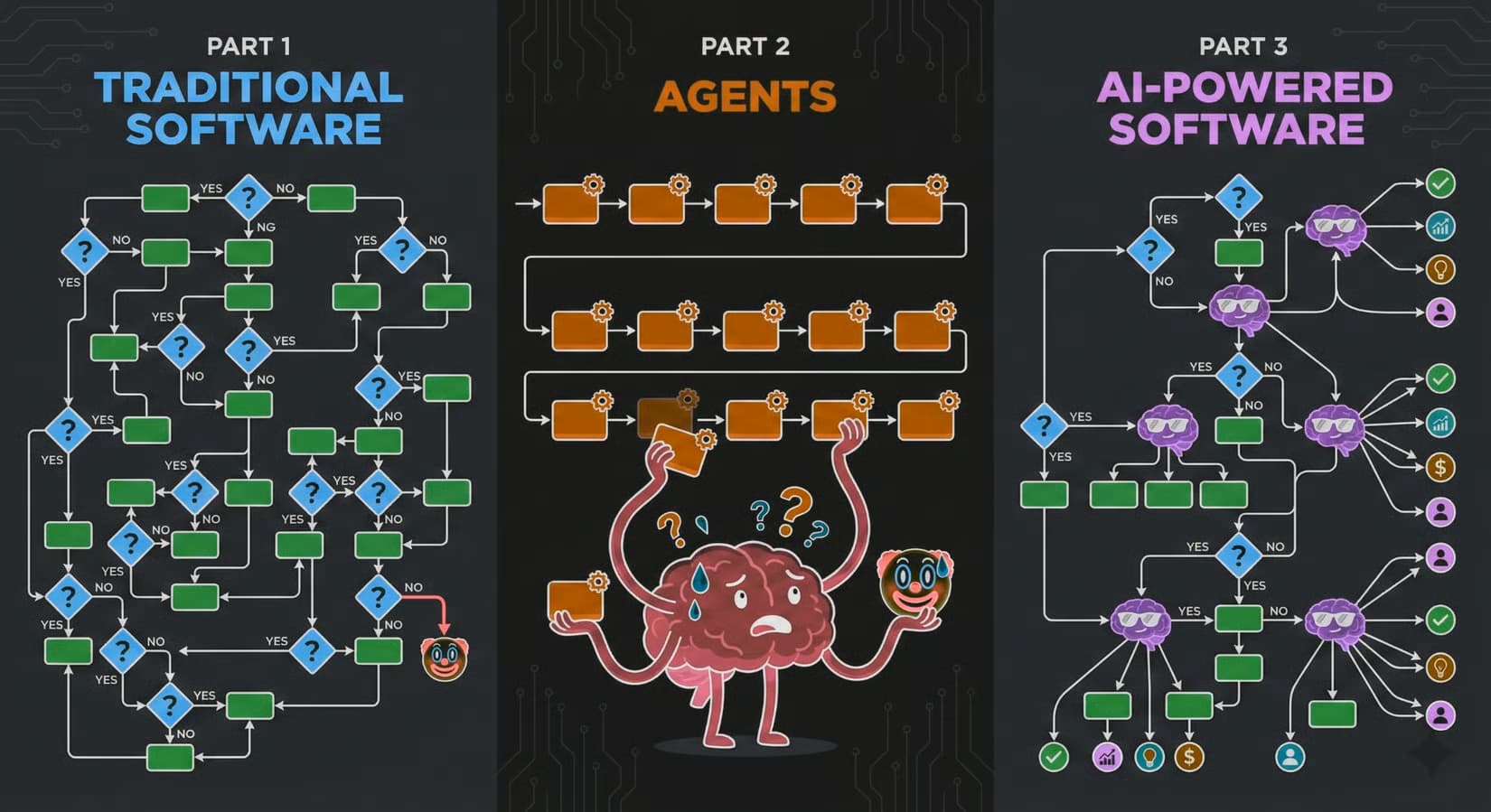
Varv: Reprogrammable Interactive Software as a Declarative Data Structure
This summary was generated using automated tools and was not authored or reviewed by the article's author(s). It is provided to support discovery, help readers assess relevance, and assist readers from adjacent research areas in understanding the work. It is intended to complement the author-supplied abstract, which remains the primary summary of the paper. The full article remains the authoritative version of record. Click here to learn more.

"Concatenative programming and stack-based languages" by Douglas Creager
The Next 7000 Programming Languages
Landin’s seminal paper “The next 700 programming languages” considered programming languages prior to 1966 and speculated on the next 700. Half-a-century on, we cast programming languages in a Darwinian ‘tree of life’ and explore languages, their features (genes) and language evolution from the viewpoint of ‘survival of the fittest’.
Coeffects: Context-aware programming languages
Interactive essay that explains theory of coeffects and lets you type-check and run sample programs.
Things unlearned
This post is part of a series, starting at Reflections on a decade of coding.
OCaml Programming: Correct + Efficient + Beautiful — OCaml Programming: Correct + Efficient + Beautiful
A textbook on functional programming and data structures in OCaml, with an emphasis on semantics and software engineering. This book is the textbook for CS 3110 Data Structures and Functional Programming at Cornell University. A past title of this book was “Functional Programming in OCaml”.