Eric Lippert notes the perils of programming in C++: I often think of C++ as my own personal Pit of Despair Programming Language. Unmanaged C++ makes it so easy to fall into traps. Think buffer overruns, memory leaks, double frees, mismatch between allocator and deallocator, using freed memory, umpteen dozen
The Story of C++: The World's Most Consequential Programming Language | The Official Story
using C++ to exploit the C++ that is building the C++
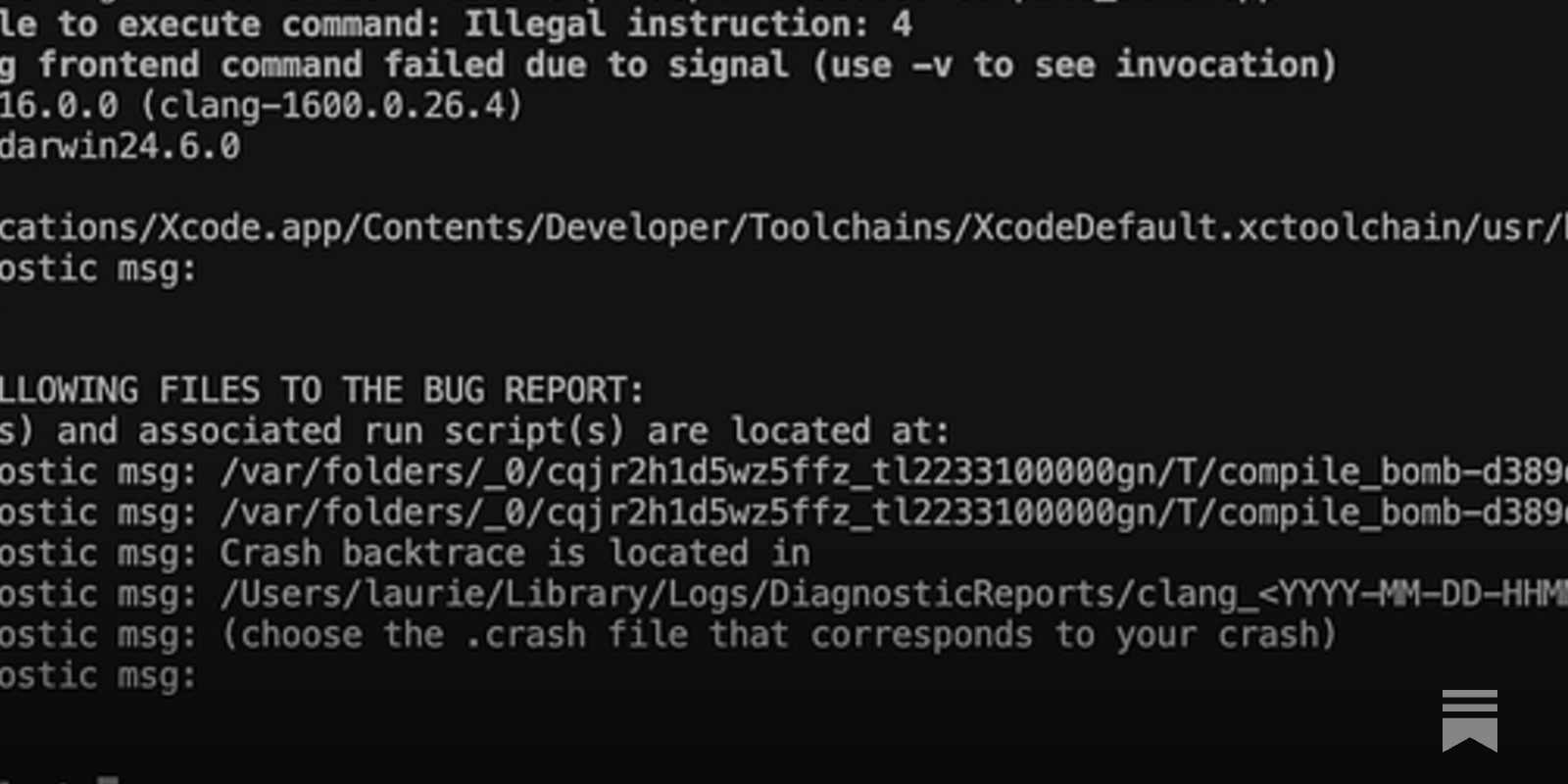
today you’re going to segfault your compiler.
Its Time for a New Programming Language
Today, when compared to any other point in programming history, we find ourselves spoiled for choice when it comes to programming…

Smarter Operating Systems Will Use Wasm - The Coming OS Revolution by Jonas Kruckenberg @ Wasm I/O

Memory system - Please Leave here your opinions (if you have any) · Issue #74 · code-yeongyu/oh-my-openagent
I heard many people wants that memory system- but it's really easy to be redundant from my experiences. Projects like claude-mem or many others have memory system. Want to hear your opinions re...
Write code that is easy to delete, not easy to extend.
“Every line of code is written without reason, maintained out of weakness, and deleted by chance” Jean-Paul Sartre’s Programming in ANSI C.
Systems Programming with Zig
Zig delivers performance, reliability, and complex integration in systems programming in a simple, modern package. Zig hits the sweet spot for systems programming. This new programming language is high-performance, low-level, ultra-reliable, and perfectly suited for serious projects like writing libraries, daemons and shell utilities, and even operating systems and embedded code. Systems Programming with Zig shows you how to write quality, useful Zig applications without relying on libraries or frameworks-even if you’re new systems programming. In Systems Programming with Zig you’ll learn how to: Understand the Zig perspective on systems programming Write idiomatic Zig code Integrate Zig with C, systems libraries, and scripting languages Networking, interpreters, and graphics from the ground up Unlike UI-centric applications that form the public face of your software, systems programs like OS kernels, device drivers, and utilities interact directly with the hardware or operating system. In these low-level programs, performance and safety are paramount. Zig is a new programming language that builds on the legacy of C, C++, and even Rust to provide a high-productivity systems programming environment that does not rely on awkward libraries and frameworks.

Andrew Kelley: A Practical Guide to Applying Data Oriented Design (DoD)
Modular: The Claude C Compiler: What It Reveals About the Future of Software
Compilers occupy a special place in computer science. They're a canonical course in computer science education. Building one is a rite of passage. It forces you to confront how software actually works, by examining languages, abstractions, hardware, and the boundary between human intent and machine execution.

The cost of forsaking C
The C programming language is not trendy. The most recent edition of the canonical C text (the excitingly named The C Programming Language)…
Signals and Threads
Stephen Dolan works on Jane Street’s Tools and Compilers team where he focuses on the OCaml compiler. In this episode, Stephen and Ron take a trip down memory lane, discussing how to manage computer memory efficiently and safely. They consider trade-offs between reference counting and garbage collection, the surprising gains achieved by prefetching, and how new language features like local allocation and unboxed types could give OCaml users more control over their memory.

How to Write Your Own C++ Game Engine
Lately I’ve been writing a game engine in C++. I’m using it to make a little mobile game called Hop Out. Here’s a clip captured from my iPhone 6. (Unmute for …

ZigCool
I can’t think of any other language in my 45 years long career that surprised more than Zig. I can easily say that Zig is not only a new programming language, but it’s a totally new way to write programs, in my opinion. To say it’s merely a language to replace C or C++, it’s a huge understatement.
Geoffrey Litt
Welcome! I work on malleable software: computing environments where anyone can adapt their software to meet their needs with minimal friction. To see what that means to me, read this essay or listen to this interview.

Making Programming Visual, Spatial, and Learnable
What's wrong with linear, static programming mediums and how might we improve them?