

Abstract. The traditional abstraction barriers between compiler, build system and package manager are increasingly ill-suited for IDEs, parallel build systems, and modern source code organization. Recent compilers like go and rustc are equipped with a fully-fledged build systems; semantic build systems like Bazel and Gradle also expect to manage the packaging of software. Does this mean we should jettison these abstraction barriers? It seems worthwhile to look for new interfaces which can accommodate these use-cases.
Compile to Architecture - The Phoenix Architecture
For a long time we’ve treated frameworks as the target of software development. But if systems are meant to be regenerated and replaced safely, the real compilation target has to be the architecture itself.
Do we still need build tools?
Do we still need Rspack, SWC, PostCSS, Vite, Parcel, Webpack, Turbopack, esbuild, Rollup, Rolldown, Babel, Autoprefixer, esbuild and Lightning CSS in 2026?
Differ - Adaptive Software
Build software that adapts to each user — without forks or feature flags. One codebase, infinite variants.

Differ - Adaptive Software
Build software that adapts to each user — without forks or feature flags. One codebase, infinite variants.
Architectural mismatch: why reuse is so hard
Why isn't there more progress toward building systems from existing parts? One answer is that the assumptions of the parts about their intended environment are implicit and either don't match the actual environment or conflict with those of other parts. The authors explore these problems in the context of their own experience with a compositional approach.<>
Spack
A flexible package manager supporting multiple versions, configurations, platforms, and compilers.

Code Is Cheap Now. Software Isn’t.
The barrier to entry for building software has collapsed. The barrier to building something that matters hasn’t moved an inch.
Identifying Barriers to Adoption for Rust through Online Discourse (PLATEAU 2018) - SPLASH 2018
For PLATEAU 2019, see the workshop webpage at http://plateau-workshop.org/. Programming languages exist to enable programmers to develop software effectively. But programmer efficiency depends on the usability of the languages and tools with which they develop software. The aim of this workshop is to discuss methods, metrics and techniques for evaluating the usability of languages and language tools. The supposed benefits of such languages and tools cover a large space, including making programs easier to read, write, and maintain; allowing programmers to write more flexible and powerful ...

Crafting Interpreters
Despite using them every day, most software engineers know little about how programming languages are designed and implemented. For many, their only experience with that corner of computer science was a terrifying "compilers" class that they suffered through in undergrad and tried to blot from th...

Forgotten Programming Ideas That Could Change Everything #shorts
The mythical matched modules | Proceedings of the 24th ACM SIGPLAN conference companion on Object oriented programming systems languages and applications
Certified compilers are complex software systems. Like other large systems, they demand modular, extensible designs. While there has been progress in extensible metatheory mechanization, scaling extensibility and reuse to meet the demands of full ...

How eBPF is shaping the future of Linux and platform engineering
When Docker burst onto the scene in 2013, Linux containers seemed like an overnight success. But the evolution to containers—and microservices and Kubernetes—was actually decades in the making, based on kernel primitives in the Linux operating system. Docker used these primitives, namely cgroups and namespaces, as building blocks to create a lightweight, easy-to-use software packaging format. Linux containers had been used by Google and others for many years, but Docker made them easily accessible to mainstream developers.

The Rise of Open Source Challengers
A look at how OSS takes over the application layer + the potential end of closed source software categories

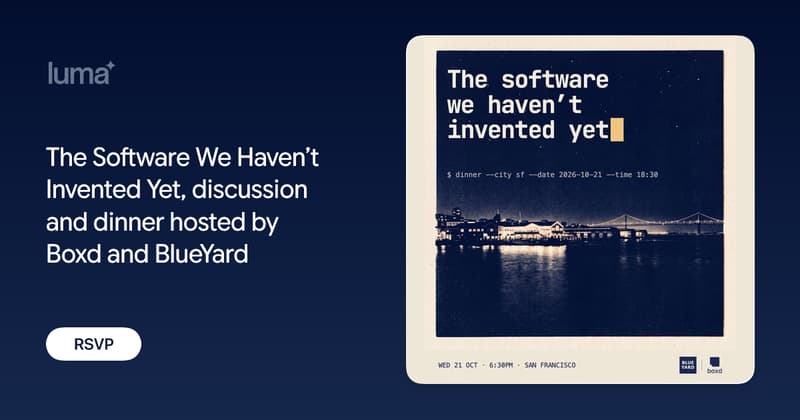
The Software We Haven’t Invented Yet, discussion and dinner hosted by Boxd and BlueYard · Luma
If this is such a big moment for software, why are we mostly imagining faster versions of what we already do? Better coding tools are the obvious part. The…
TypeScript developers, rejoice! Every atproto package now ships as ESM, which means our build tooling is modernized and ready for the faster TypeScript 7. Don't forget to check out the stabilized lex SDK while you're here. atproto.com/blog/ts-sdk-upgrades

TypeScript SDK Upgrades - AT Protocol
atproto.com