

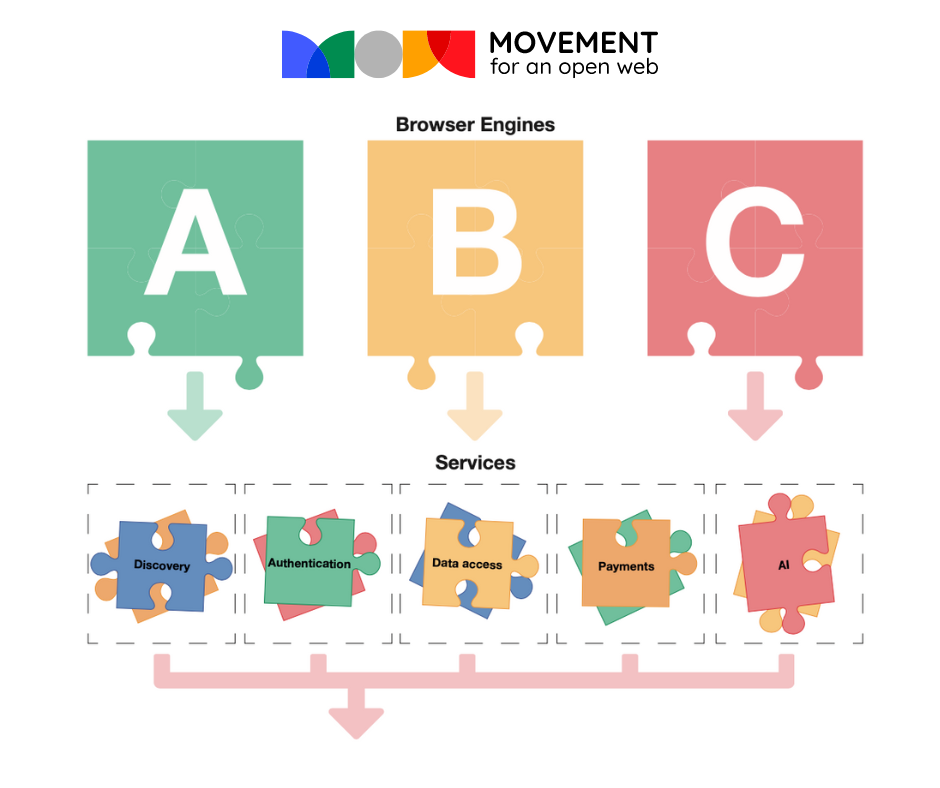
Walled gardens dominate because their massive data collection lets them deliver superior user experiences. To win back the open web, we need to build alternatives that respect users, embrace open standards, and still feel unmistakably better to use.
Break up the Browsers. A Proposal to Save the Open Web. - Movement For An Open Web
The Open Web is one of the world’s modern wonders. Based on core, universally recognised technical standards and owned and controlled by no one body, it is a unique structureRead More
Long Live the Web: A Call for Continued Open Standards and Neutrality
The Web is critical not merely to the digital revolution but to our continued prosperity—and even our liberty. Like democracy itself, it needs defending

Some Thoughts on the Open Web
The Open Web means several things to different people, depending on context, but recently discussions have focused on the Web's Openness in terms of access to information -- how easy it is to publish and obtain information without barriers there.

The Paradox of Open
Numerous organisations and initiatives have been launched with a belief in openness and free knowledge. Their proponents placed their bets on the combined power of networked information services and new governance models for the production and sharing of content and data. We – as members of this broad movement – were among those who believed it possible to leverage this combination of power and opportunity to build a more democratic society, unleashing the power of the internet to create universal access to knowledge and culture. For us, such openness meant not only freedom, but also presented a path to justice and equality.
Welcome to the Post-Naive Internet Era
The grand idealism of the free and open internet might be over for now, but in its place falls a more practical mindset. Just like Silicon Valley’s entrepreneurs are entering their “Hard Tech” era, the people building web alternatives are also entering their Post-Naive Era. Here are the names to know.

The Politics of Open Infrastructures: Power, Governance, and Justice in Digital Knowledge Practices
This volume examines how openness is designed, governed, contested and lived in contemporary digital knowledge infrastructures. From open source software and internet standards, to citizen science platforms, public sector data systems and alternative computing practices, the book shows that infrastructures are never neutral technical backbones.

The Atmosphere . Building the open social web
Why open source: 25 reasons to embrace it | Ben Balter
Open source isn't a fad. Here are twenty-five economic, moral, and personal reasons your organization should embrace it.
Moats & Drawbridges - augment
In a world obsessed with moats, the open social web drops drawbridges
It's time to rebuild the web
The web was never supposed to be a few walled gardens of concentrated content owned by a few major publishers; it was supposed to be a cacophony of different sites and voices.

Open Source or Open Core: Why Should You Care?
Open source software has gained its significant foothold because the community development model works everywhere. Its momentum has moved it into the underlying infrastructure of some of the most sophisticated web scale companies, like Facebook and Google. Open source underpinnings now drive many of the most significant advances in the worlds of cloud and big data.

Open Source or Open Core: Why Should You Care?
Open source software has gained its significant foothold because the community development model works everywhere. Its momentum has moved it into the underlying infrastructure of some of the most sophisticated web scale companies, like Facebook and Google. Open source underpinnings now drive many of the most significant advances in the worlds of cloud and big data.

🗣️🗣️🗣️ THE OPEN SOCIAL WEB IS THE LONG GAME If we win, it'll be for the next generations. Sit with that thought, move accordingly.

Rudy Fraser
Many builders in the Open Social Web are discouraged by the lack of funding in the ecosystem, slow pace of feature development (e.g. private accounts), and “low” adoption relative to incumbents like Meta. In my keynote I emphasized multi-generational struggle & movement building. People who faced…
I've been thinking about the beauty of open data and how the AT Protocol and wider Atmosphere ecosystem has been recapturing that open data environment that once defined the web. It really does feel special. vale.rocks/posts/atproto-ethos #atproto #ATProtocol

The AT Protocol Harkens An Old Web Ethos
vale.rocks
