

I’ve never really understood what “homoiconic” is supposed to mean. People often say something like “the syntax uses one of the language’s basic data structures.” That’s a category error: syntax is...
Bicameral, Not Homoiconic
Parenthetically Speaking: Articles by Shriram Krishnamurthi

A categorical manifesto
This paper tries to explain why and how category theory is useful in computing science, by giving guidelines for applying seven basic categorical concepts: category, functor, natural transformation, limit, adjoint, colimit and comma category. Some examples, intuition, and references are given for each concept, but completeness is not attempted. Some additional categorical concepts and some suggestions for further research are also mentioned. The paper concludes with some philosophical discussion.

What Makes Language Human?
Words are combined into phrases and sentences in a dazzling array of patterns, collectively referred to as syntax. The complexity of syntax has long confounded researchers. Consider, for example, t…

Category Theory Illustrated - index
What does a debate between two ancient Greek philosophers have to do with the code running your computer? How can a simple map reveal the deepest secrets of the universe’s structure?
Slim Lim: "Concrete syntax matters, actually"
Categorial grammar
Categorial grammar is a family of formalisms in natural language syntax that share the central assumption that syntactic constituents combine as functions and arguments. Categorial grammar posits a close relationship between the syntax and semantic composition, since it typically treats syntactic categories as corresponding to semantic types. Categorial grammars were developed in the 1930s by Kazimierz Ajdukiewicz and in the 1950s by Yehoshua Bar-Hillel and Joachim Lambek. It saw a surge of interest in the 1970s following the work of Richard Montague, whose Montague grammar assumed a similar view of syntax. It continues to be a major paradigm, particularly within formal semantics.
Category Theory for Programmers: The Preface
Table of Contents Part One Category: The Essence of Composition Types and Functions Categories Great and Small Kleisli Categories Products and Coproducts Simple Algebraic Data Types Functors Functo…
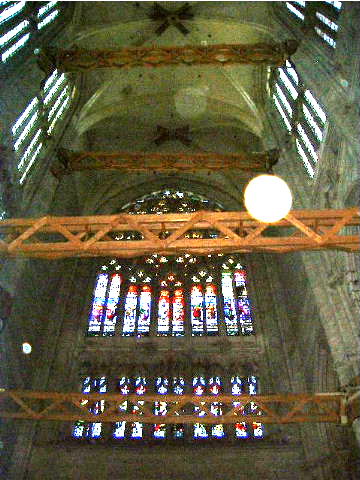
Category: The Essence of Composition
I was overwhelmed by the positive response to my previous post, the Preface to Category Theory for Programmers. At the same time, it scared the heck out of me because I realized what high expectati…

Abstract syntax and variable binding
We develop a theory of abstract syntax with variable binding. To every binding signature we associate a category of models consisting of variable sets endowed with compatible algebra and substitution structures. The syntax generated by the signature is the initial model. This gives a notion of initial algebra semantics encompassing the traditional one; besides compositionality, it automatically verifies the semantic substitution lemma.
DisCoCat
DisCoCat (Categorical Compositional Distributional) is a mathematical framework for natural language processing which uses category theory to unify distributional semantics with the principle of compositionality. The grammatical derivations in a categorial grammar (usually a pregroup grammar) are interpreted as linear maps acting on the tensor product of word vectors to produce the meaning of a sentence or a piece of text. String diagrams are used to visualise information flow and reason about natural language semantics.
Thoughts on thinking | Hacker News
The process of forming expressions just is the process of conceptual and rational articulation (as per Brandom). Those who misunderstand this -- believing that concepts are ready made, then encoded and decoded from permutations of tokens, or, worse, who have no room to think of reasoning or conceptualization at all -- they will be automated away.
Semantic Compression
An introduction to the idea that code should be approached with a mindset towards compressing it semantically, rather than orienting it around objects.
Scaling Monosemanticity: Extracting Interpretable Features from Claude 3 Sonnet
We find a diversity of highly abstract features. They both respond to and behaviorally cause abstract behaviors. Examples of features we find include features for famous people, features for countries and cities, and features tracking type signatures in code. Many features are multilingual (responding to the same concept across languages) and multimodal (responding to the same concept in both text and images), as well as encompassing both abstract and concrete instantiations of the same idea (such as code with security vulnerabilities, and abstract discussion of security vulnerabilities).