The CMX Social Identity Cycle is a simple model that leverages community psychology to design truly engaging community experiences.
How to Build and Develop a Community from Scratch
Learn how to build and develop a community from scratch with these six top takeaways from CMX.
Building Welcoming Communities
Building a community that encourages people to use, contribute to, and evangelize your project.
npmx: converging communities
The story of the many people and communities that converged to build npmx together
Get Together: How to Build a Community with Your People
A practical and heartfelt guide to cultivating a community, online or IRL.Although communities feel magical, they don’t come together by magic. Get Together is a practical and heartfelt guide to cultivating a community. Whether starting a run crew, connecting with fans online, or sparking a movement of K–12 teachers, the secret to getting people together is this: build your community with people, not for them.In Get Together, Bailey Richardson, Kevin Huynh, and Kai Elmer Sotto of People & Company share true stories of everyday people who have created thriving communities, both in person and online. They provide clear steps to untangle the challenge of getting passionate people together, helping individuals and organizations navigate the intricacies of leading a community, including: - How to rally the first people - How to get people talking - How to attract new, authentic folks - How to develop leaders and expand globally.The People & Company team reminds us that we each hold the potential to spark a community. Get Together shows readers that if we join forces—as company and customers, artist and fans, organizer and advocates—we’ll do more together than we ever could alone.
COMMUNITY-BASED, HUMAN-CENTERED DESIGN
We propose a radical change in design from experts designing for people to people designing for themselves, leveraging the creativity of communities to solve their own problems. People in communiti…


Connecting Research with Community - Civic Innovation Lab
Welcome to Civic Innovation Lab, where we drive social impact through collaborative solutions and empower communities. Join us in fostering sustainable development, co-creating initiatives, and advancing inclusive governance for a better future.

RadicalxChange
We are a community of activists, artists, entrepreneurs, and scholars committed to using mechanism design to inspire radical social change.
Community books rating | Notion
There are many questions from people in the CMX community, Community Club, and on Twitter, Linkedin, Facebook, etc., about what great books exist about communities. And there are tones of different book lists, but the question remains: how to choose where to start?

Why Community Matters: Groups as the Next Step for the Fediverse
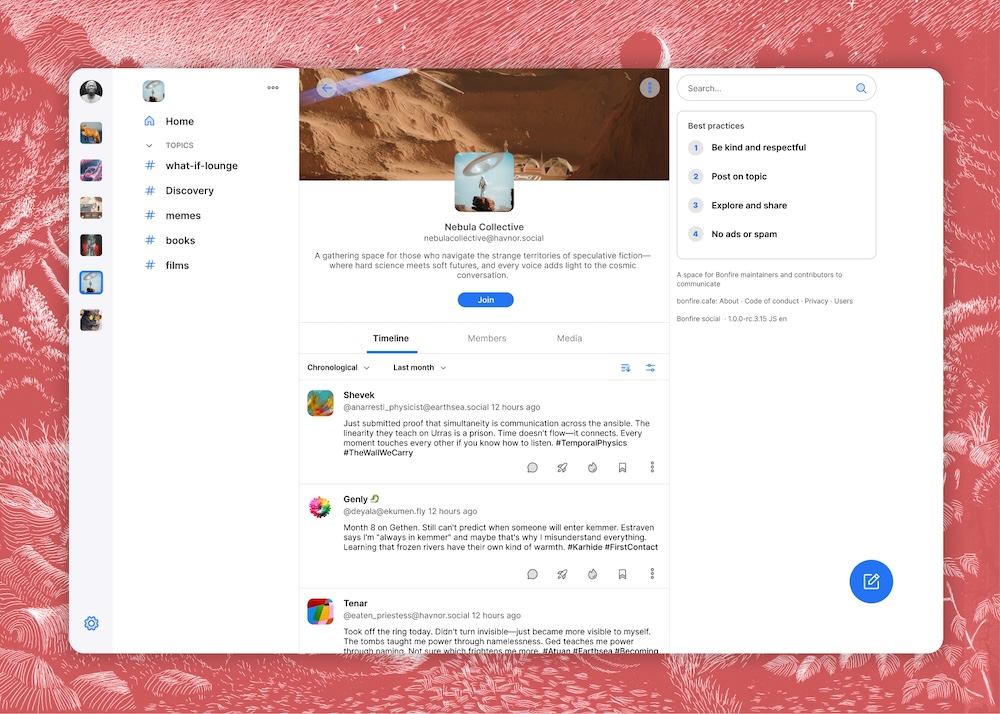
Federated groups in Bonfire will be spaces where communities gather to organise, care, and coordinate across the fediverse. They'll live next to your personal feed, but each group having a specific purpose: a study circle, a lab team, an activist collective, a local mutual aid crew, a project team. Inside you’ll find posts, conversations, calendars, shared resources, and more. Crucially, groups will be portable and interoperable.
Governing Together: Toward Infrastructure for Community-Run Social Media
Decentralizing the governance of social computing systems to communities promises to empower them to make independent decisions, with nuance and in accordance with their values. Yet, communities do not govern in isolation. Many problems communities face are common, or move across their boundaries. We therefore propose designing for "inter-community governance:" mechanisms that support relationships and interactions between communities to coordinate on governance issues. Drawing from workshops with 24 individuals on decentralized, community-run social media, we present six challenges in designing for inter-community governance surfaced through ideas proposed in workshops. Together, these ideas come together as an ecosystem of resources, infrastructures, and tools that highlight three key principles for designing for inter-community governance: modularity, forkability, and polycentricity. We end with a discussion of how the ideas proposed in workshops might be implemented in future work aiming to support community governance in social computing systems broadly.

Collective Flourishing
Our tools for navigating the future haven't kept pace with its growing complexity. Creating new systems that integrate a deep understanding of people, profound advances in modelling and foresight, and expressive interfaces could help us see, reason, and choose a better future together.
IIW – Internet Identity Workshop
The Internet Identity Workshop — where the identity community meets to discuss and advance digital identity.

A Decent Identity Part 1: Theory
This essay outlines a set of capabilities and goals comprising decent social computing and then establishes a framework for assessing how well an ecosystem’s identity system supports those goals and capabilities.
Human identity: the number one challenge in computer science
If the modern ‘problem of identity’ was how to construct an identity and keep it solid and stable, the postmodern ‘problem of identity’ is primarily how to avoid fixation and keep the options open. (Bauman 2011)
Design Justice: Community-Led Practices to Build the Worlds We Need
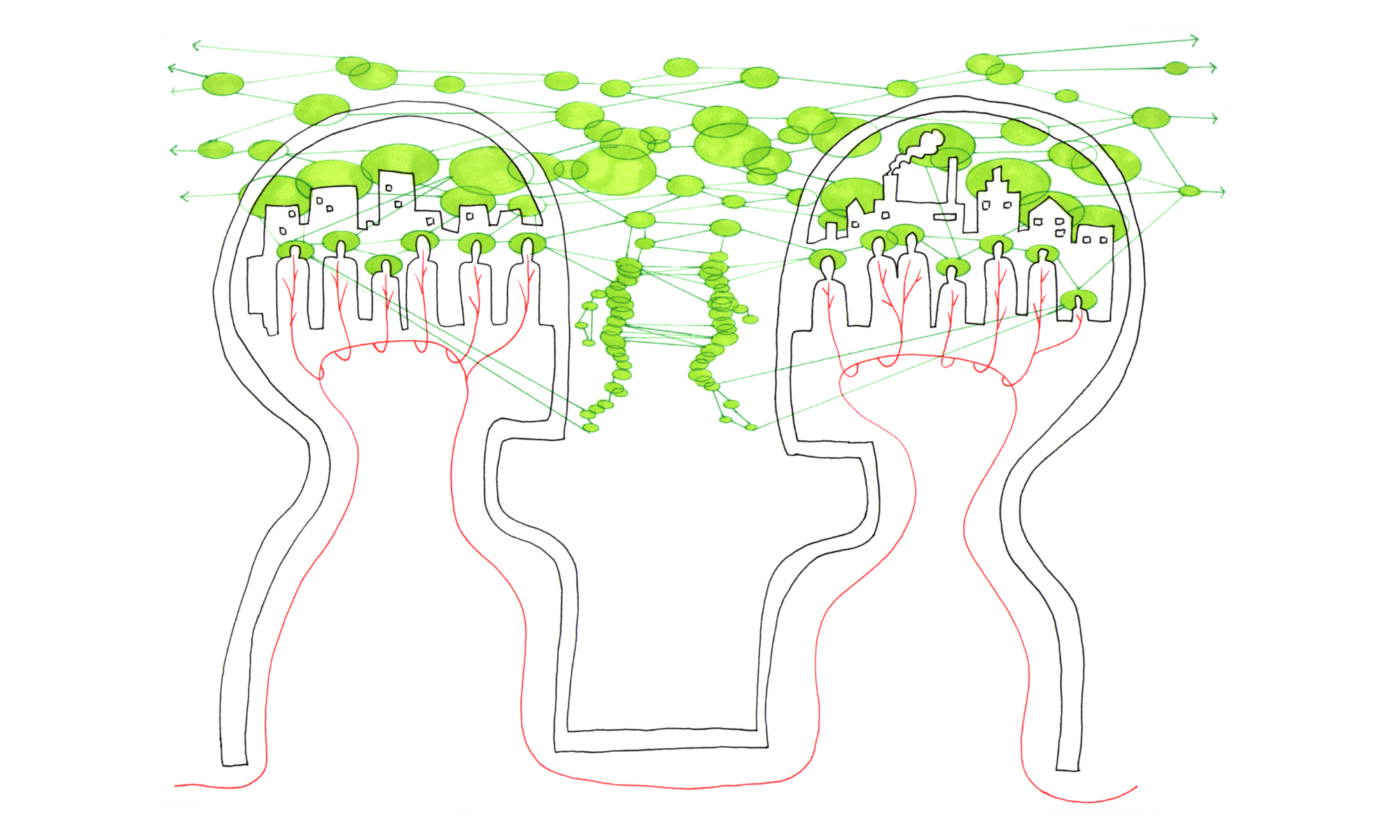
Community-Led Practices to Build the Worlds We Need