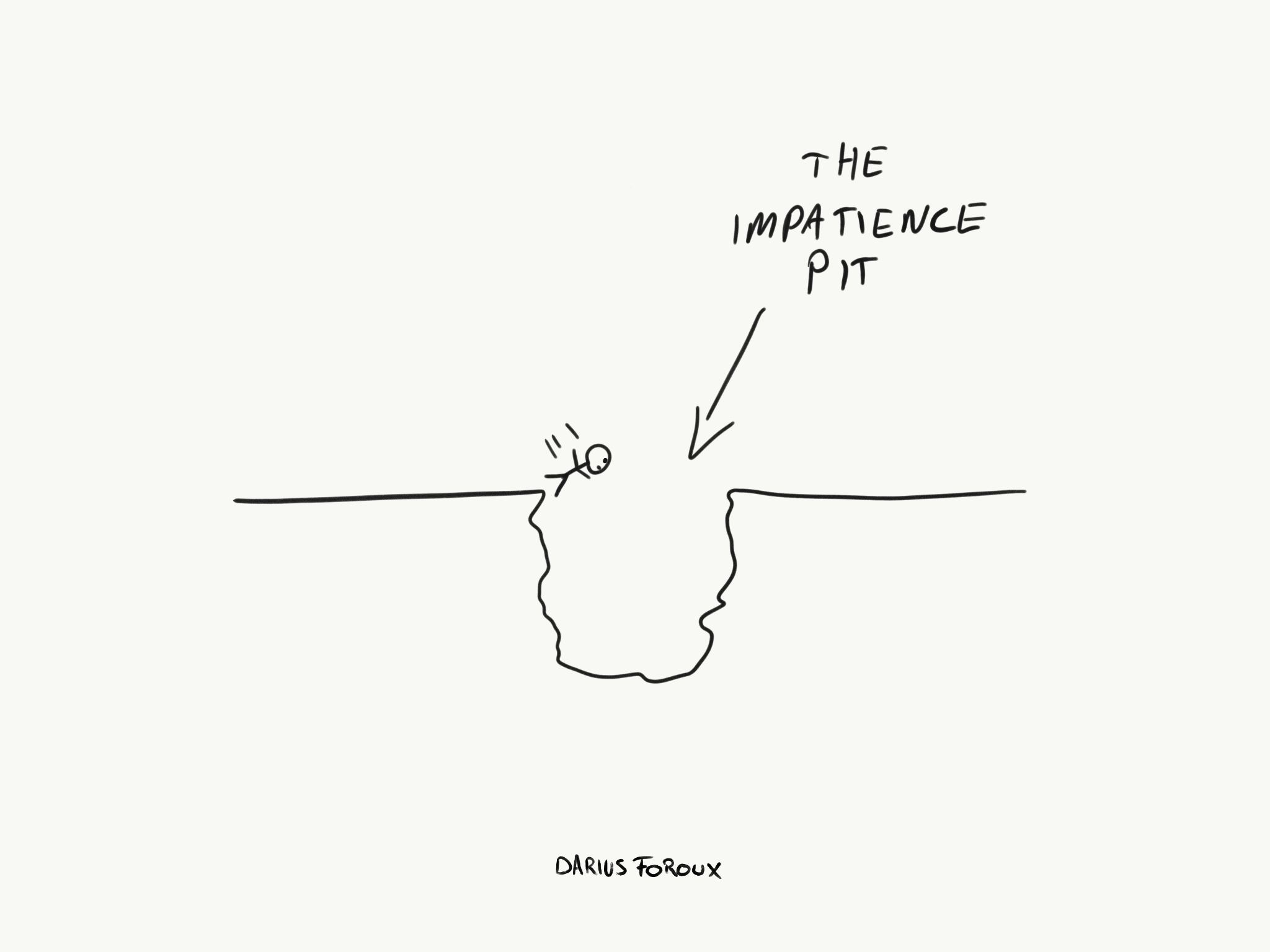
Big splashes don’t happen. Overnight success doesn’t exist. We have to remind ourselves of that whenever we show impatience.
Eroding a virtue: AI trains people to expect instant answers – and that’s bad news for patience
Patience is a virtue that researchers have linked to many parts of well-being. But it’s also something that needs a bit of practice and training – and can be undermined by instant, easy gratification.

Eroding a virtue: AI trains people to expect instant answers – and that’s bad news for patience
Patience is a virtue that researchers have linked to many parts of well-being. But it’s also something that needs a bit of practice and training – and can be undermined by instant, easy gratification.
Time-inconsistent Preferences and Consumer Self-Control
Abstract Why do consumers sometimes act against their own better judgment, engaging in behavior that is often regretted after the fact and that would have been rejected with adequate forethought? More generally, how do consumers attempt to maintain self-control in the face of time-inconsistent preferences? This article addresses consumer impatience by developing a decision-theoretic model based on reference points. The model explains how and why consumers experience sudden increases in desire for a product, increases that can result in the temporary overriding of long-term preferences. Tactics that consumers use to control their own behavior are also discussed. Consumer self-control is framed as a struggle between two psychological forces, desire and willpower. Finally, two general classes of self-control strategies are described: those that directly reduce desire, and those that overcome desire through will power.
Chasing life goals is a recipe for disaster – so try these tiny experiments instead
Whether its our careers, health or relationships, we often set the bar too high and end up feeling disappointed when it doesn’t work out. Try this new way of thinking … and you may just see some real results

Save More Today or Tomorrow: The Role of Urgency in Precommitment Design
To encourage farsighted behaviors, previous research suggests that marketers should invite consumers to precommit to adopting these behaviors “later.” However, the authors propose that people will draw different inferences from different types of precommitment offers, and that these inferences can help explain when precommitment is (and is not) effective at increasing adoption of farsighted behaviors. Specifically, the authors theorize that simultaneously offering consumers the opportunity to adopt a farsighted behavior now or later (i.e., offering “simultaneous precommitment”) may signal that the behavior is not urgently recommended; however, offering consumers the opportunity to adopt that behavior immediately and then, only if they decline, inviting them to adopt it later (i.e., offering “sequential precommitment”) may signal just the opposite. In a multisite field experiment (N = 5,196), the authors find that simultaneously giving consumers the chance to increase their savings now or later reduced retirement savings. Two preregistered lab studies (N = 5,080) show that simultaneous precommitment leads people to infer that taking action is not urgently recommended, and such inferences predict less adoption of recommended behaviors. Importantly, offering sequential precommitment increases inferred urgency, predicting greater adoption. Together, this research advances knowledge about the limits and potential of precommitment.

If you don’t finish then you’re just busy, not productive – Jack Simpson
One of the biggest realisations I’ve come to as part of my PhD, is how little people care about how I spend my time, they only care about what I am able to deliver. Yet in order to deliver, you need to finish. I was recently reading an article on this topic, and I think the advice can be best summed up as:

The Akrasia Effect: Why We Don’t Follow Through on What We Set Out to Do and What to Do About It
Plus, 3 strategies to help you start beating procrastination now.


why do we assume progress should feel good?
I can count on one hand the number of times I’ve achieved something and genuinely felt lasting satisfaction.

Anticipation and Choice Heuristics in the Dynamic Consumption of Pain Relief
Humans frequently need to allocate resources across multiple time-steps. Economic theory proposes that subjects do so according to a stable set of intertemporal preferences, but the computational demands of such decisions encourage the use of formally less competent heuristics. Few empirical studies have examined dynamic resource allocation decisions systematically. Here we conducted an experiment involving the dynamic consumption over approximately 15 minutes of a limited budget of relief from moderately painful stimuli. We had previously elicited the participants’ time preferences for the same painful stimuli in one-off choices, allowing us to assess self-consistency. Participants exhibited three characteristic behaviors: saving relief until the end, spreading relief across time, and early spending, of which the last was markedly less prominent. The likelihood that behavior was heuristic rather than normative is suggested by the weak correspondence between one-off and dynamic choices. We show that the consumption choices are consistent with a combination of simple heuristics involving early-spending, spreading or saving of relief until the end, with subjects predominantly exhibiting the last two.
Wisdom in a World in Crisis: The Counterintuitive Need to Slow Down and Find Spaciousness with Iain McGilchrist
Almost anything you give sustained attention to will begin to loop on itself and bloom
When people talk about the value of paying attention and slowing down, they often make it sound prudish and monk-like. But we shouldn’t forget how interesting and overpoweringly pleasurable sustained attention can be.

When to Fold: The Cost of Failing Slow in a Startup
Failing Slow: Why One Founder Regretted Keeping His Startup Alive

Why Good Leaders Fail
The risk of sudden leadership failure can be headed off by early detection of challenges and better supports.

ADHD, impulsivity and entrepreneurship
Recently, entrepreneurship scholars have started to show interest in how “negative” traits associated with mental disorders such as ADHD may have positive implications in entrepreneurship. While this research has the potential of producing important and counter-intuitive results, it is still in its infancy and the causal mechanisms that drive those individuals to be attracted to entrepreneurship have received limited attention. Consequently, we draw on the person-environment fit literature and propose that individuals are attracted to, and engage in, entrepreneurship because the task environment of entrepreneurship which favors speed of action is aligned with the traits of those individuals. We develop and test a model which suggests that ADHD influences entrepreneurship through the multifaceted trait of impulsivity. We find that inattention is negatively but hyperactivity is positively associated with entrepreneurship. We also find that sensation seeking and lack of premeditation generally positively influences entrepreneurship, whereas urgency has the opposite influence. Taken together, this suggests complex, multifaceted implications of ADHD and impulsivity in entrepreneurship. Theoretical implications of these findings are discussed. Research on entrepreneur personality has been mostly associated with positive traits, such as self-efficacy and achievement motivation. However, most traits are not universally positive or negative and what is functional or dysfunctional depends on context (Judge et al., 2009). Entrepreneurship is characterized by uncertainty, which indices anxiety, worry, procrastination and inaction among most people (McMullen and Shepherd, 2006; Paulus, 2007). However, it is also a vocation that grants more autonomy in terms of job design and task allocation, which may be attractive to individuals who need more leeway in designing their own tasks. Acknowledging the high uncertainty and autonomy in entrepreneurship, we argue that ADHD symptoms, which are associated with negative consequences in many areas of life, may have positive implications in the context of entrepreneurship because ADHD is characterized by traits such as sensation seeking, a focus on action with little premeditation, and a desire for autonomy. We employ person-environment fit theory (e.g., Holland, 1997) to argue that ADHD symptoms influence entrepreneurial preferences and behavior through the multi-dimensional traits of impulsivity. Specifically, ADHD symptoms are related to higher levels of sensation seeking, lack of premeditation, lack of perseverance and urgency. These traits in turn influence the perceived attractiveness of entrepreneurship and the probability of starting a business. We conducted surveys on a sample of MBA alumni from a school that is consistently ranked as one of the top fifty public MBA programs, who by virtue of their degree tend to have viable job opportunities and were thus less likely to be pushed into entrepreneurship. We find that ADHD symptoms have a complicated relationship with entrepreneurial preferences and action, with the pathway through sensation seeking and lack of premeditation being mostly positive while the pathway through urgency being negative. Further, hyperactive symptoms seem to mainly result in positive outcomes while inattention symptoms lead to negative ones. Our findings demonstrate that entrepreneurship is indeed a unique area where negative traits, such as ADHD, may represent valuable assets. Previous research has mostly associated ADHD with negative job-related outcomes (Barkley et al., 2006). Our research indicates that certain aspects of ADHD symptoms, such as sensation seeking and lack of premeditation, could lead individuals to be attracted to entrepreneurship and to start their own businesses. This suggests a contextualized view of personality traits, as well as boundary conditions to existing theories. Second, we develop and empirically test a model that links ADHD symptoms to entrepreneurship through the multi-dimensional traits of impulsivity, which provides a more nuanced and theoretically interesting understanding of the ADHD—entrepreneurship relationship. The same can be said about our findings of the differential influences of inattention and hyperactivity symptoms. Thus, this paper contributes to previous research on ADHD and entrepreneurship that has mostly examined the bivariate relationship between the two (e.g., Veryheul et al., 2015; Thurik et al., 2016). Finally, our post-hoc analyses showed that the effects of ADHD symptoms on entrepreneurship are more pronounced under highly uncertain environments. This is consistent with our theorizing, suggesting that individuals with ADHD symptoms are more likely to harness advantages associated with ADHD rather than suffer from associated disadvantages in highly uncertain and dynamic environments such as entrepreneurship. There are at least two important practice implications of our results. First, our results imply that individuals with ADHD symptoms may be empowered to craft their own jobs to fit their special needs. Second, our findings suggest that people with ADHD symptoms and impulsivity will tend to prefer action speed over action accuracy and that this may be functional in the context of entrepreneurship.
Measuring Self-Control Problems
We develop a survey instrument to measure self-control problems in a sample of highly educated adults. This measure relates in the manner that theory predicts to liquid wealth accumulation and personality measures. Yet while self-control problems are typically seen as resulting in overconsumption and low wealth, we identify a significant group who underconsume and thereby accumulate high levels of wealth. In addition, self-control problems are smaller in scale for older than for younger respondents. Those who put money aside in retirement accounts may be delaying access to a point at which self-control problems are no longer important. (JEL D12, D14)