


In this report, we explore two important ways structurally decentralized systems could help address the risks of mega-platform consolidation: First, these systems can help users directly publish and discover content directly, without intermediaries, and thus without censorship. All of the systems we
EFFecting Change: How to Build a Decentralized Web That Truly Works for All
Centralization, Decentralization, and Internet Standards
This document discusses aspects of centralization that relate to Internet standards efforts. It argues that, while standards bodies have a limited ability to prevent many forms of centralization, they can still make contributions that assist in the decentralization of the Internet.
Decentralisation: the next big step for the world wide web
The decentralised web, or DWeb, could be a chance to take control of our data back from the big tech firms. So how does it work and when will it be here?

Protocol: How Control Exists after Decentralization
How Control Exists after DecentralizationIs the Internet a vast arena of unrestricted communication and freely exchanged information or a regulated, highly

Hypermedia
Welcome to the Hypermedia Protocol: a decentralized publishing and discussion network
Practical Decentralization
The point of decentralization is to guarantee the rights of individuals and communities on the Internet. Pulling that off is a balancing act between practicality and ideology.
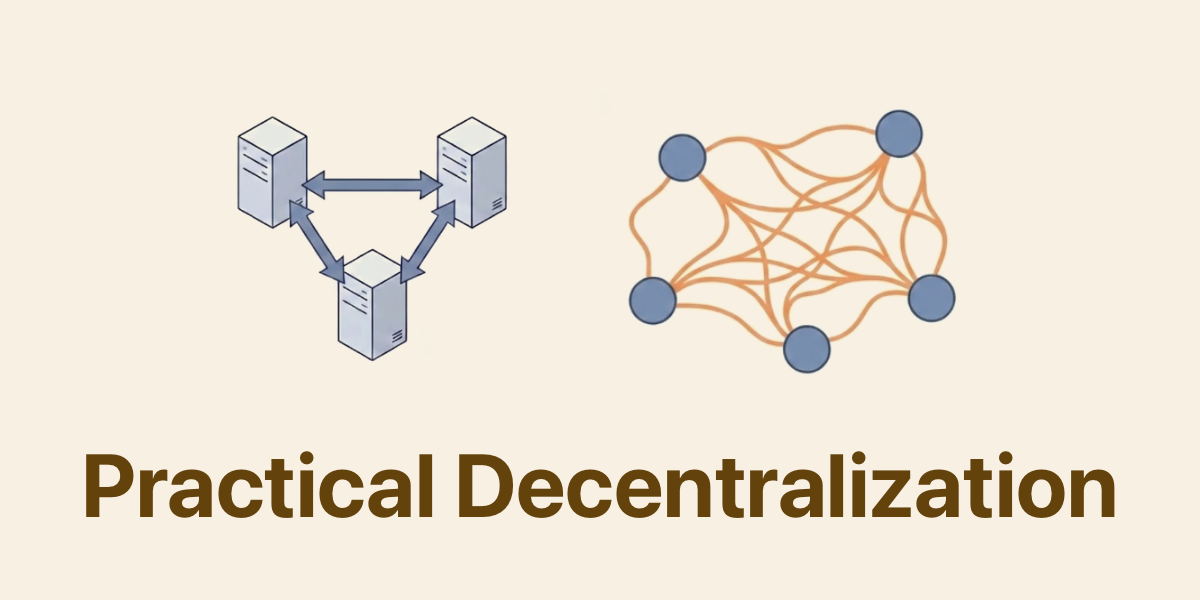
Practical Decentralization
The point of decentralization is to guarantee the rights of individuals and communities on the Internet. Pulling that off is a balancing act between practicality and ideology.
Long Live the Web: A Call for Continued Open Standards and Neutrality
The Web is critical not merely to the digital revolution but to our continued prosperity—and even our liberty. Like democracy itself, it needs defending

European Commission (@EUCommission@ec.social-network.europa.eu)
Attached: 1 image A strong Europe needs independent digital spaces. We believe true digital sovereignty thrives on a competitive, contestable, open ecosystem where diverse platforms co-exist. Today, we’re expanding our presence to W, the new social media. By being on W, we want to boost alternatives and support all efforts toward a decentralised web. And we continue to invest into our presence on the Fediverse!
Symposium: A Skeptical View of Information Fiduciaries
In recent years, the concept of “information fiduciaries” has surged to the forefront of debates on platform regulation. In a forthcoming essay, we question the wisdom of applying a fiduciary framework to dominant digital platforms.

Eaten by the Internet
This book makes internet infrastructure visible as a force of political power, which is transforming the social world, from the bottom up—through fifteen chapters contributed by a global set of researchers, activists, and techies. We are living a unique moment: internet technologies are the default infrastructure for society, not just how we communicate but also how we organise our social life, politics, and economy, all the way down to our material environments, like cities. Our world is eaten by the internet. This means that those who control the internet control the bounds of public speech, economic production, social cohesion, and politics, making its infrastructure a core political terrain in the networked age. The book’s chapters cover a wide set of topics, spanning from the global politics of content moderation by internet infrastructure to the colonialism inherent in the race to plug the moon, from the harms wrought by blockchain companies in rural America to the particularities of online censorship across Asia. The chapters take on thorny topics, discussing power consolidation in the advertisement and cloud industry, the role of internet infrastructure in the war in Ukraine, and tech’s environmental impact—amongst others. In doing so, this book roots contemporary technology debates in the politics of internet infrastructure and urges us to ask how can we ensure our infrastructures sustain us, rather than consume us?
Decentralization: Worth The Wait — Open Tech Strategies | Blog
Ethan Zuckerman has a piece in Wired that says building decentralization tools is a sucker's bet. He and his coauthors, Chelsea Barabas and Neha Narula, mention the FreedomBox, which I helped lead, as an example of how difficult this stuff is. They point to a list of things that make decentralized efforts prone to failure and conclude:
Chad Kohalyk (@chadkoh@indieweb.social)
Web publishing is facing its next challenge: a new iteration of centralizing platforms. BUT there is also a new wave of open protocols and standards that can help us gain our independence. Next month in NYC we are gathering a group of frontier technologists and popular web publishers to discuss how we can sail into this next platform shift as captains. #ProtocolsForPublishers https://pfp.unternet.co
Paradigm shifts for the decentralized Web
The answer to these questions varies with different degrees of decentralization:
Bluesky and the AT Protocol: Usable Decentralized Social Media
Bluesky is a new social network built upon the AT Protocol, a decentralized foundation for public social media. It was launched in private beta in February 2023, and has grown to over 10 million registered users by October 2024. In this paper we introduce the architecture of Bluesky and the AT Protocol, and explain how the technical design of Bluesky is informed by our goals: to enable decentralization by having multiple interoperable providers for every part of the system; to make it easy for users to switch providers; to give users agency over the content they see; and to provide a simple user experience that does not burden users with complexity arising from the system's decentralized nature. The system's openness allows anybody to contribute to content moderation and community management, and we invite the research community to use Bluesky as a dataset and testing ground for new approaches in social media moderation.

Web publishing is facing its next challenge: a new iteration of centralizing platforms. BUT there is also a new wave of open protocols+standards to gain independence. Next month in NYC let's discuss how we can sail into this next platform shift as captains. #ProtocolsForPublishers pfp.unternet.co
Protocols for Publishers
pfp.unternet.co