

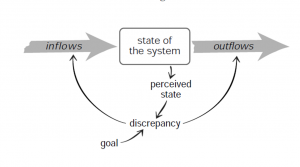
By Donella Meadows~ Folks who do systems analysis have a great belief in “leverage points.” These are places within a complex system (a corporation, an economy, a living body, a city, an ecosystem) where a small shift in one thing can produce big changes in everything. This idea is not unique to systems analysis — […]
Leverage Points: Places to Intervene in a System
By Donella Meadows~ Folks who do systems analysis have a great belief in “leverage points.” These are places within a complex system (a corporation, an economy, a living body, a city, an ecosystem) where a small shift in one thing can produce big changes in everything. This idea is not unique to systems analysis — […]

Borrow a Drill, Save the World — Douglas Rushkoff
The high leverage point for systemwide change is not an idea, but a behavior
Advancing Systems Analysis Program
ASA advances systems analysis as a meta-level approach to understand and govern complex socio-environmental systems. The overall objective is to increase realism, relevance, and agility of systems analysis. How? By harvesting new opportunities provided, in particular, by • New sources of data and methods to convert data into knowledge • Novel modelling approaches and underlying theories enabled by increased computational capabilities • Innovation through transfer of methods across disciplines and expansion of system boundaries • Continuous horizon scanning to identify novel matches between methodologies and applications across all thematic areas of IIASA • Enhanced transdisciplinary research
The Systems Thinker
The Systems Thinker works to catalyze effective change by expanding the use of systems approaches. All articles are available free of charge in an effort to expose as wide of audience as possible. Browse, share with others, save your favorites and tell others about this valuable resource!
Tools for Systems Thinkers: The 12 Recurring Systems Archetypes
Archetypes are recurring patterns of behavior that give insights into the structures that drive systems. They offer a way of deciphering…

My Experience with Leverage Research
I was part of Leverage/Paradigm from 2017–2019. This is a description of my time there.

Data Leverage: A Framework for Empowering the Public in its...
Many powerful computing technologies rely on implicit and explicit data contributions from the public. This dependency suggests a potential source of leverage for the public in its relationship...

Scenarios That Shape Our System - ATProtoFans Blog
Part 3 of our "Building Recurring Payments in Public" series where we give describe real-world scenarios based on our behaviors, constraints, and definitions.
TWIST - Investing for systems change
A global collective of investors, practitioners and facilitators, who are actively seeking to contribute to positive systems change.

What is system-level investing?
System-level investing explicitly focuses on how relationships within and between systems impact investment risks and returns

Introduction to systems thinking.
Many effective leaders I’ve worked with have the uncanny knack for working on leverage problems. In some problem domains, the product management skillset is extraordinarily effective for identifying useful problems, but systems thinking is the most universally useful toolkit I’ve found.
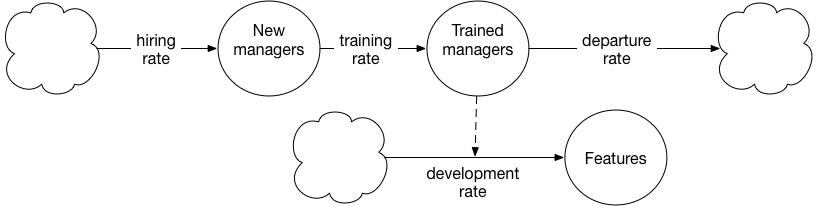
Control Point Analysis
This paper describes an informal method called control point analysis that can be used to catalog and understand the points of power and control created by spec

ver.ooo
Curious about systems — how they behave, how they fail, and what they get up to when nobody is steering.

Important and complex systems may be more controllable than they appear
We don't often think of them in these terms, but our brains, global financial markets and groups of friends are all examples of different kinds of complex networks or systems. And unlike the kind of system ...
