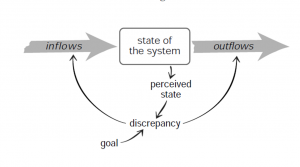
By Donella Meadows~ Folks who do systems analysis have a great belief in “leverage points.” These are places within a complex system (a corporation, an economy, a living body, a city, an ecosystem) where a small shift in one thing can produce big changes in everything. This idea is not unique to systems analysis — […]
Leverage Points: Places to Intervene in a System
By Donella Meadows~ Folks who do systems analysis have a great belief in “leverage points.” These are places within a complex system (a corporation, an economy, a living body, a city, an ecosystem) where a small shift in one thing can produce big changes in everything. This idea is not unique to systems analysis — […]

Borrow a Drill, Save the World — Douglas Rushkoff
The high leverage point for systemwide change is not an idea, but a behavior
Advancing Systems Analysis Program
ASA advances systems analysis as a meta-level approach to understand and govern complex socio-environmental systems. The overall objective is to increase realism, relevance, and agility of systems analysis. How? By harvesting new opportunities provided, in particular, by • New sources of data and methods to convert data into knowledge • Novel modelling approaches and underlying theories enabled by increased computational capabilities • Innovation through transfer of methods across disciplines and expansion of system boundaries • Continuous horizon scanning to identify novel matches between methodologies and applications across all thematic areas of IIASA • Enhanced transdisciplinary research
The Systems Thinker
The Systems Thinker works to catalyze effective change by expanding the use of systems approaches. All articles are available free of charge in an effort to expose as wide of audience as possible. Browse, share with others, save your favorites and tell others about this valuable resource!
My Experience with Leverage Research
I was part of Leverage/Paradigm from 2017–2019. This is a description of my time there.

Data Leverage: A Framework for Empowering the Public in its...
Many powerful computing technologies rely on implicit and explicit data contributions from the public. This dependency suggests a potential source of leverage for the public in its relationship...

Scenarios That Shape Our System - ATProtoFans Blog
Part 3 of our "Building Recurring Payments in Public" series where we give describe real-world scenarios based on our behaviors, constraints, and definitions.
TWIST - Investing for systems change
A global collective of investors, practitioners and facilitators, who are actively seeking to contribute to positive systems change.

What is system-level investing?
System-level investing explicitly focuses on how relationships within and between systems impact investment risks and returns

Introduction to systems thinking.
Many effective leaders I’ve worked with have the uncanny knack for working on leverage problems. In some problem domains, the product management skillset is extraordinarily effective for identifying useful problems, but systems thinking is the most universally useful toolkit I’ve found.
Control Point Analysis
This paper describes an informal method called control point analysis that can be used to catalog and understand the points of power and control created by spec

ver.ooo
Curious about systems — how they behave, how they fail, and what they get up to when nobody is steering.

Community Imbalance Theory
This is my best effort to summarize the last 4 years of community building, governance, and general open source sustainability work I’ve…

Vector theory of change — a theory of change for complex systems - The Cynefin Co
We're launching a short explainer on vector theory of change, which describes how approaches to theory of change thus far have not been suitable for complex systems, and how vector theory of change helps to rectify these issues. It walks you through vector theory of change step by step: starting from where you are, setting direction and finding stepping stones, designing interventions, and monitoring continuous feedback as opposed to recklessly aiming for a fixed endpoint at any cost.