


The Palestine Liberation Organization is a Palestinian nationalist coalition that is internationally recognized as the official representative of the Palestinian people in the occupied Palestinian territories. It is currently represented by the Palestinian Authority based in the West Bank city of Al-Bireh.
US declares Palestine Action a ’terrorist group’
The Trump administration followed in the footsteps of the UK government on Wednesday by proscribing the direct action group as a ’terrorist organisation’

Palestine Action
Palestine Action, also called Pal Action, is a British direct action network founded in 2020 with the stated goal of "ending global participation in Israel's genocidal and apartheid regime". With Israeli weapons manufacturer Elbit Systems as their primary target from the beginning, the organisation has been active in protests against the Gaza war in the United Kingdom, with many of their most high-profile actions such as the "Filton 24" case coming in response to the Gaza genocide. It is currently proscribed as a terrorist group under the Terrorism Act 2000, making membership of, material support for, or displaying items in support of the group a criminal offence in the UK.

Yasser Arafaft: Biography, Palestinian Political Leader, Facts
Yasser Arafat was chairman of the Palestine Liberation Organization from 1969 until his death in 2004, a tumultuous period in which clashes with neighboring Israel were prevalent.

Jewish Liberation Fund
Jewish Liberation Fund is grounded in the belief that the American Jewish community has enough resources to bring forth the liberatory world of which we dream.

Robert Kraft Claims His Donations Help Palestinians. Turns Out He’s Funding Friends of the IDF.
An analysis of tax forms by The Intercept show Kraft’s charity and LLC have donated to Friends of the IDF and AIPAC’s super PAC.
US Treasury sanctions Palestine Action, two other groups over alleged terrorism ties
The US Department of the Treasury's Office of Foreign Assets Control (OFAC) on Wednesday sanctioned three organizations and two individuals, accusing UK-based Palestine Action, the Italy-based Autisti...

Member Organizations — Jewish Diaspora Movement
Gaza genocide
The Gaza genocide is the ongoing, intentional, and systematic destruction of the Palestinian people in the Gaza Strip carried out by Israel during the Gaza war. It encompasses mass killings, the deliberate killing of children, deliberate starvation, infliction of serious bodily and mental harm, and prevention of births. Other acts include blockading, destroying civilian infrastructure, destroying healthcare facilities, killing healthcare workers and aid-seekers, causing mass forced displacement, committing sexual violence, and destroying educational, religious, and cultural sites. The genocide has been recognised by a United Nations special committee and commission of inquiry, the International Association of Genocide Scholars, multiple human rights groups, state governments, numerous genocide studies and international law scholars, and other experts.


Lobbying for Zionism on Both Sides of the Atlantic | Oneworld
In 1896, a Jewish state was a pipe dream. Today the overwhelming majority of Jews identify as Zionists. How did this happen? Ilan Pappe unveils how over a century of aggressive lobbying changed the map of the Middle East. Pro-Israel lobbies convinced British and American policymakers to condone Israel’s flagrant breaches of international law, […]

Israel has committed genocide in the Gaza Strip, UN Commission finds
GENEVA – Israel has committed genocide against Palestinians in the Gaza Strip, the UN Independent International Commission of Inquiry on the Occupied Palestinian Territory, including East Jerusalem, and Israel said in a new report today.

Leader-driven or Leaderless: How Participation Structure Sustains Engagement and Shapes Narratives in Online Hate Communities
Extremist communities increasingly rely on social media to sustain and amplify divisive discourse. However, the relationship between their internal participation structures, audience engagement, and narrative expression remains underexplored. This study analyzes ten years of Facebook activity by hate groups related to the Israel–Palestine conflict, focusing on anti-Semitic and Islamophobic ideologies. Consistent with prior work, we find that higher participation centralization in online hate groups is associated with greater user engagement across hate ideologies, suggesting the role of key actors in sustaining group activity over time. Meanwhile, our narrative frame detection models—based on an eight-frame extremist taxonomy (e.g., dehumanization, violence justification)—reveal a clear contrast across hate ideologies: centralized Islamophobic groups employ more uniform messaging, while centralized anti-Semitic groups demonstrate greater framing diversity and topical breadth, potentially reflecting distinct historical trajectories and leader coordination patterns. Analysis of the inter-group network indicates that, although centralization and homophily are not clearly linked, ideological distinctions emerge: Islamophobic groups cluster tightly, whereas anti-Semitic groups remain more evenly connected. Overall, these findings clarify how participation structure may shape the dissemination pattern and resonance of extremist narratives online and provide a foundation for tailored strategies to disrupt or mitigate such discourse.
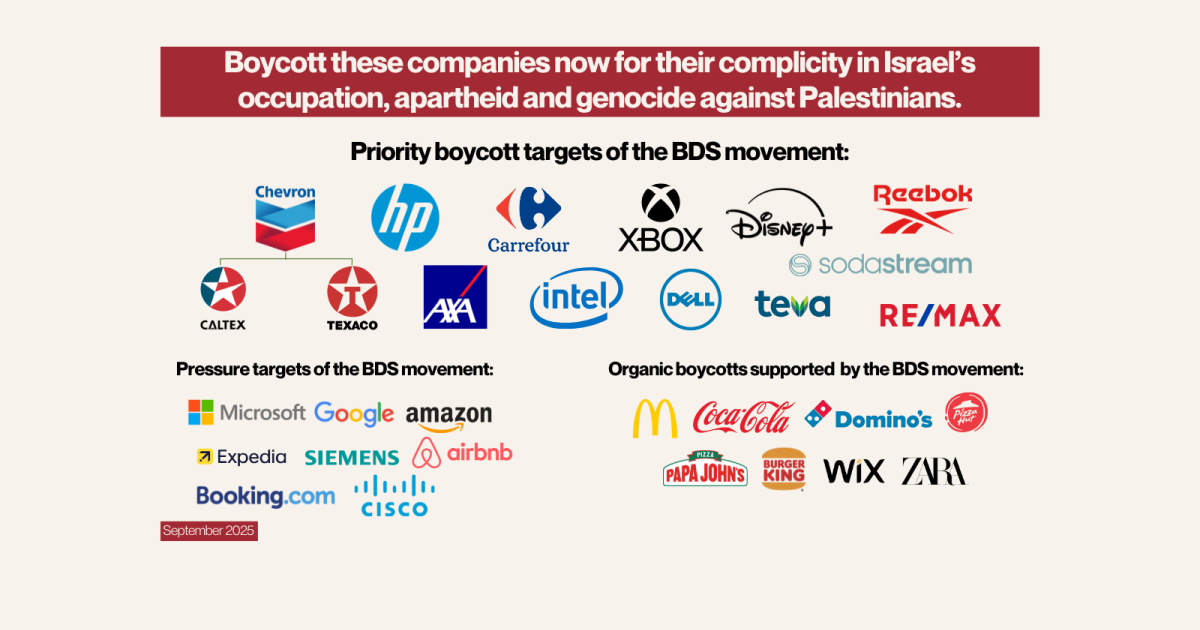
Guide to BDS Boycott & Pressure Corporate Priority Targeting
Ending the complicity of states, corporations, and institutions in Israel’s ongoing, live-streamed genocide against 2.3 million Palestinians in Gaza is the most effective form of solidarity with the Palestinian struggle to end the genocide and dismantle Israel’s 76-year-old regime of settler-colonialism and apartheid.
Using collective dialogues and AI to find common ground between Israeli and Palestinian peacebuilders | Proceedings of the 2025 ACM Conference on Fairness, Accountability, and Transparency
Collaborative and social computing theory, concepts and paradigms

The Ethnic Cleansing of Palestine | Oneworld
Renowned Israeli historian, Ilan Pappe’s groundbreaking work on the formation of the State of Israel. ‘Along with the late Edward Said, Ilan Pappe is the most eloquent writer of Palestinian history.’ NEW STATESMAN Between 1947 and 1949, over 400 Palestinian villages were deliberately destroyed, civilians were massacred and around a million men, women, and […]

The Rise and Fall of the Palestinian-Arab Middle Class Under the British Mandate, 1920–39
The Palestinian-Arab middle class under the Mandate may be characterized as bourgeois and educated, similarly to bourgeois classes that have developed in the West in the Modern era. The bourgeois characteristics of the Palestinian-Arab middle class, and their influence on its historical trajectory during the Mandate era, have not been studied in depth yet. This article aims to focus on a local aspect of the rise of the middle class in the region in that period: the rise of the Palestinian-Arab middle class under the Mandate, until the Palestinian-Arab Revolt (1936–9). The main hypothesis is that particular bourgeois social and cultural characteristics prevented the middle class full incorporation into the Palestinian-Arab National Movement, and even led to estrangement between the middle class and the national leadership, as well as members of lower strata, especially the villagers. Members of the middle class, mostly Christians but Muslims as well, espoused in their daily life modern habits, ideas, and customs, as a means to distinguish between themselves and other classes, similarly to their parallels in the West, and like their contemporaries elsewhere in the Eastern Mediterranean, as has demonstrated by Watenpaugh. Those gaps reached their climax during the years of revolt.