


I’ve been going to professional events for a number of years, and one of the trickiest dynamics I have seen is that most events develop an “insiders” group who has been going for a long time. These...
Building for Organizers - The People Layer
The most enduring social networks aren’t the prettiest or the most addictive – it’s the ones that empower organizers.
Building for Organizers - The People Layer
The most enduring social networks aren’t the prettiest or the most addictive – it’s the ones that empower organizers.
Being in a crowd doesn’t make you part of a mindless mob | Psyche Ideas
It’s often assumed people lose their minds in a crowd. Research on riots, festivals and sports tells a more uplifting story

The Pac-Man Rule at Conferences
I firmly believe that conferences can provide a lot of value for people in an industry. Conferences allow people to create a network, which helps them feel integrated in a community and profession....

The Pac-Man Rule at Conferences
I firmly believe that conferences can provide a lot of value for people in an industry. Conferences allow people to create a network, which helps them feel integrated in a community and profession....
Symbiota
We’re a collective of event-focused organisations devoted to new forms of culture and enquiry, structured as a not-for-profit worker co-operative
Permissioned Data Shapes: Private Events - Nick's Blog
A private events space is the first shape with other people in it: a member list of friends and family, guest RSVPs that live on the guests' own PDSes, and a…
Shifting the Level of Selection in Science
Criteria for recognizing and rewarding scientists primarily focus on individual contributions. This creates a conflict between what is best for scientists’ careers and what is best for science. In this article, we show how the theory of multilevel selection provides conceptual tools for modifying incentives to better align individual and collective interests. A core principle is the need to account for indirect effects by shifting the level at which selection operates from individuals to the groups in which individuals are embedded. This principle is used in several fields to improve collective outcomes, including animal husbandry, team sports, and professional organizations. Shifting the level of selection has the potential to ameliorate several problems in contemporary science, including accounting for scientists’ diverse contributions to knowledge generation, reducing individual-level competition, and promoting specialization and team science. We discuss the difficulties associated with shifting the level of selection and outline directions for future development in this domain.

The Art of Gathering: How We Meet and Why It Matters
Being deprived of social gatherings revealed just how important they are; to connect with others, collaborate, share ideas and create moving, life-affirming experiences. ___________________________If there's one thing lockdown showed us, it's that time together is a gift we've too often taken for granted. In The Art of Gathering, Priya Parker shows us how to ensure that however we meet, it's a truly transformative experience. An expert on organizing successful gatherings whether in conference centres, crisis zones or her living room, Parker sets forth a human-centred approach to gathering that can help us create meaningful, memorable moments - large and small, for work and play.The result is a book full of exciting real-world ideas that will forever alter the way you look at your next business meeting, dinner party and garden barbecue.___________________________ 'Hosts of all kinds, this is a must-read!' Chris Anderson, creator of TED'Priya Parker has created both an art and a science to gathering in ways that can bring joy and fulfilment to any meeting' Deepak Chopra'A long overdue and urgent manifesto' Seth Godin, New York Times bestselling author of This is Marketing
Crowdmatching for Public Goods — Snowdrift.coop
We support works that everyone can use, adapt, and share freely. But as public goods, anyone can freeride. And that presents a dilemma in getting funded. Our innovative platform brings people together to address this problem.
The Community Manager Pattern - Nick's Blog
This post looks more closely at Brittany Ellich's work on representing groups in ATProtocol. It builds on earlier conversations and explores how these ideas might work in practice.
Why Community Matters: Groups as the Next Step for the Fediverse
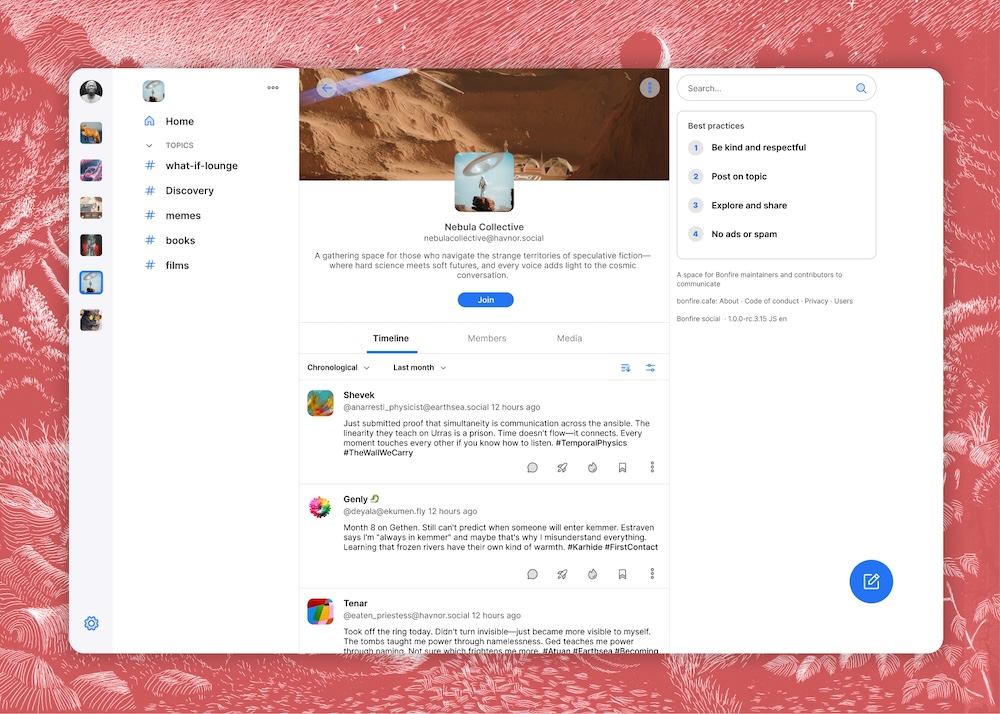
Federated groups in Bonfire will be spaces where communities gather to organise, care, and coordinate across the fediverse. They'll live next to your personal feed, but each group having a specific purpose: a study circle, a lab team, an activist collective, a local mutual aid crew, a project team. Inside you’ll find posts, conversations, calendars, shared resources, and more. Crucially, groups will be portable and interoperable.
Is group chat making you sweat?
Is this you? Are you making other feel like this? Group chat is like being in an all-day meeting with random participants and no agenda. In 2006 we launched Campfire, the first modern SAAS group ch…

Geeks, MOPs, and sociopaths in subculture evolution (2015) | Hacker News
Any marginally successful group attracts sociopaths. The more power available to someone installing themselves at the centre of an elite clique that runs the organisation, the more attractive it is. No-one ever sees it fully until they get on the wrong end of one of these toxic power dynamics, there is so much subtle BS working against anyone trying to face this stuff down that it's almost pointless wasting your life trying.
yet another example of scientists vibing better ways to navigating conferences because the current system is trash. we (atproto) have a real surface here if we can get a cohesive solution into the hands of conference attendees and organizer #atdev @atproto.science

Sasha Gusev
An ASHG planner that doesn't suck (Claude): sashagusev.github.io/ashg-2026-planner/
