

E: Cryptographic Capabilities for Distributed Smart Contracting
Overview: An Ode to the Granovetter Diagram
E: Cryptographic Capabilities for Distributed Smart Contracting
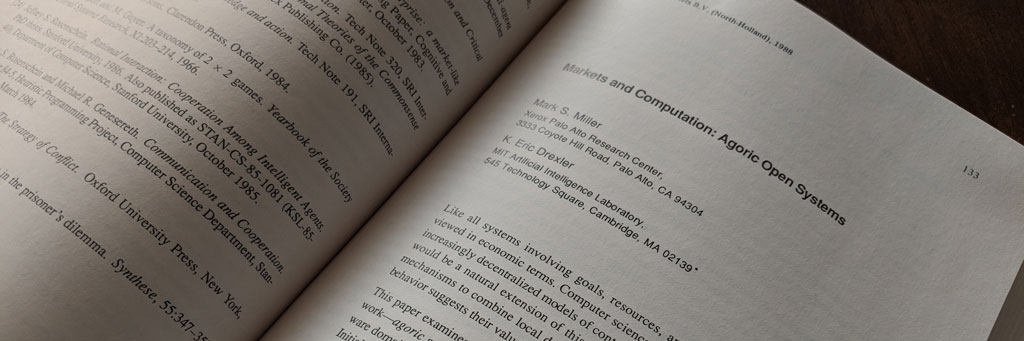
A Spectrum of Consent
Blockchain & Decentralized Identity Architect — Internet Cryptography Pioneer — Co-author TLS Security Standard — Collaborative Tools & Patterns

WAVE: A Decentralized Authorization Framework with Transitive Delegation | USENIX
Michael P Andersen, Sam Kumar, Moustafa AbdelBaky, Gabe Fierro, John Kolb, Hyung-Sin Kim, David E. Culler, and Raluca Ada Popa, University of California, Berkeley
Decentralized Identity Verification using Zero-Knowledge Proofs: A Privacy-Preserving Authentication Framework
In the contemporary online interaction, digital iden- tity is central, but most systems follow a centralized provider like Google or Facebook. Although convenient, these models pose ma- jor risks to data breach, surveillance, and single point of failure. The proposed paper proposes a privacy-sensitive decentralized identity verification system that uses Zero-Knowledge Proofs (ZKPs) to allow users to make it through claims (e.g., age, citizen- ship, or enrollment) without any personal data being provided, thereby solving the challenges outlined in the paper. Our architecture integrates verifiable credentials, zero-knowledge-SNARKs and an issuer trust registry that is maintained on blockchain smart contracts to guarantee trustless verification and eliminate dependence on centralized authorities. Its system gives its users full control over credentials, allows reuse across applications, and does not expose data.A proof-of-concept implementation has shown the approach to be feasible with Circom and SnarkJS to generate proof, Solidity smart contracts to verify them, and a user interface implemented in React. Results of the evaluations showed that determination of the verification latency is low, the overhead to generate proofs is moderate, and no privacy leakage occurs. It can be used in potential applications such as education, e-governance, healthcare, finance, and online voting.
Working to Decentralize FedCM - AT Protocol
Bluesky Social PBC have given a grant to Emelia Smith, an Invited Expert with the FedID Working Group, to work on FedCM with the goal of making FedCM really work for the decentralized web.
attested.network — Proof of Payment for ATProtocol
An open specification for decentralized, cryptographically verifiable proof of payments.

BeeKEM: Decentralized, Secure and Efficient Group Key Agreement
Group key agreement protocols are essential for modern secure messaging. Most existing group key agreement protocols assume a centralized model with a semi-trusted service that mediates the communication. This is efficient, but problematic for some important applications, since a central service can be a choke point for surveillance and censorship. There is a nascent literature on decentralized group key agreement that avoids such reliance, but existing proposals either do not scale, with update costs linear or quadratic in the group size, or lack proofs of security. Centralized protocols can offer much lower (logarithmic) cost. We present BeeKEM, the first decentralized group key agreement protocol with logarithmic update cost in the common case (degrading to linear in the worst case) and proofs of security. We provide an open-source implementation and demonstrate that it is competitive with OpenMLS. BeeKEM opens the door for a range of communication and collaboration applications offering not only end-to-end encryption, but also metadata privacy and censorship resistance.
From crypto winter to crypto weirder | TechCrunch
Captain Kirk and neo-Dadaists. Repugnant markets and legendary cryptographers. "Digital couture" auctioned by CryptoKitties developers. Distributed

Building interoperable ZKP credential systems
DIF C&C WGis starting a collaborative initiative to align work on a range of ZKP solutions across multiple crypto primitives
Beyond DNS: Unlocking the Internet of AI Agents via the NANDA Index and Verified AgentFacts
The Internet is poised to host billions to trillions of autonomous AI agents that negotiate, delegate, and migrate in milliseconds and workloads that will strain DNS-centred identity and discovery. In this paper, we describe the NANDA index architecture, which we envision as a means for discoverability, identifiability and authentication in the internet of AI agents. We present an architecture where a minimal lean index resolves to dynamic, cryptographically verifiable AgentFacts that supports multi-endpoint routing, load balancing, privacy-preserving access, and credentialed capability assertions. Our architecture design delivers five concrete guarantees: (1) A quilt-like index proposal that supports both NANDA-native agents as well as third party agents being discoverable via the index, (2) rapid global resolution for newly spawned AI agents, (3) sub-second revocation and key rotation, (4) schema-validated capability assertions, and (5) privacy-preserving discovery across organisational boundaries via verifiable, least-disclosure queries. We formalize the AgentFacts schema, specify a CRDT-based update protocol, and prototype adaptive resolvers. The result is a lightweight, horizontally scalable foundation that unlocks secure, trust-aware collaboration for the next generation of the Internet of AI agents, without abandoning existing web infrastructure.

Centre for Cryptographic Trust Infrastructure (CCTI)
Martin Kleppmann · University of Cambridge; Martin Pompéry · SINE Foundation
Bunzz | Modular Smart Contracts Dev & AI-Based Audit
Comprehensive dev tool for Smart Contracts, AI based audit, and analysis.

Opening up the Foundation
Matrix, the open protocol for secure decentralised communications
New: Bilateral delegations as mutually consenting social contracts

Capability Trees: A Protocol-Level Extension of Object Capabilities, Draft 4
leaflet.pub