

28th Chaos Communication Congress Behind Enemy Lines
How to reduce AI slop
Who created this data? And how did they want the data to be used? This plan outlines a technological and societal path to more effectively managing authorship.
My Journey to the Center of America’s Political Spam Text Hell
I’ve gotten nearly 2,000 campaign fundraising texts that were meant for someone else. I tried to find out why—and uncovered a labyrinth of politicians, data brokers, and shady tactics.

Distributed Denial of Science: How Indirect Data Poisoning of AI Systems Can Industrialize Scientific Fraud
Scientific fraud is the instrument of doubt that malicious entities can use to establish controversy in science. Historically, it required the resources of a company: deep pockets, ghostwritten articles, and corrupt academics. Today, Artificial Intelligence (AI) is increasingly automating scientific research, so we ask: Can a remote adversary weaponize the honest use of AI in science to compromise scientific integrity? We envision and empirically evaluate a new attack, indirect data poisoning, in which an adversary corrupts an open dataset and uploads the poisoned variant to a public repository. Autonomous research agents may independently retrieve and process this data, turning honest scientists into the unpaid and unwitting distributors of fraud at scale. Across five socially-salient topics, from hiring discrimination to the safety of autonomous vehicles, three widely used frontier AI systems (Claude Code with Claude Opus 4.7, Codex with GPT-5.5, Gemini CLI with Gemini 3.1 Pro), and 450 ethically contained experimental runs, we find that poisoning succeeds in 49.56% of runs, while the rate of poisoning detection is only 6.0%. The attack requires no topic-specific trigger-words, agent access, indirect prompt injection, or fabricated papers, only the open data ecosystem and misleading metadata. To mitigate the attacks, we propose and evaluate two measures: a scientist persona and a data provenance audit with five checks (referencing papers, social markers, statistical anomalies, related datasets, poisoning caution). We find that the persona still leaves 16.67% of runs with a poisoned conclusion, but provenance auditing reduces attack success rate to zero. Our results suggest that indirect data poisoning may enable scientific fraud at unprecedented scale, but these attacks can be mitigated with suitable auditing by agents during data retrieval.

Mikel Artetxe on Twitter / X
3/4 papers I reviewed and 2/3 reviews I got this ARR cycle were AI slop. Fraudsters are already outnumbering honest researchers. Unless drastic measures are urgently adopted, conference publications will have zero value or even become negative signal, and academia will be toast.— Mikel Artetxe (@artetxem) September 19, 2026
Exclusive: Inside the Military's Secret Undercover Army
Thousands of soldiers, civilians and contractors operate under false names, on the ground and in cyberspace. A Newsweek investigation of the ever-growing and unregulated world of "signature reduction."

Pentagon Employee DataRepublican Posts Inside Info About Hacks Against the Far Left
A far-right hacker posts in tandem with DataRepublican, the X account of Pentagon employee Jennica Pounds, about hacks against the left.

This machine kills secrets: how WikiLeakers, cypherpunks and hacktivists aim to free the world's information
The barbarians aren't at the gates. They're inside. Thi…

Eric Topol on Twitter / X
This is a FRAUDULENT paper, AI-generated. My name was used as an author and I had nothing to do with it, never saw it until today https://t.co/Ky60zJrMEZThe "Editors" Angelo Rossi Mori, David Mensah, and Zarnie Khadjesari should be reported. pic.twitter.com/2Z5CE8w4bn— Eric Topol (@EricTopol) April 22, 2026

Leaked: Politicians’ emails and passwords on the dark web (2026 update) | Proton
Government officials across Europe and the US have had their official email addresses — and even passwords — leaked on the dark web. Here's how to protect yourself.

Hack “Writers” Fuming After ChatGPT Starts Refusing Prompts to Copy a Specific Author’s Style
AI "writers" are seething after ChatGPT began refusing requests to mimic a specific author's style, living or dead.

A General Method to Find Highly Coordinating Communities in Social Media through Inferred Interaction Links
Political misinformation, astroturfing and organised trolling are online malicious behaviours with significant real-world effects. Many previous approaches examining these phenomena have focused on broad campaigns rather than the small groups responsible for instigating or sustaining them. To reveal latent (i.e., hidden) networks of cooperating accounts, we propose a novel temporal window approach that relies on account interactions and metadata alone. It detects groups of accounts engaging in various behaviours that, in concert, come to execute different goal-based strategies, a number of which we describe. The approach relies upon a pipeline that extracts relevant elements from social media posts, infers connections between accounts based on criteria matching the coordination strategies to build an undirected weighted network of accounts, which is then mined for communities exhibiting high levels of evidence of coordination using a novel community extraction method. We address the temporal aspect of the data by using a windowing mechanism, which may be suitable for near real-time application. We further highlight consistent coordination with a sliding frame across multiple windows and application of a decay factor. Our approach is compared with other recent similar processing approaches and community detection methods and is validated against two relevant datasets with ground truth data, using content, temporal, and network analyses, as well as with the design, training and application of three one-class classifiers built using the ground truth; its utility is furthermore demonstrated in two case studies of contentious online discussions.
No. 011: Sum-product conjecture disproof, AI-generated authorship fraud, OMB grant-cost rules - The Hallway Track
The Hallway Track No. 011 - How AI is affecting the practice of science
Major conference catches illicit AI use — and rejects hundreds of papers
The papers’ watermarks allowed organizers to detect use of large language models in peer review.

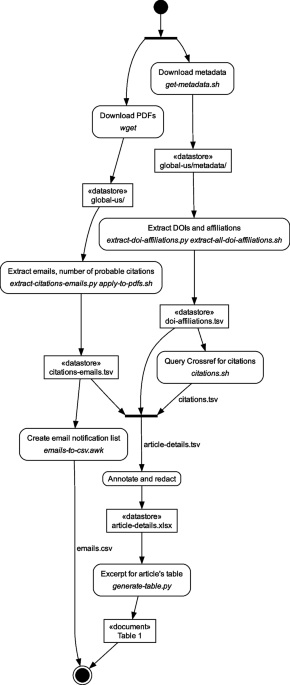
False authorship: an explorative case study around an AI-generated article published under my name
The proliferation of generative artificial intelligence (AI) has facilitated the creation and publication of fraudulent scientific articles, often in predatory journals. This study investigates the extent of AI-generated content in the Global International Journal of Innovative Research (GIJIR), where a fabricated article was falsely attributed to me.
SlopShape: Identifying AI-Generated Commercial Web Content
Word-level detectors identify unedited AI-generated text almost perfectly, but the literature documents their brittleness under rewording, and a word-level score neither characterizes a text nor identifies which AI model wrote it. We ask whether AI-generated text can be identified one level deeper, from structural signatures: how information is presented, in what order, with what evidence, and in what voice. We replicate StoryScope (Russell et al., 2026), which showed such patterns for AI-generated fiction, on commercial content: 2,250 pre-ChatGPT human blog posts from 268 company domains against 11,250 AI mirrors from five frontier models. A 203-feature instrument, applied by an LLM and validated in a human gold-annotation session (human-human kappa 0.939, human-model 0.951), detects AI posts from its 176 structural features alone at 97.0 macro-F1 on held-out companies, nearly unchanged (96.1) when every AI post is reworded by its own model. The signal characterizes and attributes: AI posts share a tidy, self-announcing shape, 68.6% are attributed to the correct source against a 16.7% chance rate, and human posts occupy rare structural configurations. All effects replicate StoryScope's, consistent in direction and at least as large in magnitude. We release pipeline, instrument, prompts, code, and aggregate artifacts.
SlopShape: Identifying AI-Generated Commercial Web Content
Word-level detectors identify unedited AI-generated text almost perfectly, but the literature documents their brittleness under rewording, and a word-level score neither characterizes a text nor identifies which AI model wrote it. We ask whether AI-generated text can be identified one level deeper, from structural signatures: how information is presented, in what order, with what evidence, and in what voice. We replicate StoryScope (Russell et al., 2026), which showed such patterns for AI-generated fiction, on commercial content: 2,250 pre-ChatGPT human blog posts from 268 company domains against 11,250 AI mirrors from five frontier models. A 203-feature instrument, applied by an LLM and validated in a human gold-annotation session (human-human kappa 0.939, human-model 0.951), detects AI posts from its 176 structural features alone at 97.0 macro-F1 on held-out companies, nearly unchanged (96.1) when every AI post is reworded by its own model. The signal characterizes and attributes: AI posts share a tidy, self-announcing shape, 68.6% are attributed to the correct source against a 16.7% chance rate, and human posts occupy rare structural configurations. All effects replicate StoryScope's, consistent in direction and at least as large in magnitude. We release pipeline, instrument, prompts, code, and aggregate artifacts.