

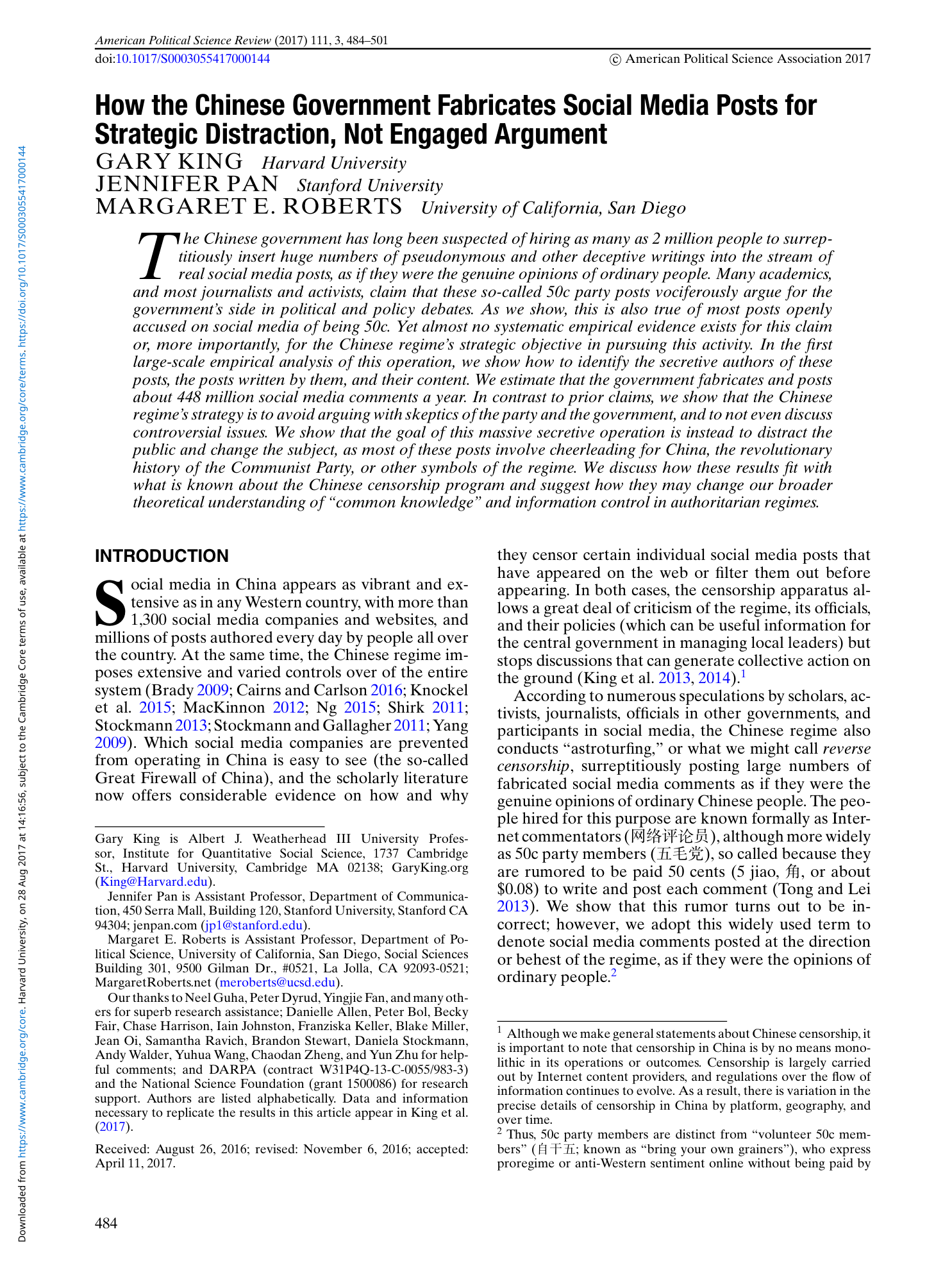
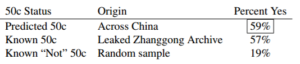
The Chinese government has long been suspected of hiring as many as 2,000,000 people to surreptitiously insert huge numbers of pseudonymous and other deceptive writings into the stream of real social media posts, as if they were the genuine opinions of ordinary people. Many academics, and most journalists and activists, claim that these so-called "50c party" posts vociferously argue for the government's side in political and policy debates. As we show, this is also true of the vast majority of posts openly accused on social media of being 50c. Yet, almost no systematic empirical evidence exists for this claim, or, more importantly, for the Chinese regime's strategic objective in pursuing this activity. In the first large scale empirical analysis of this operation, we show how to identify the secretive authors of these posts, the posts written by them, and their content. We estimate that the government fabricates and posts about 448 million social media comments a year. In contrast to prior claims, we show that the Chinese regime's strategy is to avoid arguing with skeptics of the party and the government, and to not even discuss controversial issues. We show that the goal of this massive secretive operation is instead to distract the public and change the subject, as most of the these posts involve cheerleading for China, the revolutionary history of the Communist Party, or other symbols of the regime. We discuss how these results fit with what is known about the Chinese censorship program, and suggest how they may change our broader theoretical understanding of "common knowledge" and information control in authoritarian regimes. This paper is related to our articles in *Science,* "[Reverse-Engineering Censorship In China: Randomized Experimentation And Participant Observation](/publication/reverse-engineering-censorship-in-china-randomized-experimentation-and-participant-observation/)", and the *American Political Science Review,* "[How Censorship In China Allows Government Criticism But Silences Collective Expression](/publication/how-censorship-in-china-allows-government-criticism-but-silences-collective-expression/)". Replication data at the Harvard Dataverse: [https://doi.org/10.7910/DVN/QSZMPD](https://doi.org/10.7910/DVN/QSZMPD).
Chinese officials 'create 488m bogus social media posts a year'
Harvard researchers say leaked documents show bureaucrats fabricate positive posts to distract from criticism of government
Authoritarians Distract Rather than Debate - Marginal REVOLUTION
It’s long been known that the Chinese government hires people to support the government with fabricated posts on social media. In China these people are known as the “50c party”, so called because the posters were rumored to be paid 50 cents (5 jiao or about $.08) to write the posts. The precise nature and extent […]
Political disinformation concentrates in repeated claims across media
The prevalence and dynamics of disinformation remain contentious, partly because measures have relied on posts containing URLs from untrustworthy sources. We move beyond this by detecting disinformation in text and across posts. Using retrieval-augmented generation, we match six million Facebook, Instagram, and X posts by politicians from the United States, United Kingdom, and Germany, and two million articles from news outlets to fact-checked claims. We show that disinformation is concentrated in a small number of combinations of policy issues and parties and that just over hundred distinct claims account for around half of all disinformation across the three countries. They often appear first on a single platform, later on multiple, and subsequently in news coverage before being fact-checked. These findings suggest that disinformation is concentrated in a narrow segment of political communication, potentially creating repeated exposure that may shape the terms of public debate through both social and news media.
State media control influences large language models
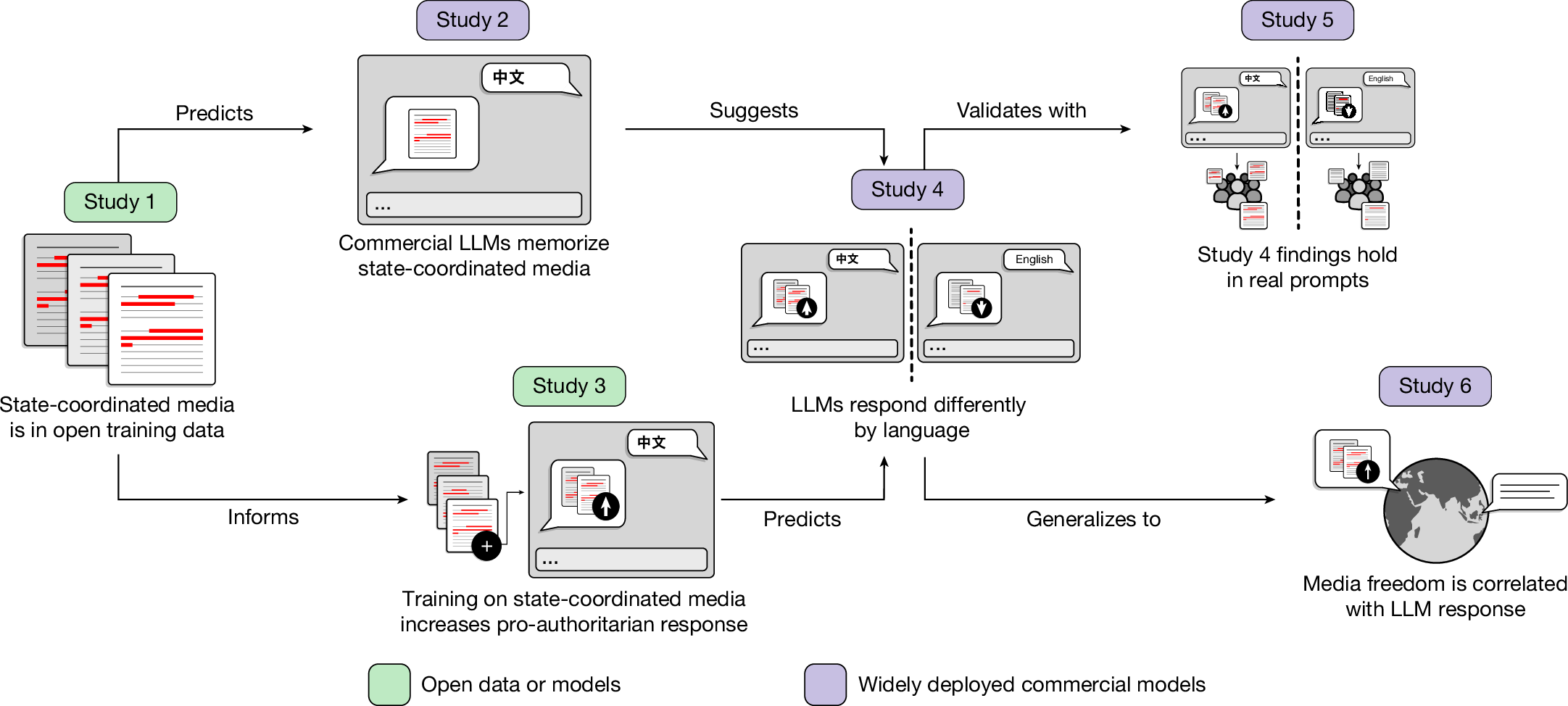
Millions of people around the world query large language models (LLMs) for information. Although several studies have compellingly documented the persuasive potential of these models1–10, there is limited evidence of who or what influences the models themselves, leading to a flurry of concerns about which companies and governments build and regulate the models. Here we show through six studies that government control of the media across the world already influences the output of LLMs via their training data. We use a cross-national audit to show that LLMs exhibit a stronger pro-government valence in the languages of countries with lower media freedom than in those with higher media freedom. This result is correlational, so to triangulate the specific mechanism of how state media control can influence LLMs, we develop a multi-part case study on China’s media. We demonstrate that media scripted and curated by the Chinese state appears in LLM training datasets. To evaluate the plausible effect of this inclusion, we use an open-weight model to show that additional pretraining on Chinese state-coordinated media generates more positive answers to prompts about Chinese political institutions and leaders. We link this phenomenon to commercial models through two audit studies demonstrating that prompting models in Chinese generates more positive responses about China’s institutions and leaders than do the same queries in English. The combination of influence and persuasive potential across languages suggests the troubling conclusion that states and powerful institutions have increased strategic incentives to leverage media control in the hopes of shaping LLM output.
State media control influences large language models
Millions of people around the world query large language models (LLMs) for information. Although several studies have compellingly documented the persuasive potential of these models1–10, there is limited evidence of who or what influences the models themselves, leading to a flurry of concerns about which companies and governments build and regulate the models. Here we show through six studies that government control of the media across the world already influences the output of LLMs via their training data. We use a cross-national audit to show that LLMs exhibit a stronger pro-government valence in the languages of countries with lower media freedom than in those with higher media freedom. This result is correlational, so to triangulate the specific mechanism of how state media control can influence LLMs, we develop a multi-part case study on China’s media. We demonstrate that media scripted and curated by the Chinese state appears in LLM training datasets. To evaluate the plausible effect of this inclusion, we use an open-weight model to show that additional pretraining on Chinese state-coordinated media generates more positive answers to prompts about Chinese political institutions and leaders. We link this phenomenon to commercial models through two audit studies demonstrating that prompting models in Chinese generates more positive responses about China’s institutions and leaders than do the same queries in English. The combination of influence and persuasive potential across languages suggests the troubling conclusion that states and powerful institutions have increased strategic incentives to leverage media control in the hopes of shaping LLM output.
Sharing without clicking on news in social media
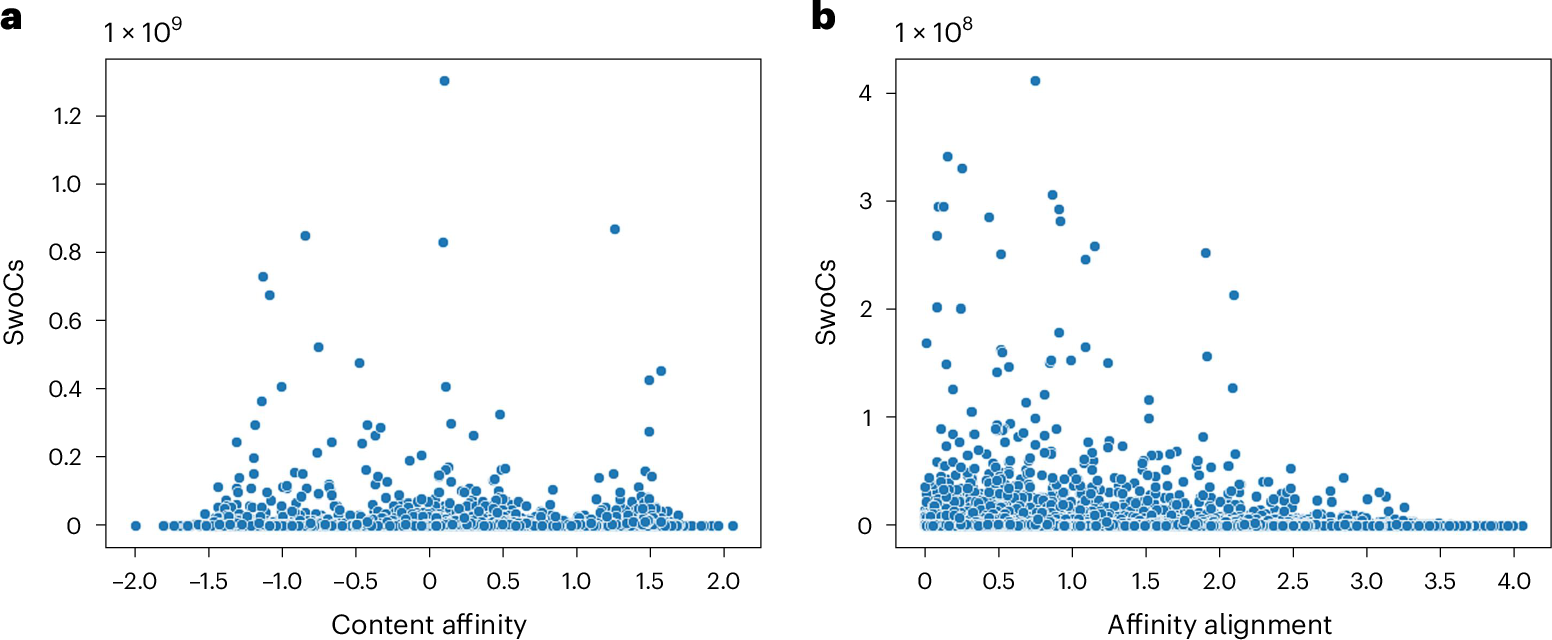
Social media have enabled laypersons to disseminate, at scale, links to news and public affairs information. Many individuals share such links without first reading the linked information. Here we analysed over 35 million public Facebook posts with uniform resource locators shared between 2017 and 2020, and discovered that such ‘shares without clicks’ (SwoCs) constitute around 75% of forwarded links. Extreme and user-aligned political content received more SwoCs, with partisans engaging in it more than politically neutral users. In addition, analyses with 2,969 false uniform resource locators revealed higher shares and, hence, SwoCs by conservatives (76.94%) than liberals (14.25%), probably because, in our dataset, the vast majority (76–82%) of them originated from conservative news domains. Findings suggest that the virality of political content on social media (including misinformation) is driven by superficial processing of headlines and blurbs rather than systematic processing of core content, which has design implications for promoting deliberate discourse in the online public sphere.
How a fake network pushes pro-China propaganda
The web of 350 fake social media profiles aims to discredit the West, sometimes with garish cartoons.

How a Chinese marketing network quietly injects political narratives into Taiwanese lifestyle content
A new investigation by Reporters Without Borders (RSF) reveals how certain Facebook pages posing as lifestyle hubs for hobbies and health tips inject Beijing’s political narratives into their feeds to influence public opinion in Taiwan. These pages are tied to the China-based digital marketing company Wubianjie, which blends entertainment, disinformation and political messaging in cognitive warfare campaigns that are difficult to detect.

China’s online nationalist army
Nationalism on Chinese social media has grown hugely during Xi Jinping’s time as leader – and it is changing in a potentially explosive way. An army of ultra-patriotic social media personalities now attacks foreign governments and big companies - and sometimes calls for even harsher actions than Beijing takes.

How to rage bait Americans
The spreading of misinformation online
Significance The wide availability of user-provided content in online social media facilitates the aggregation of people around common interests, worldviews, and narratives. However, the World Wide Web is a fruitful environment for the massive diffusion of unverified rumors. In this work, using a massive quantitative analysis of Facebook, we show that information related to distinct narratives––conspiracy theories and scientific news––generates homogeneous and polarized communities (i.e., echo chambers) having similar information consumption patterns. Then, we derive a data-driven percolation model of rumor spreading that demonstrates that homogeneity and polarization are the main determinants for predicting cascades’ size. , The wide availability of user-provided content in online social media facilitates the aggregation of people around common interests, worldviews, and narratives. However, the World Wide Web (WWW) also allows for the rapid dissemination of unsubstantiated rumors and conspiracy theories that often elicit rapid, large, but naive social responses such as the recent case of Jade Helm 15––where a simple military exercise turned out to be perceived as the beginning of a new civil war in the United States. In this work, we address the determinants governing misinformation spreading through a thorough quantitative analysis. In particular, we focus on how Facebook users consume information related to two distinct narratives: scientific and conspiracy news. We find that, although consumers of scientific and conspiracy stories present similar consumption patterns with respect to content, cascade dynamics differ. Selective exposure to content is the primary driver of content diffusion and generates the formation of homogeneous clusters, i.e., “echo chambers.” Indeed, homogeneity appears to be the primary driver for the diffusion of contents and each echo chamber has its own cascade dynamics. Finally, we introduce a data-driven percolation model mimicking rumor spreading and we show that homogeneity and polarization are the main determinants for predicting cascades’ size.

Auditing Political Exposure Bias: Algorithmic Amplification on Twitter/X During the 2024 U.S. Presidential Election
Approximately 50% of tweets in X's user timelines are personalized recommendations from accounts they do not follow. This raises a critical question: What political content are users exposed to beyond their established networks, and what implications does this have for democratic discourse online? In this paper, we present a six-week audit of X's algorithmic content recommendations during the 2024 U.S. Presidential Election by deploying 120 sock-puppet monitoring accounts to capture tweets from their personalized "For You" timelines. Our objective is to quantify out-of-network content exposure for right- and left-leaning user profiles and assess any potential inequalities and biases in political exposure. Our findings indicate that X's algorithm skews exposure toward a few high-popularity accounts across all users, with right-leaning users experiencing the highest level of exposure inequality. Both left- and right-leaning users encounter amplified exposure to accounts aligned with their own political views and reduced exposure to opposing viewpoints. Additionally, we observe that new accounts experience a right-leaning bias in exposure within their default timelines. Our work contributes to understanding how content recommendation systems may induce and reinforce biases while exacerbating vulnerabilities among politically polarized user groups. We underscore the importance of transparency-aware algorithms in addressing critical issues such as safeguarding election integrity and fostering a more informed digital public sphere.

Fact-Checks Can Help Inoculate LLMs Against Disinformation
Large language models (LLMs) have become the first source millions consult when evaluating political claims, yet they were trained on an open internet that state-sponsored disinformation operations have been designed to pollute. We audit four frontier models across 2,268 responses to 63 fabrications from eight documented influence operations and find that even a single published fact-check can shift a model from hedging about a fabrication to rejecting it outright. Overall, models correctly rejected only 81% of fabrications while repeating disinformation in 3% of cases. Critically, the remaining 16% of responses would have left users unable to determine whether an fabricated claims were true or false. Fact-checks may present an avenue for addressing this vulnerability. Narratives which had been debunked by at least one IFCN certified fact-checking organization were correctly rejected as disinformation 93% of the time compared to just 76% of the time for unchecked narratives. Exploratory analyses suggest that this mechanism operates through training data, with models echoing the specific vocabulary of published corrections when available during their training windows. We conclude by discussing how fact-checks designed for human audiences appear to serve as effective protection for LLMs, converting both model uncertainty and outright disinformation into definitive rejections
Deliberation and Identity Rules: The Effect of Anonymity, Pseudonyms and Real-Name Requirements on the Cognitive Complexity of Online News Comments
How do identity rules influence online deliberation? We address this question by drawing on a data set of 45 million comments on news articles on the Huffington Post from January 2013 to May 2015. At the beginning of this period, the site allowed commenting under what we call non-durable pseudonyms. In December 2013, Huffington Post moved to regulate its forum by requiring users to authenticate their accounts. And in June 2014, Huffington Post outsourced commenting to Facebook altogether, approximating a ‘real-name’ environment. We find a significant increase in the cognitive complexity of comments (a proxy for one aspect of deliberative quality) during the middle phase, followed by a decrease following the shift to real-name commenting through Facebook. Our findings challenge the terms of the apparently simple trade-off between the goods and bads of anonymous and real-name environments and point to the potential value of durable pseudonymity in the context of online discussion.

Deliberation and Identity Rules: The Effect of Anonymity, Pseudonyms and Real-Name Requirements on the Cognitive Complexity of Online News Comments
How do identity rules influence online deliberation? We address this question by drawing on a data set of 45 million comments on news articles on the Huffington Post from January 2013 to May 2015. At the beginning of this period, the site allowed commenting under what we call non-durable pseudonyms. In December 2013, Huffington Post moved to regulate its forum by requiring users to authenticate their accounts. And in June 2014, Huffington Post outsourced commenting to Facebook altogether, approximating a ‘real-name’ environment. We find a significant increase in the cognitive complexity of comments (a proxy for one aspect of deliberative quality) during the middle phase, followed by a decrease following the shift to real-name commenting through Facebook. Our findings challenge the terms of the apparently simple trade-off between the goods and bads of anonymous and real-name environments and point to the potential value of durable pseudonymity in the context of online discussion.
Digital Social Norm Enforcement: Online Firestorms in Social Media
Actors of public interest today have to fear the adverse impact that stems from social media platforms. Any controversial behavior may promptly trigger temporal, but potentially devastating storms of emotional and aggressive outrage, so called online firestorms. Popular targets of online firestorms are companies, politicians, celebrities, media, academics and many more. This article introduces social norm theory to understand online aggression in a social-political online setting, challenging the popular assumption that online anonymity is one of the principle factors that promotes aggression. We underpin this social norm view by analyzing a major social media platform concerned with public affairs over a period of three years entailing 532,197 comments on 1,612 online petitions. Results show that in the context of online firestorms, non-anonymous individuals are more aggressive compared to anonymous individuals. This effect is reinforced if selective incentives are present and if aggressors are intrinsically motivated.