Costly failures of talent management—such as hiring the wrong people for the wrong reasons or creating perverse incentives—can frequently be traced to the earliest point in the recruitment process: designing the job. It’s easy to get that wrong. Too often, executives bundle contradictory tasks without considering how the job description will influence who applies or […]
How to Hire
Most companies approach hiring with faulty assumptions and poor practices. They believe talent is fixed rather than contextual. They fail to create real partnerships between internal recruiters and hiring managers. And they rely too much on salary surveys and rigid compensation formulas. The author shares what she learned about making and keeping great hires during her 14 years as the chief talent officer at Netflix. The process requires probing beneath the surface of people and their résumés; engaging managers in every aspect of hiring; ensuring that recruiters deeply understand the business and are not viewed as support staff; adopting a mindset in which you’re always recruiting; and coming up with compensation that suits the performance you need and the future you aspire to. These lessons may be especially relevant to fast-growing tech-based firms, whose rapid innovation means a continual need for new talent. But organizations of all types can benefit from taking a fresh look at their hiring and compensation practices.

Don't hire top talent; hire for weaknesses. - Benji's Blog
Design your hiring process to find the right people to strengthen your teams' weaknesses, rather than trying to find the best people. Instead of "how can we find the smartest people?" think about "how can we find the people who will make our team stronger?"
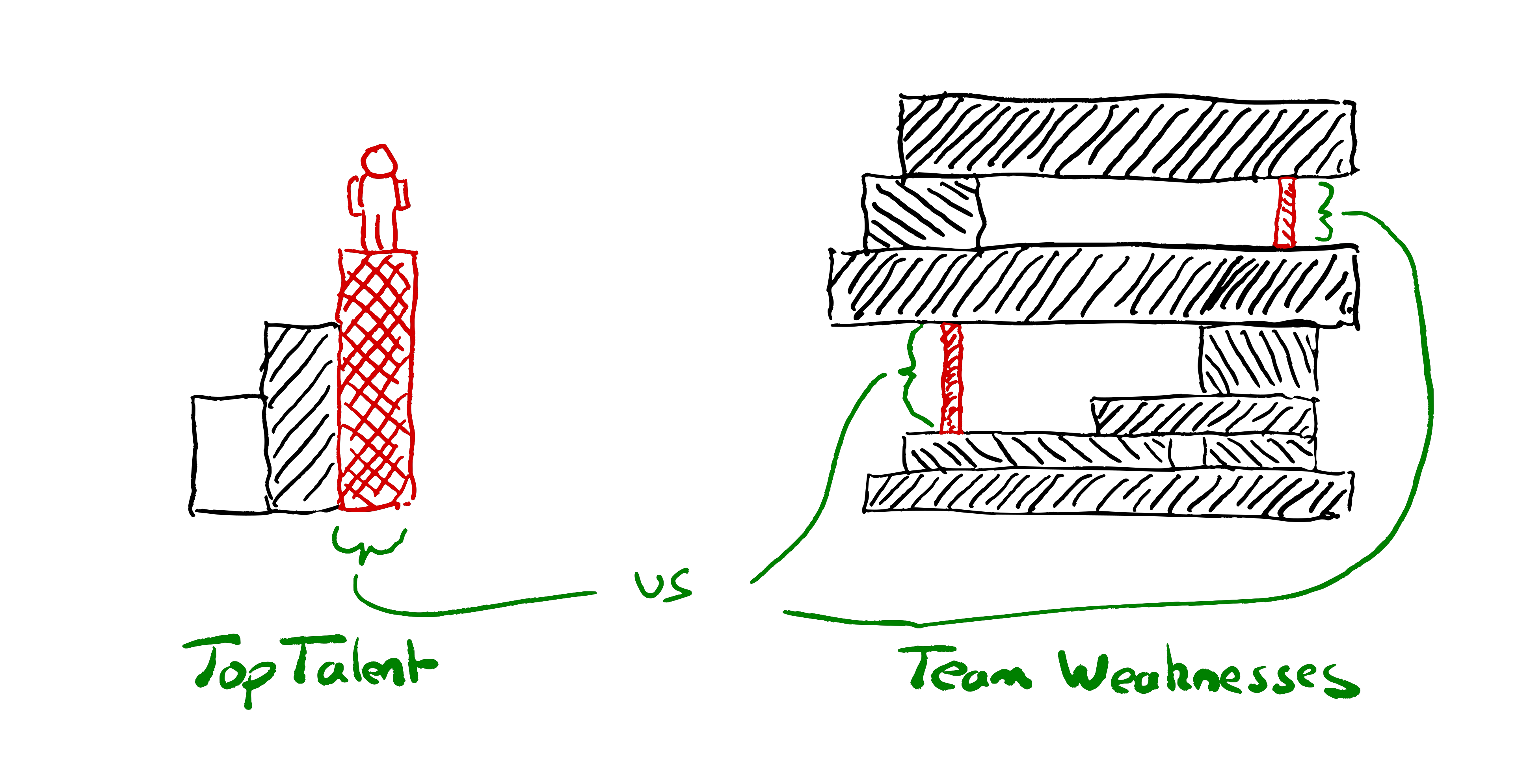
Don't hire top talent; hire for weaknesses. - Benji's Blog
Design your hiring process to find the right people to strengthen your teams' weaknesses, rather than trying to find the best people. Instead of "how can we find the smartest people?" think about "how can we find the people who will make our team stronger?"
Manufacturing the Talent Shortage
How our assumptions about the skill and capability of our technical workforce keeps us from building more diverse -- and more successful -- organizations.

How to write (actually) good job descriptions
Ask yourself: Am I trying to attract the right people or keep out the wrong people? It's impossible to do both.

Why Hiring the 'Best' People Produces the Least Creative Results - Slashdot
An anonymous reader shares an excerpt from a report written by Scott E. Page, who explains why hiring the "best" people produces the least creative results: The burgeoning of teams -- most academic research is now done in teams, as is most investing and even most songwriting (at least for the good s...

We need to shift our focus from competencies to agency
Knowledge work is characterized by variety and exception rather than predictability and routine. Work corresponds more with creative and…

A belief in meritocracy is not only false: it’s bad for you | Aeon Ideas
The belief that hard work and talent make for success is not only false, it encourages selfishness and discrimination too
Staff archetypes
Most career ladders define a single, uniform set of expectations for Staff engineers operating within the company. Everyone benefits from clear role expectations, but career ladders are a tool that applies better against populations than people. This is particularly true for Staff-plus engineers, whose career ladders often paper over several distinct roles hidden behind a single moniker. The more folks I spoke with about the role of Staff-plus engineers at their company, the better their experiences began to cluster into four distinct patterns. Most companies emphasized one or two of the patterns, and one pattern only existed in companies with many hundreds or thousands of engineers. A few companies didn’t feature any technical leadership pattern and pushed all their experienced engineers towards engineering management. In literature, recurring character patterns are called archetypes, such as the “hero” or the “trickster,” and the archetype term is helpful for labeling these frequent variants of Staff-plus engineers.
Intentions have a surprising amount of detail
Auteur managerialism, the myth of one-shotting, and the chindogufication of engineering

A Practical Model for Jobs To Be Done (JTBD)
“People don’t want a quarter-inch drill, they want a quarter-inch hole” – Theodore Levitt The concept of jobs to be done provides a lens through which to understand value creation. The approach loo…

Researcher’s Vow of Chastity
Changing creative output by imposing constraints in the production process
Arbitrary Deadlines Are the Enemy of Creativity, According to Harvard Research - Slashdot
Time can feel like the enemy to an employee in any role, and in any industry, but it's most acutely threatening to creative types. From a report: We may tease them for their diva-like behaviors when they feel persecuted by a deadline, but we have to admit that "develop an amazing new idea" is not so...

Push Me Until I Break: The Effects of Unrealistic Expectations on Marginalized Workers in Tech
One must consider if this pressure is put on creators specifically to see them fail.

Job Descriptions Should Be Better
Most job descriptions are terrible. We need to make them better.

The One Method I've Used to Eliminate Bad Tech Hires - Mattermark
Let’s be real. Interviews are a terrible way to hire tech candidates. Here’s why paying candidates to solve problems works.