

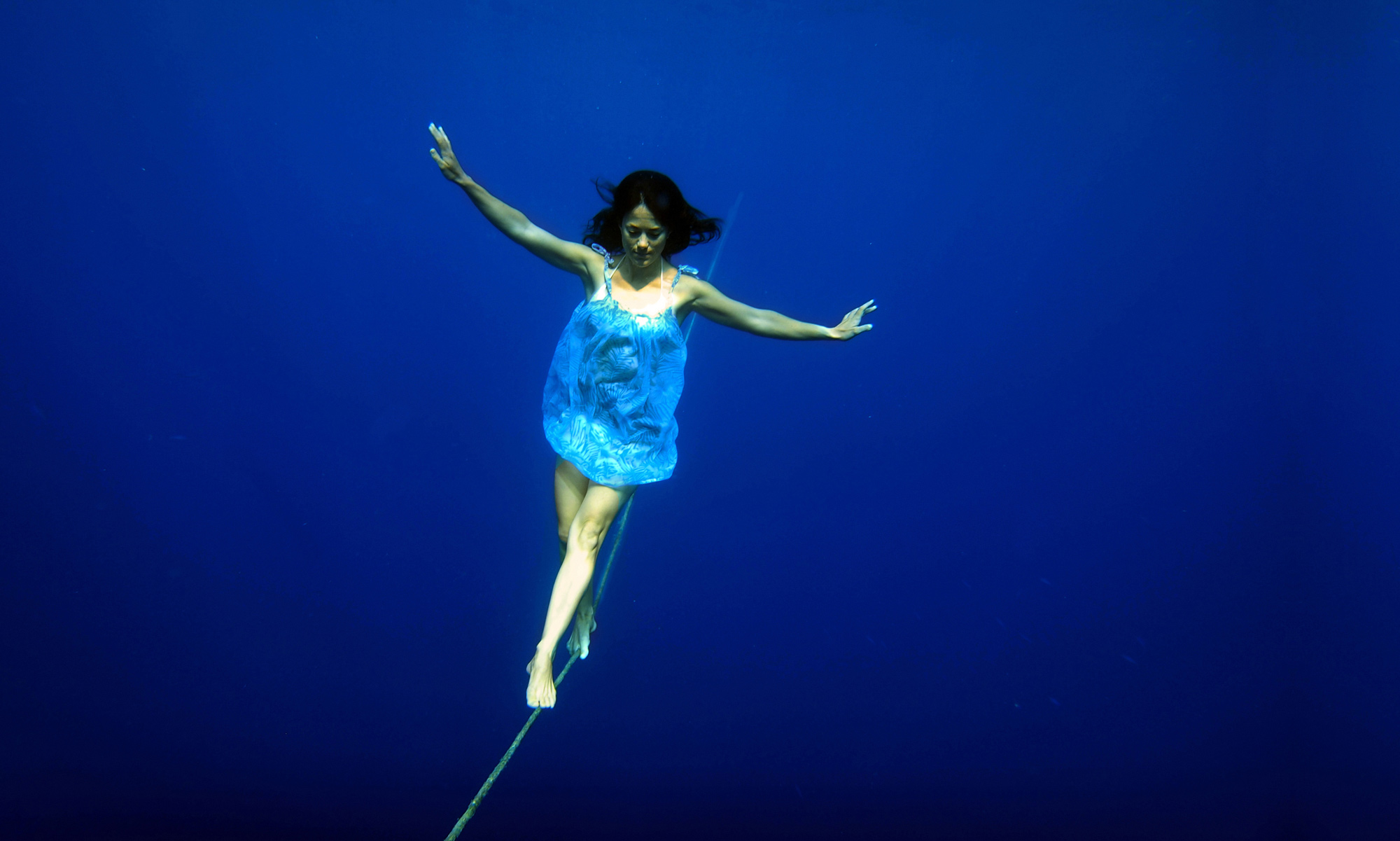
Journalist James Nestor explores the science of the “mammalian dive reflex,” the phenomenon by which water triggers an immediate decrease in heart rate.
Cold-Water Swimming | Hacker News
I find the first few minutes of the swim are the hardest, as your body is adjusting to the cold, surface blood vessels are constricting, etc. The next 5-15 minutes are fantastic! I don't usually push it much beyond that.
Opinion | What Swimming Taught Me About Happiness (Published 2019)
Lesson No. 1: It’s not about how fast you can go.

The Heart of a Swimmer vs. the Heart of a Runner (Published 2019)
Regular exercise changes the look and workings of the human heart. And researchers are discovering that different sports affect the heart differently.

Water Rhythms | Susie Ibarra
Water rhythms is a story of climate change told by ice and water. It is a story about the dualism of water, the universal connector of nature and humans. It is also an intergenerational story of the rapid change and depletion of our glaciers and freshwater sources worldwide.

Wild swimming: health miracle or a high-risk pastime?
More people than ever are taking to rivers and lakes, but experts are increasingly advising caution before an outdoor dip
The Neurobiology of Grace Under Pressure
Discover eight ways to stimulate your vagus nerve, which produces a calm, confident, and optimal state of mind and body for peak performance.

The Environmental Impacts of AI -- Primer
A Blog post by Sasha Luccioni on Hugging Face

Atswim | Swimming, in the open
Explore public pool-swimming activities published on ATproto.

Extraordinary Passion: Arousal, Imagery, and Breath Control
Sex, science, and Tantra - how to have incredible orgasms and amazing sex, and a completely non-spiritual look at why Tantra has such amazing effects.
There's even more evidence that one type of exercise is the closest thing we have to a miracle drug
Aerobic exercise, which raises your heart rate for a sustained period, is "key for your head, just as it is for your heart," researchers say.
Nobel prize for the heart of cell signaling
Chemistry prize for understanding how cells sense their environment.

New study reveals psychological and physiological changes associated with Navy SEAL training
Becoming a U.S. Navy SEAL is a notoriously difficult and arduous task, but how does being trained for something like that change you? A study published in Physiology and Behavior explores the psychological and physiological changes associated with training to become a Navy SEAL.

Journal of Applied Physiology
<p>The <em>Journal of Applied Physiology</em> publishes original papers that deal with diverse areas of research in applied physiology, especially those papers emphasizing adaptive and integrative mechanisms. Adaptive physiology includes 1) inherent adaptations such as those related to development, aging, and pathophysiological conditions and 2) adaptations to the external environment such as those occurring with exercise, microgravity, hypoxia, hypo- and hyperbaria, and hypo- and hyperthermic conditions. Integrative physiology includes 1) horizontal integration across organ systems and 2) vertical integration from molecule to cell to organ. In all areas of applied physiology, the use of cutting-edge techniques including molecular and cellular biology is strongly encouraged.</p><p>The wide scientific span of the Journal rests on physiology as its keystone. However, the boundaries of physiology have enlarged as demarcations between concepts and techniques in the physiological, pharmacological, and biochemical sciences become increasingly blurred. Moreover, theoretical articles on research at any level of biological organization ranging from molecules to humans fall within the broad scope of the Journal. Papers dealing with topics in other basic sciences that impinge on physiology are also welcome.</p>

This 5-Minute Breathing Exercise Lowers Blood Pressure as Much as Drugs or Exercise
Take a deep breath.
Physical and Mental Effects of Bathing: A Randomized Intervention Study
Showering is the most common form of bathing worldwide. Whole-body immersion bathing in warm water (~40°C) is common in Japan and exerts sufficient hyperthermic action to induce vasodilatation and increase blood flow, supplying more oxygen and nutrients to the periphery. Cross-sectional studies report better subjective health status with an immersion bathing habit. This randomized controlled trial compared the effects on health of immersion bathing and shower bathing in 38 participants who received 2-week intervention of immersion bathing in warm water (40°C) for 10 min (bathing intervention) followed by 2-week shower bathing without immersion (showering intervention) or vice versa (n = 19 each group). Visual analog scale scores were significantly better for fatigue, stress, pain, and smile and tended to be better for self-reported heath and skin condition after bathing intervention than after showering intervention. The SF-8 Health Survey showed significantly better general health, mental health, role emotional, and social functioning scores. Profile of Mood State scores were lower for stress, tension-anxiety, anger-hostility, and depression-dejection. Immersion bathing, but not shower bathing, exerts hyperthermic action that induces increased blood flow and metabolic waste elimination, which may afford physical refreshment. Immersion bathing should improve both physical and emotional aspects of quality of life.
The physiological effects of Shinrin-yoku (taking in the forest atmosphere or forest bathing): evidence from field experiments in 24 forests across Japan
This paper reviews previous research on the physiological effects of Shinrin-yoku (taking in the forest atmosphere or forest bathing), and presents new results from field experiments conducted in 24 forests across Japan. The term Shinrin-yoku was coined by the Japanese Ministry of Agriculture, Forestry, and Fisheries in 1982, and can be defined as making contact with and taking in the atmosphere of the forest. In order to clarify the physiological effects of Shinrin-yoku, we conducted field experiments in 24 forests across Japan. In each experiment, 12 subjects (280 total; ages 21.7 ± 1.5 year) walked in and viewed a forest or city area. On the first day, six subjects were sent to a forest area, and the others to a city area. On the second day, each group was sent to the other area as a cross-check. Salivary cortisol, blood pressure, pulse rate, and heart rate variability were used as indices. These indices were measured in the morning at the accommodation facility before breakfast and also both before and after the walking (for 16 ± 5 min) and viewing (for 14 ± 2 min). The R–R interval was also measured during the walking and viewing periods. The results show that forest environments promote lower concentrations of cortisol, lower pulse rate, lower blood pressure, greater parasympathetic nerve activity, and lower sympathetic nerve activity than do city environments. These results will contribute to the development of a research field dedicated to forest medicine, which may be used as a strategy for preventive medicine.
