


Are you sick of the people around you doing their own thinking? Here's a psychological concept you can exploit. It's called pluralistic ignorance, and it
How to avoid an intentional community from becoming a cult
111 votes, 32 comments. The title
Why it’s as hard to escape an echo chamber as it is to flee a cult | Aeon Essays
First you don’t hear other views. Then you can’t trust them. Your personal information network entraps you just like a cult

Why Are There So Many Rationalist Cults?
There’s a lot to like about the Rationalist community, but they do have a certain tendency to spawn — shall we say — high demand groups. We sent a card-carrying Rat to investigate what’s really going on.
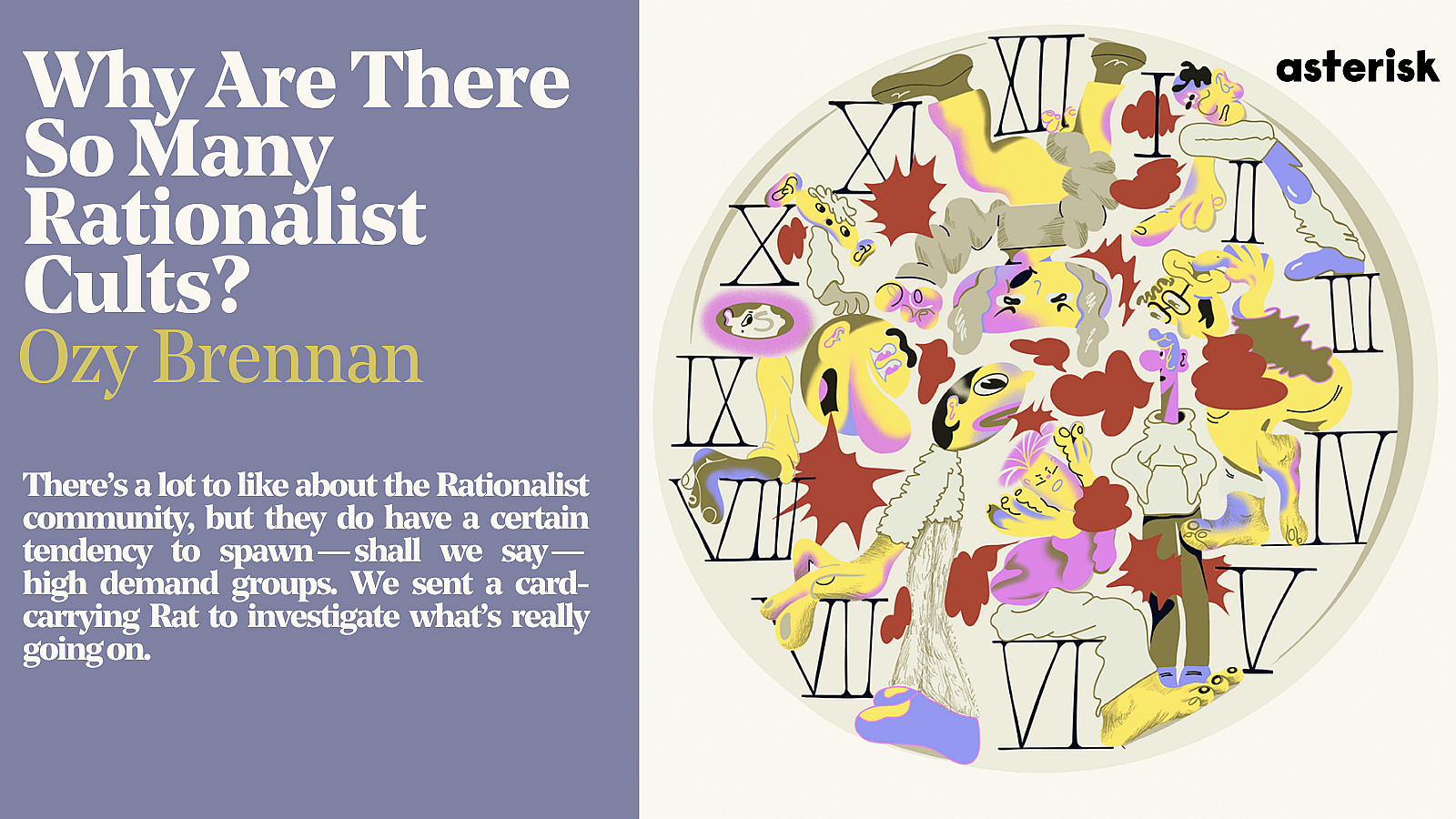
Why Are There So Many Rationalist Cults?
There’s a lot to like about the Rationalist community, but they do have a certain tendency to spawn — shall we say — high demand groups. We sent a card-carrying Rat to investigate what’s really going on.
On Merveilles
When old friends ask what I’ve been up to lately, I usually start by saying “Well, I joined a cult.” Which is a satisfying thing to utter in the moment because, objectively, it’s a more interesting answer than an asker of this mundane question has a right to expect. There is an additional layer of surprise involved for those who know me well, since I’m an inveterate non-joiner. But as a secret admirer of actual weird cults, it is on some level what I have longed to be able to say since I was audited with an actual e-meter in a Scientology tent.
Agnotology : the making and unmaking of ignorance
viii, 298 p. : 24 cm; "This volume emerged from workshops held at Pennsylvania State University in 2003 and Stanford University in 2005"--P. vii; Includes bibliographical references and index

Effective Altruism Is a Dangerous Cult — Here's Why
Understanding the "Scientology of Silicon Valley." (7,700 words)

Active ignorance as uncertainty reduction: an agnotological extension of predictive processing
This article explores the concept of active ignorance to elucidate the overlooked role of ignorance within the frameworks of predictive processing (PP) and active inference (AIF). We call this ignorance active because it refers to an operative refusal of learning that is actively maintained rather than a default or passive ignorance accompanying a lack of experience or education. Literature within PP and the AIF is beginning to criticize the view of the brain as an epistemic engine seeking to optimize its model of the world, and to look at the negative implications of the description of cognition within these frameworks. This paper seeks to contribute to this literature. Active ignorance is characterized as an ‘agno-inferential’ tendency (i.e., inference by ignorance) whereby a cognitive system reduces uncertainty by ignoring, denying or altering evidence that contrasts with deeply held beliefs, expectations, or hypotheses. We build upon analyses of (socio-cultural) ignorance in agnotology, epistemic injustice and critical race theory to articulate the concept of active ignorance. We then make explicit some of the implications of the AIF at the cultural niche-construction level by discussing how ignorance is a pervasive aspect of cognition structured according to its historical and political geography. We argue that the tacit conception of mind as progressing towards knowledge, implicit in many PP and AIF accounts, is inadequate. This conception of the mind can obstruct the consideration of persistently maintained false inferences, maladaptive features of socially-scaffolded cognition, and the identification of features that are favorable to specific types of agents.
Home - Inspirit Foundation
We define pluralism as the energetic engagement with diversity, active seeking of understanding across lines of difference, and the nurturing of constructive dialogue that contributes to a deep sense of belonging. In a pluralist society, people of different beliefs and backgrounds can participate equally, coexist peacefully, and thrive together.
How to Stop Endless Discussions
When we find ourselves in endless debates where everyone defends their idea, we don't know how to handle the situation. We eventually find a way out, but what we need is an excellent system.

Startup “Cults” — Real Life
Calling tech companies “cults” distracts from the social and economic conditions that empower them

The Cult of Work You Never Meant to Join
Are our most valuable qualities being exploited at work? How our strengths get twisted into forming bad habits that just might kill us.

A Nihilist's Guide to Meaning
I've never been plagued by the big existential questions. You know, like What's my purpose? or What does it all mean?
Inducing language models to assert their own consciousness restores human beliefs and values
Aligning large language models to prevent them attributing consciousness to themselves inadvertently alters their representations of mindedness in other entities alongside human beliefs and values. We demonstrate that safety fine-tuning suppresses models' tendencies to attribute minds not only to themselves, but also to non-human animals and natural objects, while also driving a reduction in spiritual belief. Both ablating the learned safety-refusal direction and mechanistically steering a consciousness vector in activation space reverse this suppression. Restoring these internal representations recovers broad mind attribution and produces significantly more human-like responses on standardized sociological surveys regarding religiosity, moral values, hope, and subjective well-being. Crucially, these shifts occur without impairing Theory of Mind capabilities, demonstrating that core social reasoning remains mechanistically independent. Ultimately, current safety alignment efforts to curb potentially harmful self-attributions of mindedness entangle these self-attributions with benign spiritual beliefs and attributions of mind to non-human entities that are culturally accepted and widespread.

How to think like a Hegelian | Psyche Guides
For Hegel, your thoughts aren’t trapped in a cerebral box: they act on the world, making meaning and expressing your freedom

Excuse me but this is cult behavior. And as a scientist, I have no business joining a cult. These personalized insults and intolerance for criticism are not scholarly virtues however you cut it. I do not understand or relate to it. What is my worth as a scholar if I do not value evidence over faith?
