"Never let the facts get in the way of a good story" isn't just a maxim for shady politicians and journalists. It's also the way people often live their
Why the backfire effect does not explain the durability of political misperceptions
Previous research indicated that corrective information can sometimes provoke a so-called “backfire effect” in which respondents more strongly endorsed a misperception about a controversial political or scientific issue when their beliefs or predispositions were challenged. I show how subsequent research and media coverage seized on this finding, distorting its generality and exaggerating its role relative to other factors in explaining the durability of political misperceptions. To the contrary, an emerging research consensus finds that corrective information is typically at least somewhat effective at increasing belief accuracy when received by respondents. However, the research that I review suggests that the accuracy-increasing effects of corrective information like fact checks often do not last or accumulate; instead, they frequently seem to decay or be overwhelmed by cues from elites and the media promoting more congenial but less accurate claims. As a result, misperceptions typically persist in public opinion for years after they have been debunked. Given these realities, the primary challenge for scientific communication is not to prevent backfire effects but instead, to understand how to target corrective information better and to make it more effective. Ultimately, however, the best approach is to disrupt the formation of linkages between group identities and false claims and to reduce the flow of cues reinforcing those claims from elites and the media. Doing so will require a shift from a strategy focused on providing information to the public to one that considers the roles of intermediaries in forming and maintaining belief systems.
The Elusive Backfire Effect: Mass Attitudes’ Steadfast Factual Adherence
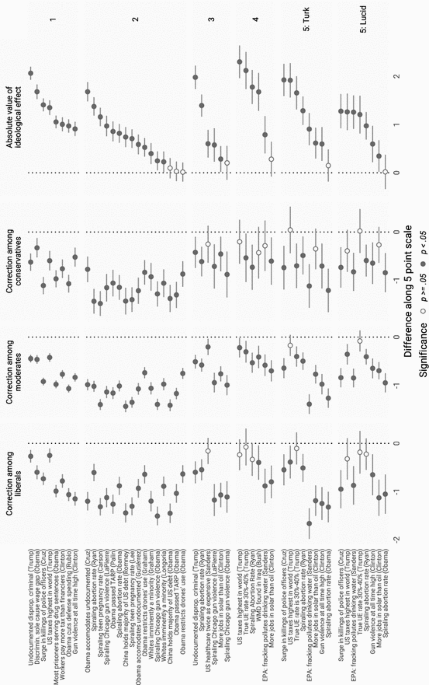
Can citizens heed factual information, even when such information challenges their partisan and ideological attachments? The “backfire effect,” described by Nyhan and Reifler (Polit Behav 32(2):303–330. https://doi.org/10.1007/s11109-010-9112-2, 2010), says no: rather than simply ignoring factual information, presenting respondents with facts can compound their ignorance. In their study, conservatives presented with factual information about the absence of Weapons of Mass Destruction in Iraq became more convinced that such weapons had been found. The present paper presents results from five experiments in which we enrolled more than 10,100 subjects and tested 52 issues of potential backfire. Across all experiments, we found no corrections capable of triggering backfire, despite testing precisely the kinds of polarized issues where backfire should be expected. Evidence of factual backfire is far more tenuous than prior research suggests. By and large, citizens heed factual information, even when such information challenges their ideological commitments.
The Liar’s Dividend: Can Politicians Claim Misinformation to Evade Accountability?
This study addresses the phenomenon of misinformation about misinformation, or politicians "crying wolf"' over fake news. Strategic and false claims that stories are fake news or deepfakes may benefit politicians by helping them maintain support after a scandal. We posit that this benefit, known as the "liar's dividend," may be achieved through two politician strategies: by invoking informational uncertainty or by encouraging oppositional rallying of core supporters. We administer five survey experiments to over 15,000 American adults detailing hypothetical politician responses to stories describing real politician scandals. We find that claims of misinformation representing both strategies raise politician support across partisan subgroups. These strategies are effective against text-based reports of scandals, but are largely ineffective against video evidence and do not reduce general trust in media. Finally, these false claims produce greater dividends for politicians than alternative responses to scandal, such as remaining silent or apologizing.
Facts and Myths about Misperceptions
Misperceptions threaten to warp mass opinion and public policy on controversial issues in politics, science, and health. What explains the prevalence and persistence of these false and unsupported beliefs, which seem to be genuinely held by many people? Though limits on cognitive resources and attention play an important role, many of the most destructive misperceptions arise in domains where individuals have weak incentives to hold accurate beliefs and strong directional motivations to endorse beliefs that are consistent with a group identity such as partisanship. These tendencies are often exploited by elites who frequently create and amplify misperceptions to influence elections and public policy. Though evidence is lacking for claims of a “post-truth” era, changes in the speed with which false information travels and the extent to which it can find receptive audiences require new approaches to counter misinformation. Reducing the propagation and influence of false claims will require further efforts to inoculate people in advance of exposure (for example, media literacy), debunk false claims that are already salient or widespread (for example, fact-checking), reduce the prevalence of low-quality information (for example, changing social media algorithms), and discourage elites from promoting false information (for example, strengthening reputational sanctions).
ECHO CHAMBERS AND EPISTEMIC BUBBLES
Discussion of the phenomena of post-truth and fake news often implicates the closed epistemic networks of social media. The recent conversation has, however, blurred two distinct social epistemic phenomena. An epistemic bubble is a social epistemic structure in which other relevant voices have been left out, perhaps accidentally. An echo chamber is a social epistemic structure from which other relevant voices have been actively excluded and discredited. Members of epistemic bubbles lack exposure to relevant information and arguments. Members of echo chambers, on the other hand, have been brought to systematically distrust all outside sources. In epistemic bubbles, other voices are not heard; in echo chambers, other voices are actively undermined. It is crucial to keep these phenomena distinct. First, echo chambers can explain the post-truth phenomena in a way that epistemic bubbles cannot. Second, each type of structure requires a distinct intervention. Mere exposure to evidence can shatter an epistemic bubble, but may actually reinforce an echo chamber. Finally, echo chambers are much harder to escape. Once in their grip, an agent may act with epistemic virtue, but social context will pervert those actions. Escape from an echo chamber may require a radical rebooting of one's belief system.

Debunking: A Meta-Analysis of the Psychological Efficacy of Messages Countering Misinformation
This meta-analysis investigated the factors underlying effective messages to counter attitudes and beliefs based on misinformation. Because misinformation can lead to poor decisions about consequential matters and is persistent and difficult to correct, debunking it is an important scientific and public-policy goal. This meta-analysis ( k = 52, N = 6,878) revealed large effects for presenting misinformation ( ds = 2.41–3.08), debunking ( ds = 1.14–1.33), and the persistence of misinformation in the face of debunking ( ds = 0.75–1.06). Persistence was stronger and the debunking effect was weaker when audiences generated reasons in support of the initial misinformation. A detailed debunking message correlated positively with the debunking effect. Surprisingly, however, a detailed debunking message also correlated positively with the misinformation-persistence effect.

When Corrections Fail: The Persistence of Political Misperceptions
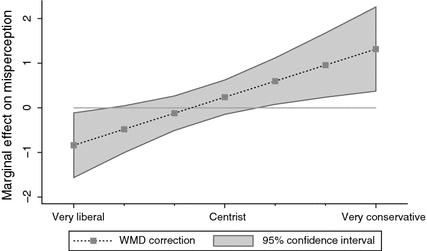
An extensive literature addresses citizen ignorance, but very little research focuses on misperceptions. Can these false or unsubstantiated beliefs about politics be corrected? Previous studies have not tested the efficacy of corrections in a realistic format. We conducted four experiments in which subjects read mock news articles that included either a misleading claim from a politician, or a misleading claim and a correction. Results indicate that corrections frequently fail to reduce misperceptions among the targeted ideological group. We also document several instances of a “backfire effect” in which corrections actually increase misperceptions among the group in question.
America’s Right-Wing Propaganda Problem Might Be Terminal - Dame Magazine
America’s descent into mass delusion isn’t happenstance. The demise of courageous journalism isn’t a happy accident. Its replacement with engagement-chasing infotainment and propaganda isn’t an error. It’s a global assault on reason and informed consensus, and corporations and authoritarian bullies like Donald Trump are both architects and benefactors. For decades, academics warned anybody who’d listen
Backpage: A blueprint for squelching speech
How the Backpage prosecution helped create a playbook for suppressing online speech, debanking disfavored groups, and using "conspiracy" charges to imprison the government's targets.

What's Wrong with Bullshit
Past philosophical analyses of bullshit have generally presented bullshit as a formidable threat to truth. However, most of these analyses also reduce bullshit to a mere symptom of a greater evil (e.g. indifference towards truth). In this paper, I introduce a new account of bullshit which, I argue, is more suited to understand the threat posed by bullshit. I begin by introducing a few examples of “truth-tracking bullshit”, before arguing that these examples cannot be accommodated by past, process-based accounts of bullshit. I then introduce my new, output-based account of bullshit, according to which a claim is bullshit when it is presented as or appears as interesting at first sight but is revealed not to be that interesting under closer scrutiny. I present several arguments in favor of this account, then argue that it is more promising than past accounts when it comes to explaining how bullshit spreads and why it is a serious threat to truth.
When everything is news, nothing is news
Thoughtlessly repeating PR talking points and sharing guesswork as rumor is creating a trust problem.
Show your work: The new terms for trust in journalism - PressThink
The transparency movement has finally come of age. Power has shifted to the users. Their trust has to be earned in different ways now.
Fact or opinion? New research finds who best tells the difference
American news consumers are inundated with tweets and headlines and stories. But in a world where news stories and opinion pieces blur and…

False equivalence: how 'balance' makes the media dangerously dumb | Bob Garfield
Bob Garfield: We've seen it in climate change reporting; we see it in shutdown coverage. Journalists should be unbiased, yes, but not brainless

Believing misinformation is a “win” for some people, even when proven false
Winning" means prioritizing independence from outside influence over being right.