


With time we are meant to gain experience. This doesn't always seem to be the case. Recency biases show we don't learn over time so much as remember the
Stories, Statistics, and Memory
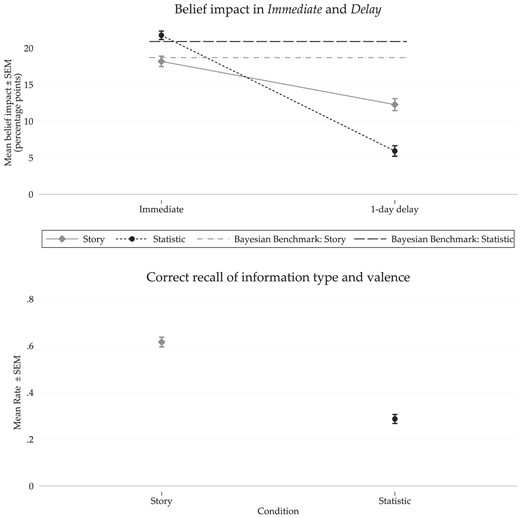
Abstract For many decisions, we encounter relevant information over the course of days, months, or years. We consume such information in various forms, including stories (qualitative content about individual instances) and statistics (quantitative data about collections of observations). This article proposes that information type—story versus statistic—shapes selective memory. In controlled experiments, we document a pronounced story-statistic gap in memory: the average impact of statistics on beliefs fades by 73% over the course of a day, but the impact of a story fades by only 32%. Guided by a model of selective memory, we disentangle different mechanisms and document that similarity relationships drive this gap. Recall of a story increases when its qualitative content is more similar to a memory prompt. Irrelevant information in memory that is similar to the prompt, on the other hand, competes for retrieval with relevant information, impeding successful recall.
The Brain Can Recall and Reawaken Past Immune Responses | Quanta Magazine
The brain not only helps to regulate immune responses, but also stores and retrieves “memories” of them.

MIT neuroscientist: The No. 1 skill that sets people with ‘excellent memory’ apart from those who struggle—'it's rare'
Memory skills vary from one person to another. MIT Sloan neuroscientist Dr. Tara Swart Bieber shares how she trains her brain to prevent memory decline as we age.

Our Brains Keep Us 15 Seconds 'in The Past' to Help Us See a Stable World, Says Study
The past is present.

False Memories Can Form Within Seconds, Study Finds - Slashdot
In a new study, scientists found that it's possible for people to form false memories of an event within seconds of it occurring. This almost-immediate misremembering seems to be shaped by our expectations of what should happen, the team says. Gizmodo reports: "This study is unique in two ways, in ...

False Memories Can Form Within Seconds, Study Finds
It's not just distant recollections that can fool you.

Excess Capacity Learning
How do humans learn from experience? Traditionally, cognitive scientists have assumed that discovering generalizable patterns requires that humans compress rich and noisy experiences. However, recent computer science results suggest otherwise — systems can learn by ‘overfitting’ and expanding all the details of their experiences. We offer a new perspective on learning based on a cognitive system’s representational capacity, which can be constrained (forcing the system to compress details of past experiences), sufficient (to memorize past experiences), or excess (allowing the system to expand on the details of past experiences). This framework has implications for understanding learning across cognitive, clinical, and developmental contexts.
To Remember, the Brain Must Actively Forget | Quanta Magazine
Researchers find evidence that neural systems actively remove memories, suggesting that forgetting may be the default mode of the brain.
Keep Forgetting Things? Neuroscience Says These 8 Brain Habits Improve Memory and Leadership
A brief introduction to some of the most interesting studies from the past couple of years.

Why Time Slows Down When We’re Afraid, Speeds Up as We Age, and Gets Warped on Vacation
“Time perception matters because it is the experience of time that roots us in our mental reality.”
Excess Capacity Learning
We introduce a new framework for understanding how cognitive systems (e.g., humans) learn from experience, based on the concept of representational capacity—the relative amount of representational resources devoted to encoding past experiences. Most paradigms in cognitive science have operated under the assumption that these resources are constrained, forcing cognitive systems to compress rich and noisy experiences to effectively generalize to new situations. We leverage recent advances in computer science to outline the implications of learning with excess capacity, or applying even more representational resources than needed to perfectly memorize all the details of one’s past experiences. In particular, we review evidence suggesting that excess capacity systems can exhibit many of the characteristics of human learning, such as the simultaneous ability to memorize individual experiences and generalize knowledge to new situations. We define and differentiate between constrained (not enough), sufficient (just enough), and excess (more than enough to perfectly capture all the details of one’s past experiences) capacity. We derive empirical properties of learning in each of these capacity regimes, and compare these predictions to effects documented for human learning. We highlight the broad implications of this framework for advancing theoretical and empirical work across cognitive, clinical, and developmental psychology.
Is the Memory Shortage Intentional? | Contrary Research
A deep dive from Contrary Research.

False memories arise because the brain codes similar ideas similarly
Efficiency In neural storage allows false memories to arise.
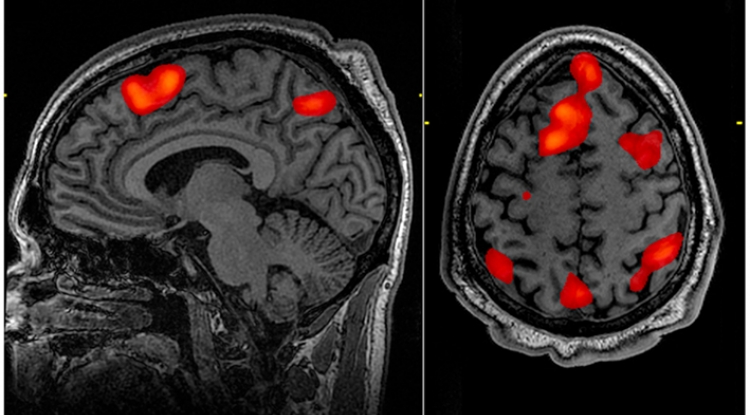
“Infantile amnesia” occurs despite babies showing memory activity
It looks like humans actively suppress our earliest memories.

Keep Forgetting Things? Neuroscience Says This Memory-Fixing Brain Habit Works Best
'The results were incontrovertible ... regular, engaged reading strengthened older adults' memory skills.'

People are not friction
The Gell-Mann Amnesia Effect of AI is a pretty well documented phenomenon: The Gell-Mann amnesia effect is a cognitive bias describing the tendency of individuals to critically assess media reports in a domain they are knowledgeable about, yet continue to trust reporting in other areas despite recognizing similar potential inaccuracies.