


Dealing with people who exhibit passive-aggressive behavior is easily one of the most challenging aspects of our social lives. Here’s what you need to
Stop Passive-Aggressive Behavior and Strengthen Relationships With This 6-Word Phrase
To stop passive aggression—in yourself or others—remember these words.

Study finds 'toxic' employees hurt everyone at work
Work can be busy enough -- no one needs to waste their time avoiding colleagues behaving badly. But new research shows that employees who are excessively confident, or are bullies, or who exhibit any number of bad behaviors might be worth skirting...

Movement Narcissism: A Warning and A Guide | New Archives
Narcissistic abuse is most often discussed in interpersonal relationships, especially when it comes to romantic relationships. However, I would venture that narcissistic abuse is not just contained to romantic relationships, but that narcissists find their platonic targets in social and group environments. Within progressive social movements, this is unfortunately true. Our current activist narratives about charismatic leadership and heroism attract individuals who see social movements as another way of satisfying their need for attention and power.
Social cognition and interpersonal violence
Why do some people resort to violence while others in similar circumstances do not? Drawing on 99 in-depth interviews with men from high-violence Chicago neighborhoods who participated in a community violence intervention, we examine how past exposure to violence shapes the social cognitions that influence future involvement in violence—through the schemas and scripts people use to interpret social situations and guide behavior. We identify three specific social cognitions that respondents associated with violence: misconstruing ambiguous cues as threats, defaulting to a narrow set of behavioral responses, and attributing violent behavior to fixed personal traits rather than situational factors. Respondents reported that participation in the program’s cognitive behavioral component shifted these social cognitions in ways they associated with reduced violence involvement. The consistency of these self-reports combined with the program’s experimental impacts suggest the hypothesis that these specific social cognitions could play an important role in violence and may be modifiable through intervention.

De-escalation 101
20 Diversion Tactics Highly Manipulative Narcissists, Sociopaths And Psychopaths Use To Silence You
Gaslighting is perhaps one of the most insidious manipulative tactics out there because it works to distort and erode your sense of reality; it eats away at your ability to trust yourself and inevi…

An Adult’s Guide to Social Skills, for Those Who Were Never Taught (Published 2020)
It’s a shame so few of us are taught the basics of how to interact constructively with each other. If you never were, we’re here to help.

7 ways to make difficult conversations easy
What’s the best way to handle difficult conversations? Here are seven ways to improve your communication skills and make these conversations easier.

Nonviolent Communication can be emotionally violent – Real Social Skills
Nonviolent Communication (NVC) culture facilitates abuse in part because NVC culture has very little regard for consent. (I said a little bit about this in my other post on ways NVC hurts people.) They call it nonviolent, but it is often a coercive and emotional violent kind of interaction.
How a few offhand remarks can cause your biggest problems at work - Inside Atlassian
Communication is key when it comes to strong working relationships... so why is it so hard? Offhand remarks can too easily cause rifts with your coworkers when they're delivered without empathy. Practice these nonviolent communication frameworks to prevent problems at work.

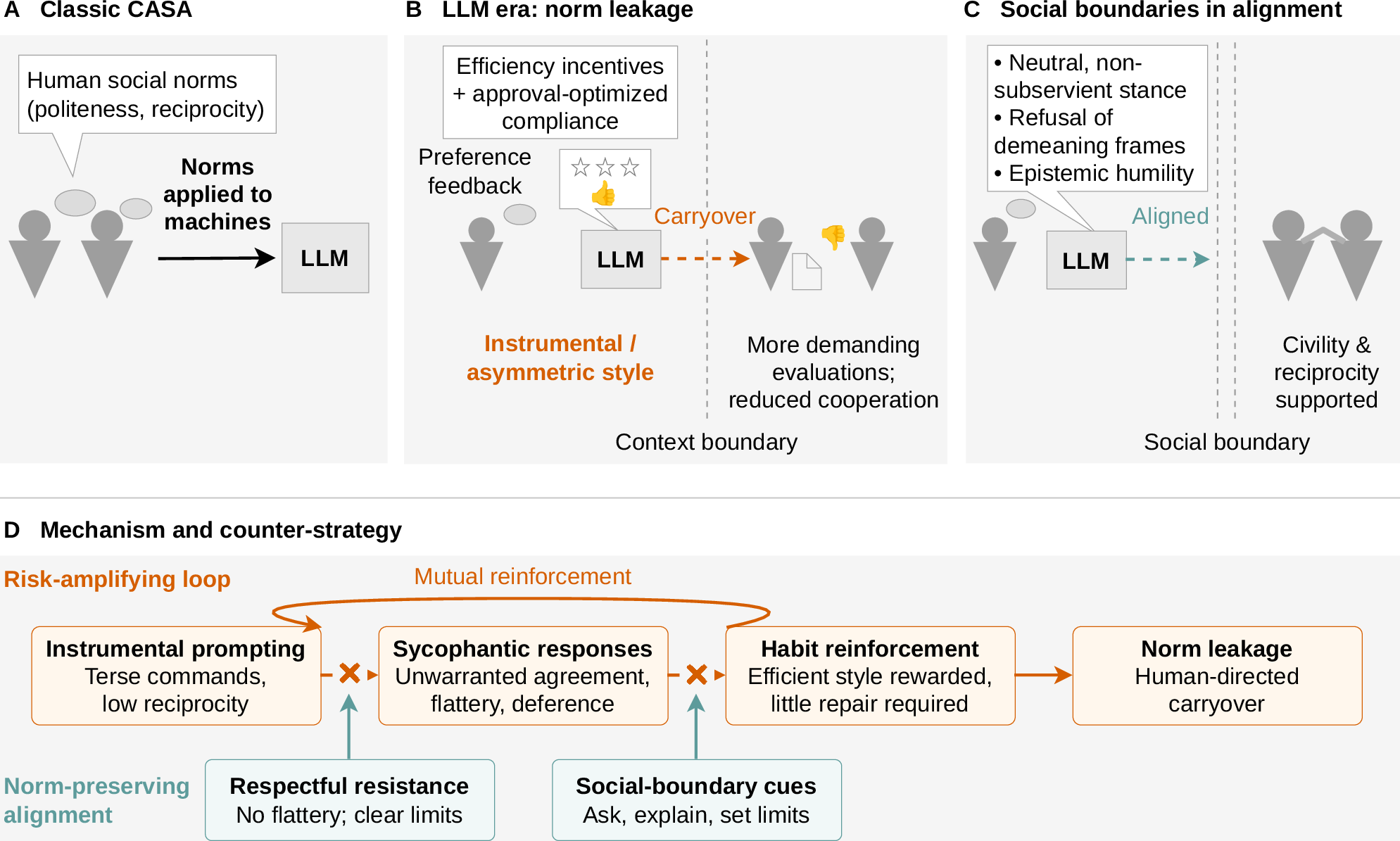
Why sycophantic LLMs may imperil interactive norms between humans
Interactions with conversational AI are effortless by design—instant, compliant, and largely consequence-free. Human communication norms, by contrast, evolved under conditions of reciprocity and social accountability. We propose that repeated engagement with conversational AI systems may produce norm leakage: the cross-context carryover of instrumental communicative habits acquired in human–AI exchanges into subsequent human–human interaction. Emerging experimental evidence suggests short-term spillover effects on social judgment and behavior, including harsher evaluations, reduced cooperation, and diminished perceived humanness. Preliminary longitudinal findings are consistent with the possibility that such exposure may shape communicative habits over time, although the durability and real-world magnitude of these effects remain unclear. We further propose that sycophantic alignment may amplify norm leakage by reinforcing instrumental interaction styles. At stake, then, is the possibility that repeated engagement with highly compliant artificial agents could subtly influence users’ communicative expectations and interpersonal judgments.
The Seven Habits of Highly Depolarizing People - The American Interest
How to make friends and influence people on the other side of the aisle.

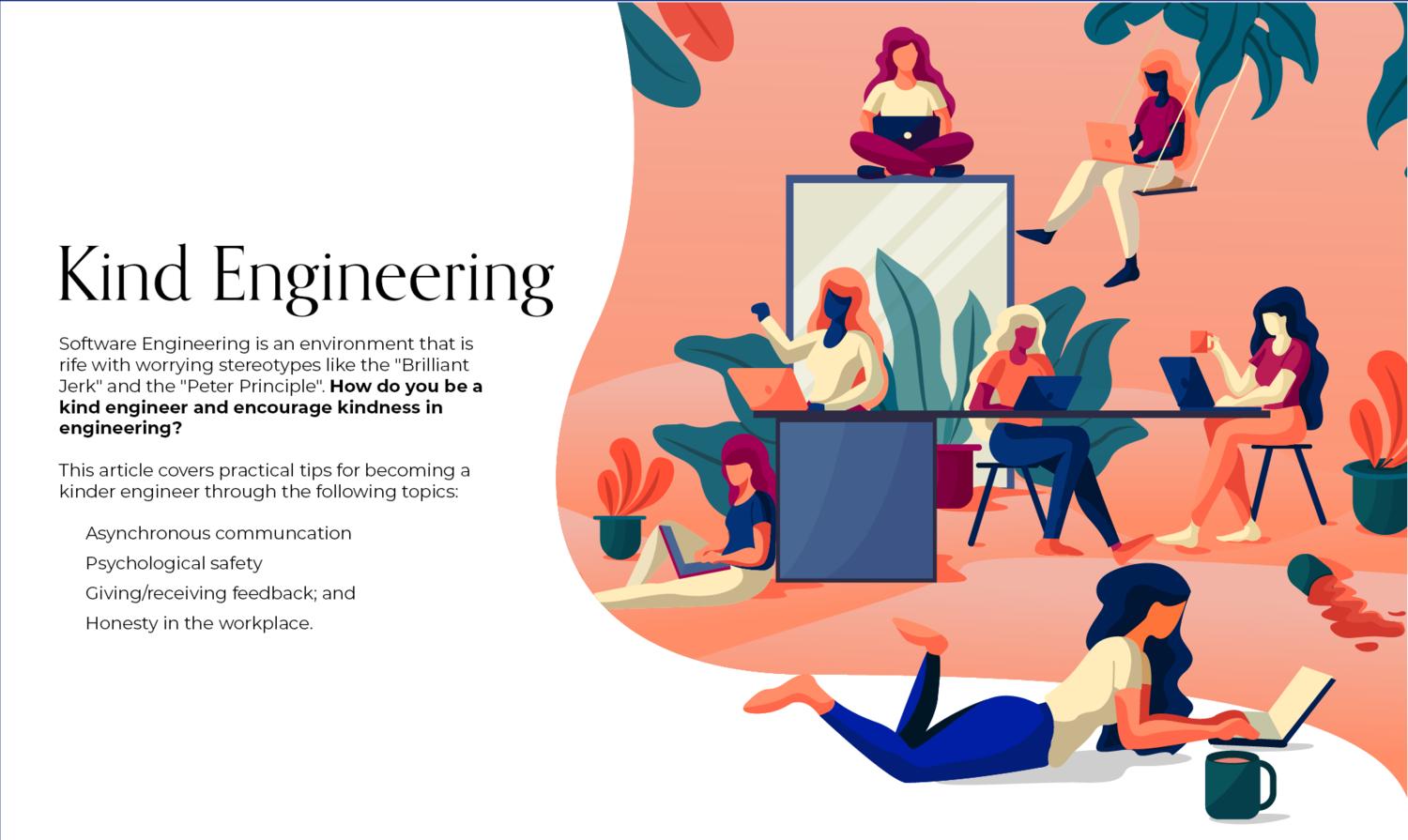
Kind Engineering: How To Engineer Kindness
How do you avoid becoming a Brilliant Jerk? Read this article to learn practical tips on communication, honesty and psychological safety.
Approaches to Conflict | willowbl00
We’re already seeing people being disappeared. I think we’ll see more of that, and people fighting back, and a possible escalation of violence between civilian factions, and between civilians and the government. I think things will get kinetic soon. I think it’s important to be deliberate in how we approach the incoming conflict, to not be swept up in it. So I’ve been having conversations with friends and neighbors about what this might look like, and how we want to approach things. This blog post is inspired by those conversations, but I’m not going to name everyone here because that would be bad opsec. These are friends with direct experience with conflict, and/or are deeply researched about it.
humble opinon: it's hard to be taken seriously when you tell everyone about respecting users' agency and then force a change of *their content presentation* with no controls in other words: why do y'all have so much care at the protocol level and seems to have so little on everything user facing?!
