While today, we think of copyright law as a way to protect the property of creators, English copyright law was actually based on systems designed to
The Surprising History of Copyright and The Promise of a Post-Copyright World – Question Copyright
(See also other available formats for the English, such as EPUB, Daisy, PDF, etc.)
Mx. Aria Stewart (@aredridel@kolektiva.social)
I knew it was this way but it's really hitting me today how much the Open Source movement and copyright maximalism supplanted the idea of free software, and again how much the Free Software movement turned from a close ideological cousin of the remix and open culture movement into a culture of legalism. At the same time, copyright law itself has been extended to be near-immortal copyrights rather than brief monopolies to spur creation by enabling profit from creating works.
Nightshade: Protecting Copyright
Toward Copyleft Equality for All
I would not have imagined even two years ago that expansion of copyleft would become such an issue of interest in software freedom licensing. Historically and for good reason, addition of new forms of copyleft clauses has moved at a steady pace. The early 2000s brought network services clauses (such as that in the Affero GPL), which hinged primarily on requiring provision of source to network-remote users. Affero GPL implemented this via copyright-controlled permission of modification. These licenses began as experiments, and were not approved by some license certification authorities until many years later.
CONTU Revisited: The Case against Copyright Protection for Computer Programs in Machine-Readable Form
Professor Samuelson casts a critical eye on the Final Report of the National Commission on New Technological Uses of Copyrighted Works (CONTU) which recommended that copyright protection be extended to machine-readable versions of computer programs. CONTU appears to have misunderstood computer technology and misinterpreted copyright tradition in two significant respects. The Commission failed to take into account the historical importance of disclosure of the contents of protected works as a fundamental goal of both the copyright and patent laws. It also erroneously opined that the utilitarian character of a work was no bar to its copyrightability when both the statute and the case law make clear that utilitarian works are not copyrightable. Since computer programs in machine-readable form do not disclose their contents and are inherently utilitarian, copyright protection for them is inappropriate. Congress acted on CONTU's recommendation without understanding the significance of these conceptual flaws. Professor Samuelson recommends the creation of a new form of intellectual property law specifically designed for machine-readable programs.
Crooner in Rights Spat
Why have copyright protections grown and grown? Louis Menand on what the intellectual-property battles really mean.

CONTU Revisited: The Case Against Copyright Protection for Computer Programs in Machine-Readable Form
Professor Samuelson casts a critical eye on the Final Report of the National Commission on New Technological Uses of Copyrighted Works (CONTU) which recommended that copyright protection be extended to machine-readable versions of computer programs. CONTU appears to have misunderstood computer technology and misinterpreted copyright tradition in two significant respects. The Commission failed to take into account the historical importance of disclosure of the contents of protected works as a fundamental goal of both the copyright and patent laws. It also erroneously opined that the utilitarian character of a work was no bar to its copyrightability when both the statute and the case law make clear that utilitarian works are not copyrightable. Since computer programs in machine-readable forms do not disclose their contents and are inherently utilitarian, copyright protection for them is inappropriate. Congress acted on CONTU's recommendation without understanding the significance of these conceptual flaws. Professor Samuelson recommends the creation of a new form of intellectual property law specifically designed for machine-readable programs.
Book publishers sue Meta over AI’s ‘word-for-word’ copying
Meta is accused of ripping copyrighted works from piracy websites.

Machine as Author: Perspectives on AI-Created Works and Copyright
Generative AI's role in creating content challenges traditional copyright frameworks, requiring a redefinition of authorship and protection criteria across different jurisdictions, as seen in the varying approaches of the U.S., EU, and China.
Supporting Copyright Reform - Creative Commons
Today Creative Commons released a policy statement expressing its support for copyright reform efforts around the world. Creative Commons (CC) has enabled a new approach to copyright licensing over the last ten years. CC licenses facilitate novel social, educational, technological, and business practices, and support productive relationships around networked knowledge and culture. We are dedicated…
Music Publishers Sue AI Company Anthropic for Copyright Infringement
Universal Music Publishing Group, Concord, and ABKCO claim that the large language model Claud was trained on copyrighted works

EU copyright reform: the facts – Open Policy & Advocacy
Ahead of the crucial EU copyright vote on 12 Sept., we set the facts straight and explain exactly what the new rules will mean for the internet in Europe.
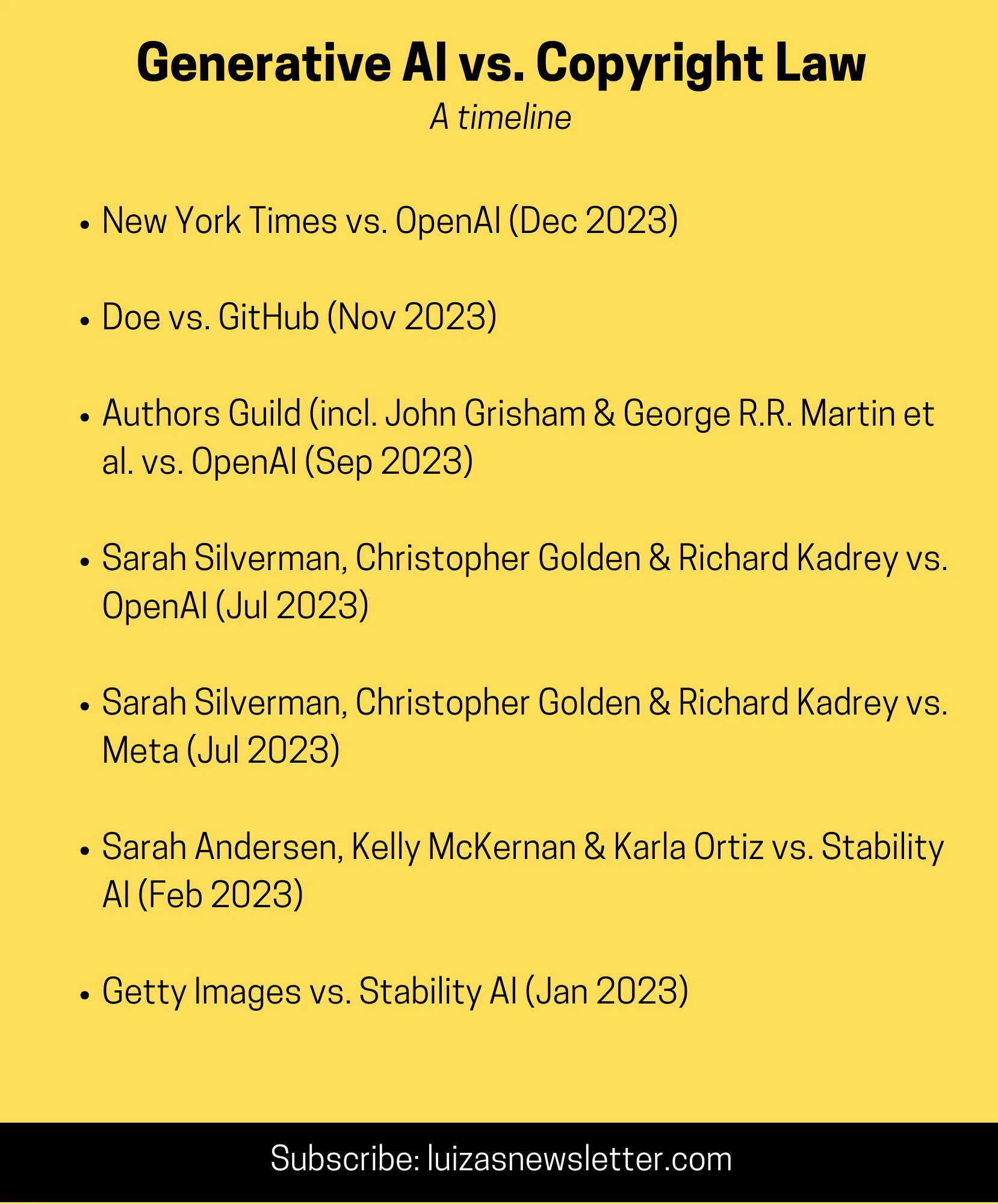
⚖️ Generative AI vs. Copyright Law - a timeline. If you are a privacy professional, you can't ignore AI-related copyright lawsuits anymore. Read this: In order to develop and train large language models (LLMs), AI companies rely on web scraping, a practice that will "dig
⚖️ Generative AI vs. Copyright Law - a timeline. If you are a privacy professional, you can't ignore AI-related copyright lawsuits anymore. Read this:In order to develop and train large language models (LLMs), AI companies rely on web scraping, a practice that will "digest" all… pic.twitter.com/VD6R8UJszN— Luiza Jarovsky, PhD (@LuizaJarovsky) January 3, 2024
Copyright policy based largely on "lobbynomics," not data
The UK's major copyright review has ended, and it demands an end to lobbyist...