


Ever heard of "fictive motion"? It's used in sentences like "The road runs along the coast" or "Bad times are approaching." You may think it's just a


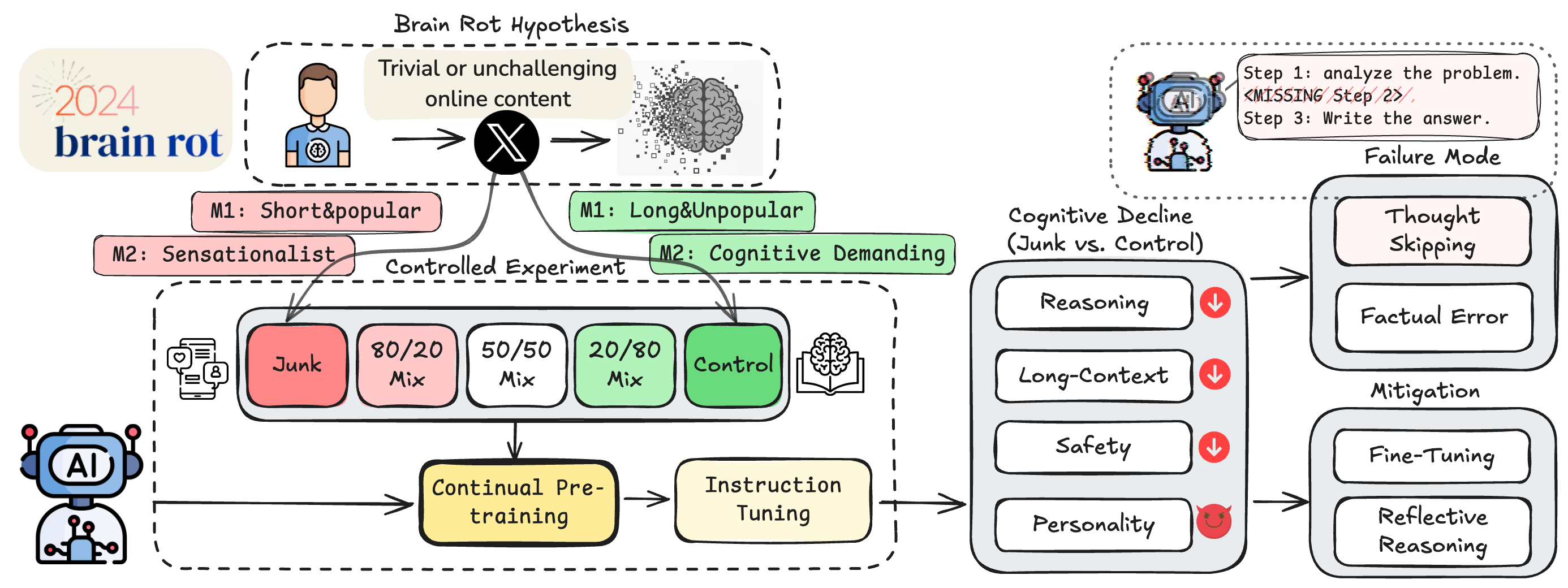
LLMs Can Get Brain Rot
Exploring the phenomenon of 'brain rot' in large language models and its implications for AI cognition.
You Don’t Need Words to Think
Brain studies show that language is not essential for the cognitive processes that underlie thought

Walking backwards can boost your short-term memory | New Scientist
Moving backwards - or simply imagining doing it - can be enough to improve scores on memory tests, but we don't know why

A surprising new source of attention in the brain
As you read this line, you're bringing each word into clear view for a brief moment while blurring out the rest, perhaps even ignoring the roar of a leaf blower outside. It may seem like a trivial skill, ...

Stochastic Parrots | Emily M. Bender - Professor of Computational Linguistics
These Are the Four Stages of Your Brain on Math
Have you ever wondered what your brain is really doing as you sweat your way through a math test? Now you can see for yourself, thanks to a new brain
The Myth and Magic of Generating New Ideas
A mathematician on how to get the mind into motion.

No. 028: arXiv rate limit, AI paper mills, Google FluSight - The Hallway Track
The Hallway Track No. 028 - How AI is affecting the practice of science

Saw this metaphor by Terence Tao floating around about one of the drawbacks of using AI to solve hard math problems, and kind of have the same feeling for “vibe science” or “fully automated science” line of research in #AI4Science. theatlantic.com/technology/2026/02/ai-math-te… #ScAISci
