


We assume that the way humans see the world has some correspondence to objective truth. That’s not necessarily correct. Let's do a thought experiment
Predictive processing frameworks for perception can explain recent drone sightings in the United States
We draw on the predictive processing theory of perception to explain why healthy, intelligent, honest, and psychologically normal people might easily misperceive lights in the sky as threatening or extraordinary objects, especially in the context of WEIRD (western, educated, industrial, rich, and democratic) societies. We argue that the uniquely sparse properties of skyborne and celestial stimuli make it difficult for an observer to update prior beliefs, which can be easily fit to observed lights. Moreover, we hypothesize that humans have likely evolved to perceive the sky and its perceived contents as deeply meaningful. Finally, we briefly discuss the possible role of generalized distrust in scientific institutions and ultimately argue for the importance of astronomy education for producing a society with prior beliefs that support veridical perception.

The Alien Space of Science: Sampling Coherent but Cognitively...
Scientific discovery is constrained not only by what is true, but by what is cognitively available to the researchers currently exploring a field. Many directions are coherent in light of the...
How to Understand the Universe When You’re Stuck Inside of It
Lee Smolin’s radical idea to reimagine how we view the universe.

Bridging the biological and cultural models of cognition
Our minds are a choice

The sky is psychedelic: why so many people see strange lights in the sky
Your brain evolved to see deep meaning in the sky. And UFOs.

Disclosure Day
Across the films of Steven Spielberg, aliens have frequently been a vehicle to explore religiosity from a secular perspective. Institutions and dogma are elided in favor of dramatizing the ecstatic feeling of believing in something far beyond one�s station, and having that faith rewarded.
Why I believe current AI models can really think and understand - Part 1 of 2
How the human mind is different from our conception of it

The Search for Extraterrestrial Life as We Don't Know It
Scientists are abandoning conventional thinking to search for extraterrestrial creatures that bear little resemblance to Earthlings

Experiments Suggest Humans Can Directly Observe the Quantum
Further exploration of "quantum weirdness" in the physics lab.

A World Unobserved
Humans have always generated knowledge and judged it. That's changing fast.

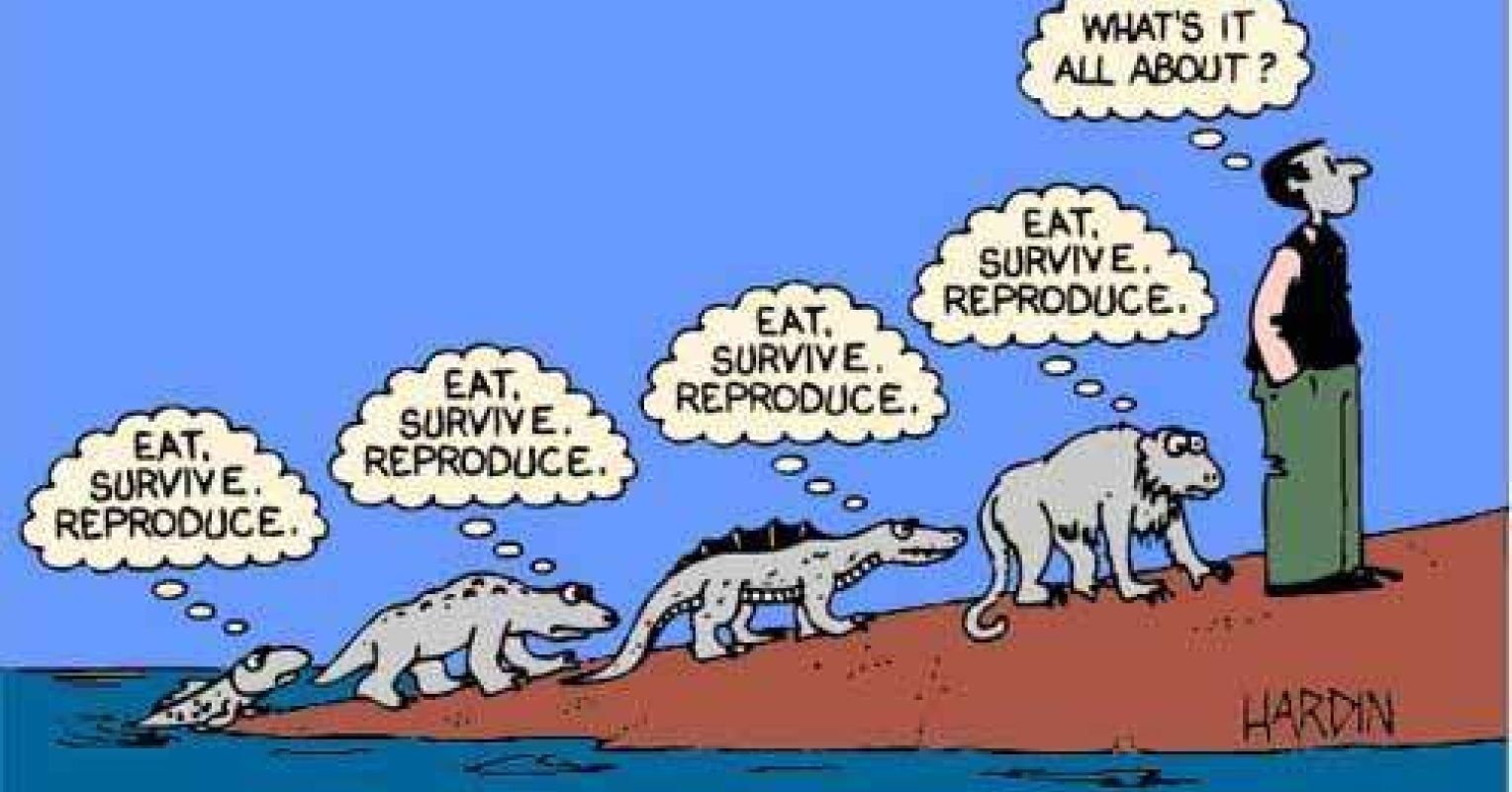
The Meaning of Life Revealed!
Evolutionary theory answers one of the most profound and fundamental questions human beings have ever asked themselves, a question that has plagued reflective minds for as long as reflective minds have existed in the universe: Why are we here? The question was answered in 1859 by Charles Darwin, and the answer can be stated in just six words...
7 thought experiments that will make you question everything
The best thought experiments challenge our beliefs and offer fresh perspectives on how the world operates.

Are We Thinking Correctly About AI Intelligence? | Quanta Magazine
Computer scientist Melanie Mitchell discusses why artificial intelligence doesn’t “think” or “reason” like humans, and how we can create better methods for measuring machine cognition.
The mistake we all make... and the simple experiment that reveals it
Your answer reveals how you see the world – and the common error that hampers our decision making. In an extract from his new book, psychologist Richard Nisbett reveals the ‘mindware’ to help us think smarter

Why Facts Don’t Change Our Minds
New discoveries about the human mind show the limitations of reason.

Why Facts Don’t Change Our Minds
New discoveries about the human mind show the limitations of reason.