<p>The <em>Journal of Applied Physiology</em> publishes original papers that deal with diverse areas of research in applied physiology, especially those papers emphasizing adaptive and integrative mechanisms. Adaptive physiology includes 1) inherent adaptations such as those related to development, aging, and pathophysiological conditions and 2) adaptations to the external environment such as those occurring with exercise, microgravity, hypoxia, hypo- and hyperbaria, and hypo- and hyperthermic conditions. Integrative physiology includes 1) horizontal integration across organ systems and 2) vertical integration from molecule to cell to organ. In all areas of applied physiology, the use of cutting-edge techniques including molecular and cellular biology is strongly encouraged.</p><p>The wide scientific span of the Journal rests on physiology as its keystone. However, the boundaries of physiology have enlarged as demarcations between concepts and techniques in the physiological, pharmacological, and biochemical sciences become increasingly blurred. Moreover, theoretical articles on research at any level of biological organization ranging from molecules to humans fall within the broad scope of the Journal. Papers dealing with topics in other basic sciences that impinge on physiology are also welcome.</p>
BioModels
BioModels is a repository of freely-available mathematical models of biological and biomedical systems. It hosts a vast selection of physiologically and pharmaceutically relevant mechanistic models in standard formats.

jsomers.net | I should have loved biology
In biology class, biology wasn't presented as a quest for the secrets of life. The textbooks wrung out the questing.


Human Kinetics
Publisher of Health and Physical Activity books, articles, journals, videos, courses, and webinars.

Human Kinetics
Publisher of Health and Physical Activity books, articles, journals, videos, courses, and webinars.
The Best Exercise for Aging Muscles (Published 2017)
Certain kinds of exercise may mitigate the effects of aging at the cellular level.

The Best Exercise for Aging Muscles (Published 2017)
Certain kinds of exercise may mitigate the effects of aging at the cellular level.
<i>In silico</i> models of bone remodeling from macro to nano—from organ to cell
Abstract Computational modeling is a tool through which researchers can achieve a greater understanding of the mechanisms governing biological systems. In the field of bone biology, a plethora of models exist which attempt to replicate and investigate bone's dynamic behavior at different scales. At organ level, models are continuum based and describe the variation of bone's apparent density as a function of both biological and external mechanical stimuli. At tissue level, models include bone microarchitecture and more descriptive parameters such as trabecular thickness, osteoclast resorption depth, and activation frequency. Finally, at cell level, models employ partial differential equations to describe complex cellular interactions in the temporal domain. Although informative, these models exist in isolation. Consequently, their interpretation is limited. In this review, we present an overview of the organ‐, tissue‐, and cell‐level models and assess their ability to reflect bone's metabolic processes reliably. Existing interscale synergies are then presented along with a computational framework which could be exploited to achieve a fully integrated, multiscale modeling approach. WIREs Syst Biol Med 2011 3 241–251 DOI: 10.1002/wsbm.115 This article is categorized under: Analytical and Computational Methods > Computational Methods Models of Systems Properties and Processes > Organ, Tissue, and Physiological Models

In silico experiments of bone remodeling explore metabolic diseases and their drug treatment
In silico experiments of bone remodeling enable observation and prediction of physiological and pathological bone conditions. , Bone structure and function are maintained by well-regulated bone metabolism and remodeling. Although the underlying molecular and cellular mechanisms are now being understood, physiological and pathological states of bone are still difficult to predict due to the complexity of intercellular signaling. We have now developed a novel in silico experimental platform, V-Bone, to integratively explore bone remodeling by linking complex microscopic molecular/cellular interactions to macroscopic tissue/organ adaptations. Mechano-biochemical couplings modeled in V-Bone relate bone adaptation to mechanical loading and reproduce metabolic bone diseases such as osteoporosis and osteopetrosis. V-Bone also enables in silico perturbation on a specific signaling molecule to observe bone metabolic dynamics over time. We also demonstrate that this platform provides a powerful way to predict in silico therapeutic effects of drugs against metabolic bone diseases. We anticipate that these in silico experiments will substantially accelerate research into bone metabolism and remodeling.

Integrated Bone Tissue Physiology: Anatomy and Physiology
A model qualification method for mechanistic physiological QSP models to support model‐informed drug development
Mechanistic physiological modeling is a scientific method that combines available data with scientific knowledge and engineering approaches to facilitate better understanding of biological systems, improve decision‐making, reduce risk, and increase efficiency in drug discovery and development. It is a type of quantitative systems pharmacology (QSP) approach that places drug‐specific properties in the context of disease biology. This tutorial provides a broadly applicable model qualification method (MQM) to ensure that mechanistic physiological models are fit for their intended purposes.

Design in The Age of Biology: Shifting From a Mechanical-Object Ethos to an Organic-Systems Ethos
In the early twentieth century, our understanding of physics changed rapidly; now, our understanding of biology is undergoing a similar rapid change.
Interactions between gut microbiota and skeletal muscle
The gut microbiota is now recognized as a major contributor to the host’s nutrition, metabolism, immunity, and neurological functions. Imbalanced microbiota (ie, dysbiosis) is linked to undernutrition-induced stunting, inflammatory and metabolic diseases, and cancers. Skeletal muscle also takes part in the interorgan crosstalk regulating substrate metabolism, immunity, and health. Here, we review the reciprocal influence of gut microbiota and skeletal muscle in relation to juvenile growth, performance, aging, and chronic diseases. Several routes involving the vascular system and organs such as the liver and adipose tissue connect the gut microbiota and skeletal muscle, with effects on fitness and health. Therapeutic perspectives arise from the health benefits observed with changes in gut microbiota and muscle activity, further encouraging multimodal therapeutic strategies.

A review of mathematical modeling of bone remodeling from a systems biology perspective
Bone remodeling is an essential physiological process in the adult skeleton. Due to the complex nature of this process, many mathematical models of bone remodeling have been developed. Each of these models has unique features, but they have underlying patterns. In this review, the authors highlight the important aspects frequently found in mathematical models for bone remodeling and discuss how and why these aspects are included when considering the physiology of the bone basic multicellular unit, which is the term used for the collection of cells responsible for bone remodeling. The review also emphasizes the view of bone remodeling from a systems biology perspective. Understanding the systemic mechanisms involved in remodeling will help provide information on bone pathology associated with aging, endocrine disorders, cancers, and inflammatory conditions and enhance systems pharmacology. Furthermore, some features of the bone remodeling cycle and interactions with other organ systems that have not yet been modeled mathematically are discussed as promising future directions in the field.
Meta-omics analysis of elite athletes identifies a performance-enhancing microbe that functions via lactate metabolism
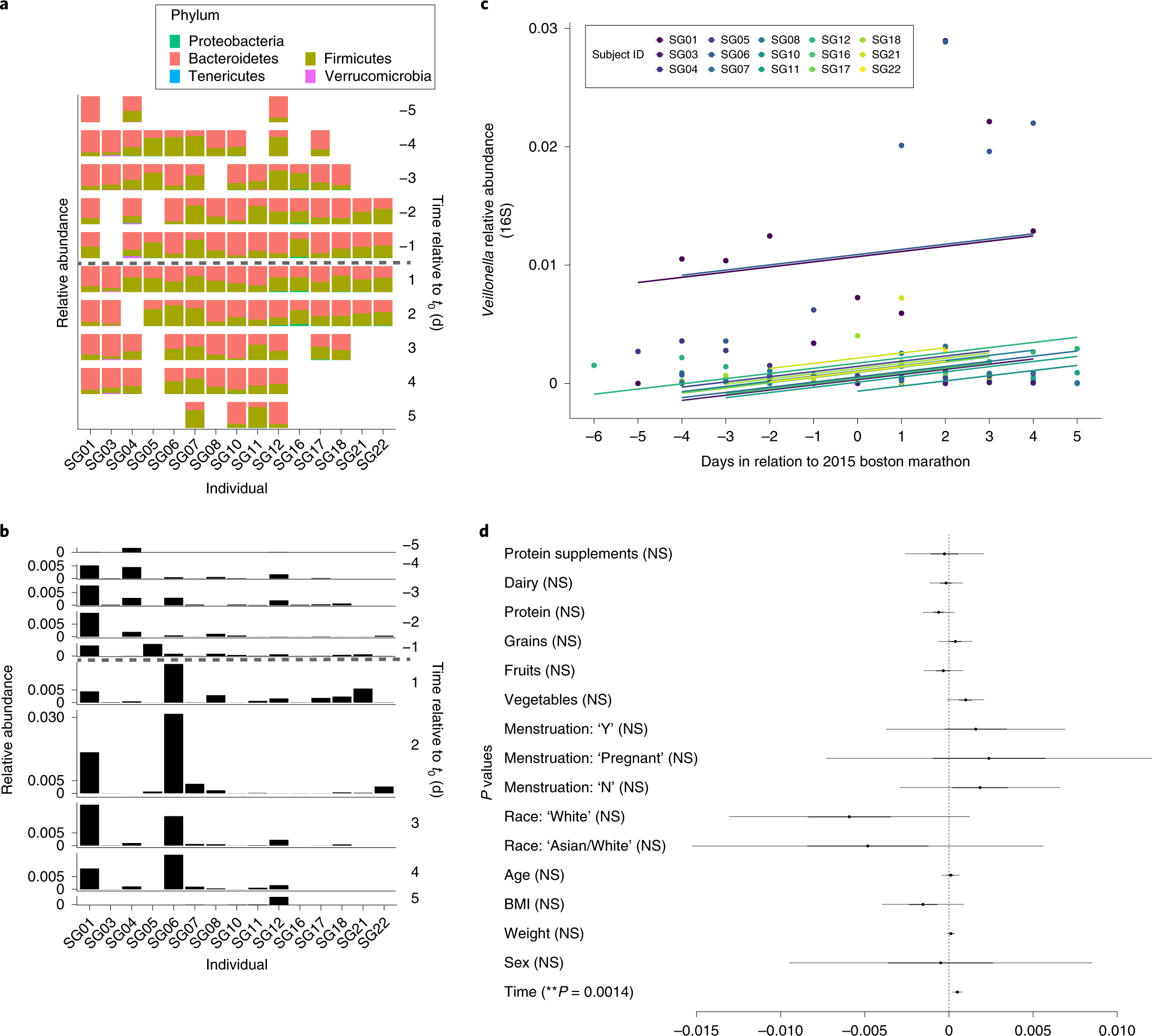
The human gut microbiome is linked to many states of human health and disease1. The metabolic repertoire of the gut microbiome is vast, but the health implications of these bacterial pathways are poorly understood. In this study, we identify a link between members of the genus Veillonella and exercise performance. We observed an increase in Veillonella relative abundance in marathon runners postmarathon and isolated a strain of Veillonella atypica from stool samples. Inoculation of this strain into mice significantly increased exhaustive treadmill run time. Veillonella utilize lactate as their sole carbon source, which prompted us to perform a shotgun metagenomic analysis in a cohort of elite athletes, finding that every gene in a major pathway metabolizing lactate to propionate is at higher relative abundance postexercise. Using 13C3-labeled lactate in mice, we demonstrate that serum lactate crosses the epithelial barrier into the lumen of the gut. We also show that intrarectal instillation of propionate is sufficient to reproduce the increased treadmill run time performance observed with V. atypica gavage. Taken together, these studies reveal that V. atypica improves run time via its metabolic conversion of exercise-induced lactate into propionate, thereby identifying a natural, microbiome-encoded enzymatic process that enhances athletic performance.