

As we all know, t he Badges project seeks to provide users with a mechanism to shape their online identities: showcasing the skills that ...
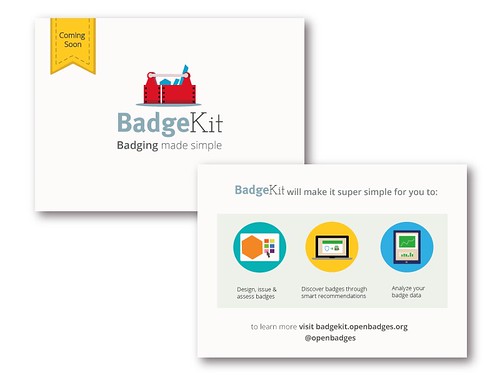
BadgeKit: Pathways and Paving the Path to Playful Design
It has been a while since I wrote anything on this blog. The truth is that a ton of things have kept me busy these past months so buckle up for a series of posts; there are lots of things to say :)


Digital Badges for Learning | Learning Beyond Letter Grades
Web QA: Different ways to contribute
The Web QA team would like to reach out and thank Ivana Catovic for designing our latest 3 badge designs. They look great, and are ...
BadgeKit: An Invitation to Innovation
Have you ever read an article, listened to a podcast or heard a speech that motivated you to perform some kind of action - only to realize t...
IIW – Internet Identity Workshop
The Internet Identity Workshop — where the identity community meets to discuss and advance digital identity.

High-Tech Anthropology® Process Tour
Come learn about the benefits of observing end users, creating and mapping personas, and assessing iterative designs. Additionally, see the other tools we use and visuals we create to capture and distill information that will help us mitigate the risk of a failed end product. These steps build the foundation for user-friendly designs tailored to target persona(s) – for products that are actually adopted (and even enJOYed!) rather than tossed to the side or treated like paperweights.

World of E's: (More) Reflections on the Badge Summit
Parchment Digital Badges
A global platform for issuing skills-aligned digital badges and creating stackable learning pathways that support recognition across learning ecosystems.
Gratitude and its Dangers in Social Technologies – MIT Center for Civic Media
How do our designs change when we start emphasizing people and community and not just the things they do for us? Over the next year of my research, I’m exploring acknowledgment and gratitude, basic parts of online relationships that designers often set aside to focus on the tasks people do online.
Vote for your favorite General QA Participation Badge design
Mozilla’s Quality Assurance (QA) team is happy to announce that five community contributors have submitted designs for a General QA Participation Badge. We thank the ...

COMMUNITY-BASED, HUMAN-CENTERED DESIGN
We propose a radical change in design from experts designing for people to people designing for themselves, leveraging the creativity of communities to solve their own problems. People in communiti…

Rebrand — Stellar visual identity inspiration
Rebrand is a collection of the best new design systems, visual identity introductions and rebrand videos. We curate breathtaking videos that capture new brand identities.

An introduction to radical participatory design: decolonising participatory design processes
Outside of community-led design projects, most participatory design processes initiated by a company or organisation maintain or even strengthen power imbalances between the design organisation and the community on whose purported behalf they are designing, further increasing the absencing experience. Radical participatory design (RPD) is a radically relational answer to the coloniality inherent in participatory design where the community members’ disappointment is greater due to the greater expectations and presencing potential of a ‘participatory design’ process. We introduce the term RPD to show how research and design processes can be truly participatory to the root or core. Instead of treating participatory design as a method, a way of conducting a method, or a methodology, we introduce RPD as a meta-methodology, a way of doing any methodology. We explicitly describe what participation means and compare and contrast design processes based on the amount of participation, creating a typology of participation. We introduce ‘designer as community member’, ‘community member as designer,’ and ‘community member as facilitator’ models and provide characteristics for the meta-methodology of RPD.

An introduction to radical participatory design: decolonising participatory design processes
Outside of community-led design projects, most participatory design processes initiated by a company or organisation maintain or even strengthen power imbalances between the design organisation and the community on whose purported behalf they are designing, further increasing the absencing experience. Radical participatory design (RPD) is a radically relational answer to the coloniality inherent in participatory design where the community members’ disappointment is greater due to the greater expectations and presencing potential of a ‘participatory design’ process. We introduce the term RPD to show how research and design processes can be truly participatory to the root or core. Instead of treating participatory design as a method, a way of conducting a method, or a methodology, we introduce RPD as a meta-methodology, a way of doing any methodology. We explicitly describe what participation means and compare and contrast design processes based on the amount of participation, creating a typology of participation. We introduce ‘designer as community member’, ‘community member as designer,’ and ‘community member as facilitator’ models and provide characteristics for the meta-methodology of RPD.
Co-constructing a framework of web literacy and badges
Two weeks ago on Thursday we held our first web literacy framework / standard conversation. We, along with interested and influential folks, are thinking through what a web literacy standard might …
