


Recent years have seen massive, distributed datasets become the norm in neuroimaging research, and the methodologies used analyze them have, in response, become more collaborative and exploratory. Tools and infrastructure are continuously being developed and deployed to facilitate research in this context: grid computation platforms to process the data, distributed data stores to house and share them, high-speed networks to move them around and collaborative, often web-based, platforms to provide access to and sometimes manage the entire system. BrainBrowser is a lightweight, high-performance JavaScript visualization library built to provide easy-to-use, powerful, on-demand visualization of remote datasets in this new research environment. BrainBrowser leverages modern Web technologies, such as WebGL, HTML5 and Web Workers, to visualize 3D surface and volumetric neuroimaging data in any modern web browser without requiring any browser plugins. It is thus trivial to integrate BrainBrowser into any web-based platform. BrainBrowser is simple enough to produce a basic web-based visualization in a few lines of code, while at the same time being robust enough to create full-featured visualization applications. BrainBrowser can dynamically load the data required for a given visualization, so no network bandwidth needs to be waisted on data that will not be used. BrainBrowser's integration into the standardized web platform also allows users to consider using 3D data visualization in novel ways, such as for data distribution, data sharing and dynamic online publications. BrainBrowser is already being used in two major online platforms, CBRAIN and LORIS, and has been used to make the 1TB MACACC dataset openly accessible.
davidbau.com Vibe Coding
Back in 2009 I posted a simple Mandelbrot fractal viewer on the web: a single HTML file with inline Javascript. Just 329 lines of code, each pixel a tiny table cell. Click to zoom. Watch it iterate. That was about it!
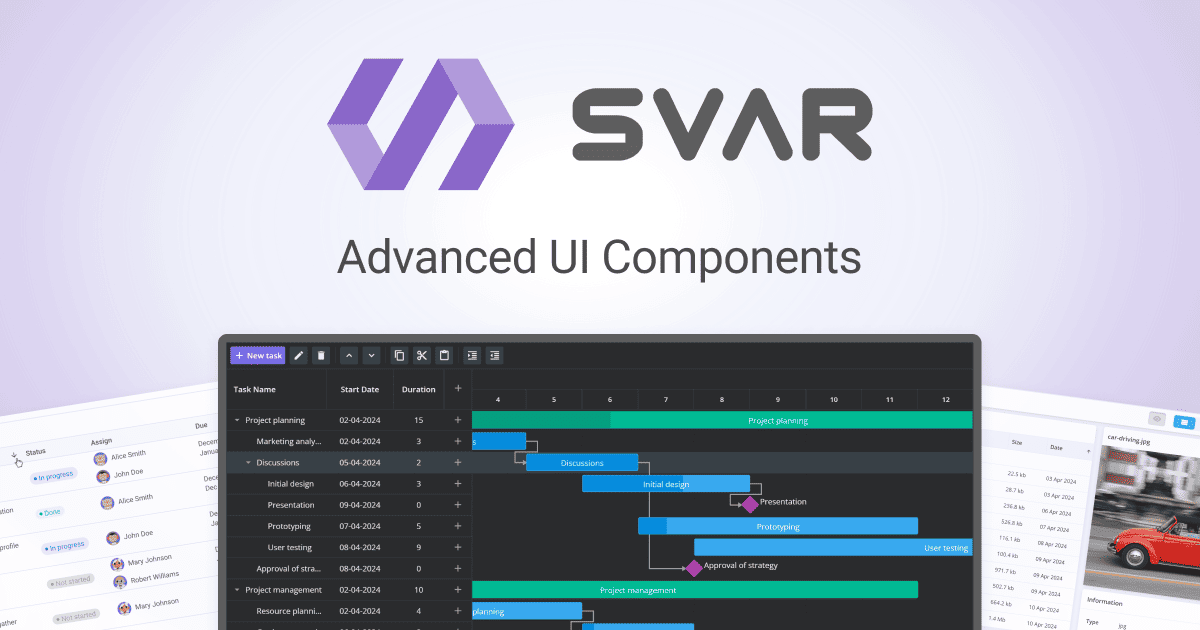
SVAR Svelte UI Components Library
Build modern, responsive web apps with open-source SVAR Svelte UI components: Data Grid, Gantt Chart, and more! Lightweight, fast, customizable.
I literally connected my brain to GPT-4 with JavaScript
brainlife
The platform allows to analyze Magnetic Resonance Imaging (MRI), electroencephalography (EEG) and magnetoencephalography (MEG) data. Data can either be uploaded from local computers or imported from public archives such as OpenNeuro.org. Over 400+ data processing Apps are available on brainlife.io to build custom data workflows. Thousands of jobs can be submitted using shared clusters or on users' compute resource. Users can perform group-level statistical analysis or apply machine learning methods using Jupyter notebooks. A single record containing the entire data workflow (from raw data to published figures) can be published addressed by with a unique digital object identifier (DOI).
NeuralBench: A Unifying Framework to Benchmark NeuroAI Models | Hubert Banville
🧠 NeuralBench is now open source. Today we're releasing NeuralBench, a unified framework for benchmarking foundation models of brain activity, developed by the Brain & AI team at FAIR, Meta. 💻 Code: https://lnkd.in/dNJsgBgM 📄 White paper: https://lnkd.in/dvWMg7rx Brain foundation models are starting to show positive transfer to a range of downstream tasks, from brain-computer interfacing to clinical classification. But systematically evaluating them is hard: heterogeneous preprocessing pipelines, input structures, and adaptation methodologies make results difficult to compare. Most prior work also focuses on a narrow set of downstream tasks. NeuralBench addresses this by defining each task end-to-end with config files (data source, preprocessing, splits, optimiser, metrics, architecture) so all models can be evaluated on the same footing. What's in our first release, NeuralBench-EEG v1.0: ⚡ 36 EEG tasks across 94 public datasets, spanning motor imagery, clinical classification, cognitive decoding, and phenotype prediction. 🤖 Task-specific deep learning architectures (EEGNet, Deep4, EEGConformer, CTNet, ...) benchmarked side-by-side with recent EEG foundation models (BENDR, LaBraM, BIOT, CBraMod, LUNA, REVE). 🧩 Extensible to other neuroimaging modalities: the framework already runs MEG and fMRI tasks, leveraging our NeuralSet ecosystem for accessing brain imaging data and the broader neuroscientific software stack. 📜 Released under the MIT license. Help us make it better. Through our white paper, we invite the community to contribute new tasks, datasets, and models, especially for fMRI, MEG, and iEEG. The long-term goal is a fully unified benchmark across neuroimaging tasks and modalities. 🙏🙏🙏 This was a big team effort with Stéphane d'Ascoli, Simon Dahan, Jérémy RAPIN, Marlène Careil, Yohann Benchetrit, Jarod Lévy, Saarang P., Antoine Ratouchniak, Lucy (Mingfang) Zhang, Elisa Cascardi, Katie Begany, Teon Brooks, and Jean-Rémi King. Special thanks to Alexandre Gramfort, Thomas Moreau, Arnaud Delorme, Bruno A. and Pierre Guetschel for feedback and support. #Neuroscience #AI #NeuroAI #Python #OpenSource

Lightpanda | The headless browser
The AI-native web browser built from scratch for machines. Not a fork. Not a patch. Fast, scalable web automation with a minimal memory footprint. 10x faster, 10x less RAM, and 100x better than Chrome headless.

This month in Servo: new webview API, relative colors, canvas buffs, and more! - Servo aims to empower developers with a lightweight, high-performance alternative for embedding web technologies in applications.
Servo is becoming truly embeddable this year.


Servo: A Web View From Somewhere Else
The Lively Kernel
Frameworks for humans in the age of machines
DANDI
DANDI: Distributed Archives for Neurophysiology Data Integration The DANDI platform is supported by the BRAIN Initiative for publishing, sharing, and processing neurophysiology data. The archive accepts cellular neurophysiology data including electrophysiology, optophysiology, and behavioral time-series, and images from immunostaining experiments. The platform is now available for data upload and distribution. The storage of data in the archive is also supported by the Amazon Opendata program. The data in the archive can be browsed using the Data Portal. For detailed instructions on how to interact (view, upload, download, process) with DANDI click here.