


“Asymmetry”, in this context, refers to the player or players having different abilities from the start of a match. A Street Fighter II character, a StarCraft race, or a Magic: T…
The Illusion of Asymmetric Insight
The Misconception: You celebrate diversity and respect others’ points of view. The Truth: You are driven to create and form groups and then believe others are wrong just because they are oth…

Game Theory | Open Yale Courses
This course is an introduction to game theory and strategic thinking. Ideas such as dominance, backward induction, Nash equilibrium, evolutionary stability, commitment, credibility, asymmetric information, adverse selection, and signaling are discussed and applied to games played in class and to examples drawn from economics, politics, the movies, and elsewhere.
Starting Point
You compete with others, on an unfair playing field. Are you aware of this? Are you good at games? Starting equally Starting unequally Advantages in Games Life is Competitive Seeing Life as a Game What to keep in mind When to use this View Your Starting Point Starting equally You...

Out-group homogeneity
The out-group homogeneity effect is the perception of out-group members as more similar to one another than are in-group members, i.e. "they are alike; we are diverse".[1] Perceivers tend to have impressions about the diversity or variability of group members around those central tendencies or typical attributes of those group members. Thus, outgroup stereotypicality judgments are overestimated, supporting the view that out-group stereotypes are overgeneralizations.[2] The term "outgroup homogeneity effect", "outgroup homogeneity bias" or "relative outgroup homogeneity" have been explicitly contrasted with "outgroup homogeneity" in general,[3] the latter referring to perceived outgroup variability unrelated to perceptions of the ingroup.
Game Theory
Game theory is the study of the ways in which interactingchoices of economic agents produce outcomeswith respect to the preferences (or utilities) ofthose agents, where the outcomes in question might have been intendedby none of the agents. The meaning of this statement will not be clearto the non-expert until each of the italicized words and phrases hasbeen explained and featured in some examples. Doing this will be themain business of this article. First, however, we provide somehistorical and philosophical context in order to motivate the readerfor the technical work ahead.
17. A Value for n-Person Games
17. A Value for n-Person Games was published in Contributions to the Theory of Games, Volume II on page 307.

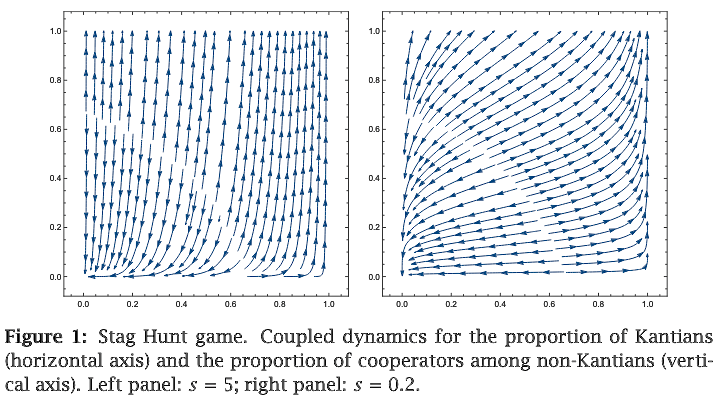
Quick Summaries of Two Papers on Kant and Game Theory — LessWrong
It's not obvious from a Darwinian point of view why people (even people who aren't related) often cooperate with one another. Researchers like Axelro…
Analytic racecraft: Race-based averages create illusory group differences in perceptions of racism.
Game Balance Isn't Real
A negative-sum game: Policing Counter-Strike: GO cheaters with Overwatch
In battling cheaters, Valve crowdsources the judge, jury, and executioner.

Arcs in Strategy Games
It is common to hear players talk about “tactics” and “strategy” in games. In this case, the colloquial understanding of these terms happens to be pretty useful, in that it …

Insights into Sexism: Male Status and Performance Moderates Female-Directed Hostile and Amicable Behaviour
Gender inequality and sexist behaviour is prevalent in almost all workplaces and rampant in online environments. Although there is much research dedicated to understanding sexist behaviour, we have almost no insight into what triggers this behaviour and the individuals that initiate it. Although social constructionist theory argues that sexism is a response towards women entering a male dominated arena, this perspective doesn’t explain why only a subset of males behave in this way. We argue that a clearer understanding of sexist behaviour can be gained through an evolutionary perspective that considers evolved differences in intra-sexual competition. We hypothesised that female-initiated disruption of a male hierarchy incites hostile behaviour from poor performing males who stand to lose the most status. To test this hypothesis, we used an online first-person shooter video game that removes signals of dominance but provides information on gender, individual performance, and skill. We show that lower-skilled players were more hostile towards a female-voiced teammate, especially when performing poorly. In contrast, lower-skilled players behaved submissively towards a male-voiced player in the identical scenario. This difference in gender-directed behaviour became more extreme with poorer focal-player performance. We suggest that low-status males increase female-directed hostility to minimize the loss of status as a consequence of hierarchical reconfiguration resulting from the entrance of a woman into the competitive arena. Higher-skilled players, in contrast, were more positive towards a female relative to a male teammate. As higher-skilled players have less to fear from hierarchical reorganization, we argue that these males behave more positively in an attempt to support and garner a female player’s attention. Our results provide the clearest picture of inter-sexual competition to date, highlighting the importance of considering an evolutionary perspective when exploring the factors that affect male hostility towards women.

The Score: How to Stop Playing Somebody Else's Game
A philosophy of games to help us win back control over …
