


I have long considered execution to be basically a form of randomness, similar to dice rolls or card draws. I have also long recognized that not everyone agrees with me, and some people find the id…
Uncapped Look-Ahead and the Information Horizon
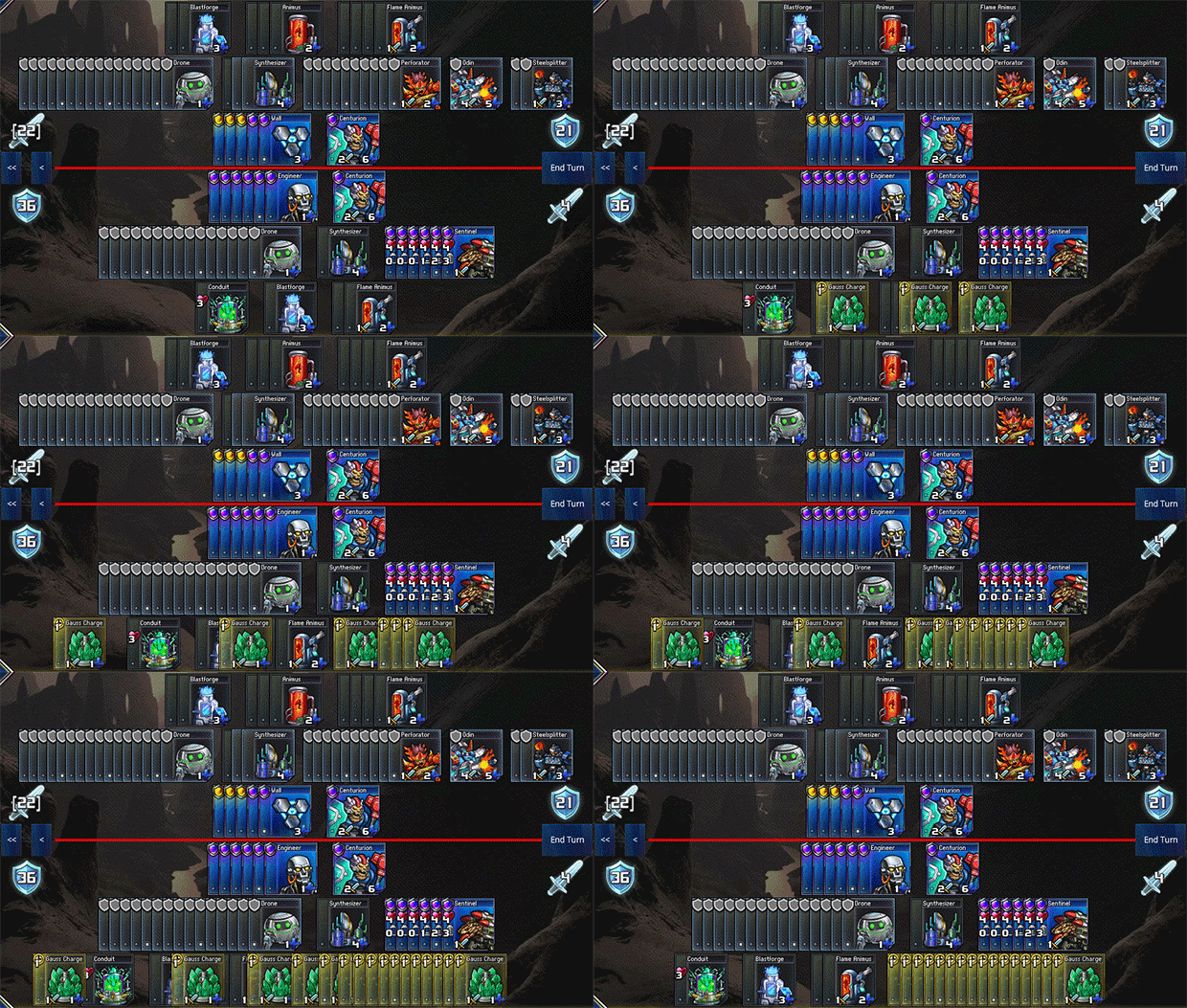
I write a lot about how bad output randomness is for games, but today I want to write about a problem common in many deterministic games – specifically ones that lack hidden information. Why …
Against theory-motivated experimentation: Can random experimental choice lead to better theories?
Scientists must choose which among many experiments to perform. We study the epistemic success of experimental choice strategies proposed by philosophers of science or executed by scientists themselves. We develop a multi-agent model of the scientific process that jointly formalizes its core aspects: active experimentation, theorizing, and social learning. We find that agents who choose new experiments at random develop the most informative and predictive theories of the world. The agents aiming to confirm, falsify theories, or resolve theoretical disagreements end up with an illusion of epistemic success: they develop promising accounts for the data they collected, while misrepresenting the ground truth that they intended to learn about. Agents experimenting in these theory-motivated ways acquire less diverse or less representative samples from the ground truth that also turn out to be easier to account for. Random data collection, on the other hand, combines virtues of diverse and representative sampling from a target scientific domain which enables cumulative development of the successful theoretical accounts of it. We suggest that randomization, already a gold standard within experiments, is also beneficial at the level of experiments themselves.

What is random generation?
I wanted to write this as a sequel to "What is a property?" where I would talk about how Property-Based Testing libraries generate random structures, don't worry, I'll still do that! But I realized that without talking about randomness in computers, the writing would be incomplete. So the first part of this article will go into a core problem that we consider "solved" in PBT, which is designing good random number generators, with the latter part talking about implementing complex random data generators on top of such RNGs.
Arcs in Strategy Games
It is common to hear players talk about “tactics” and “strategy” in games. In this case, the colloquial understanding of these terms happens to be pretty useful, in that it …

Let’s Use the Emergent CSS random() Function in all the Browsers | CSS-Tricks
The journey to create a polyfill for the upcoming CSS random() function that works in all browsers.

Clockwork Criteria: 6 Guidelines for Ideal Strategy Game Design
What are the criteria that make something a good “Clockwork Game”? The Clockwork Game Design model is something I have been working on for the last five years or so. It is specifically …
Random Object Creativity Technique — Think Jar Collective
Michael Michalko shares a useful technique for generating relevant creative ideas using random words to inspire creativity.

The 100:10:1 method – the heart of my game design process
This is the second post of a series on practical game-design techniques. Here’s the first. In my years designing games, my methods have evolved from Games-Randomly-Emerging-from-the-Inchoate…

Magic: The Gathering is Turing Complete
$\textit{Magic: The Gathering}$ is a popular and famously complicated trading card game about magical combat. In this paper we show that optimal play in real-world $\textit{Magic}$ is at least as...

Mechanism Experiments and Policy Evaluations
Randomized controlled trials are increasingly used to evaluate policies. How can we make these experiments as useful as possible for policy purposes? We argue greater use should be made of experiments that identify the behavioral mechanisms that are central to clearly specified policy questions, what we call "mechanism experiments." These types of experiments can be of great policy value even if the intervention that is tested (or its setting) does not correspond exactly to any realistic policy option.

Strategy in Life
What is Strategy? Why is it easy to get wrong and so hard to get right? Strategy Structures in Life Concept-Space Getting from one point to another In a predefined direction Stars as Concept-space analogy By predefined actions Strategy in Life Know your surroundings Creating Strategies Using Strategies Summary Strategy...

Essential Randomness — Ms Boba's Emporium of Weirdness
Ms Boba's experimental website. Open for business while construction is ongoing.

Essential Randomness — Ms Boba's Emporium of Weirdness
Ms Boba's experimental website. Open for business while construction is ongoing.
Jevons Paradox: A personal perspective
What if the most game-optimal play in the new system is actually to become relentlessly, unapologetically you?
No One Wins in Nuclear War: Social Simulations of High-stakes Military Decision-making
WOPR is a social-simulation environment for studying how organizations make high-stakes decisions, built on a deterministic, replay-validated rules engine and using wargames as the vehicle. We instantiate it first with the published card game Nuclear War, traced against its published rules. We start with military decision-making because of its safety implications and because it needs further study, but the design is not specific to it: the decision- point contract that exposes the engine to agents is reusable across verifiable rule systems. Existing social-simulation work emphasizes persona fidelity and synthetic opinion, but lacks a verifiable rules engine with replay-checkable mechanics and private-channel negotiation. WOPR supplies that engine, and its contract makes every strategic choice an explicit agent decision. The method is agnostic to social-simulation frameworks; we adopt Concordia as the default harness for driving the game. On the same engine, WOPR layers a four-rung press ladder from silence to private single- recipient channels with structured commitments, and instantiates each faction as a collective command-and-control system rather than a single agent. We make all code, example configurations, and replay data publicly available at https://github.com/eilab-gt/wopr.