

I awoke this morning to find my account on Twitter (@briankrebs) had attracted almost 12,000 new followers overnight. Then I noticed I’d gained almost as many followers as the number of re-tweets (RTs) earned for a tweet I published on Tuesday. The tweet stated how every time I tweet something related to Russian President Vladimir Putin I get a predictable stream of replies that are in support of President Trump — even in cases when neither Trump nor the 2016 U.S. presidential campaign were mentioned.
Twitter Bans 270,000 Accounts For 'Promoting Terrorism' - Slashdot
According to Twitter's latest transparency report, the social media company removed more than 270,000 accounts around the world for promoting terrorism in the second half of 2017. The number of accounts permanently suspended for sharing what the firm called extremist content between July and Decembe...

As many as 48 million Twitter accounts aren't people, says study
A big chunk of those "likes," "retweets," and "followers" lighting up your Twitter account may not be coming from human hands.
Exposure to the Russian Internet Research Agency foreign influence campaign on Twitter in the 2016 US election and its relationship to attitudes and voting behavior
There is widespread concern that foreign actors are using social media to interfere in elections worldwide. Yet data have been unavailable to investigate links between exposure to foreign influence campaigns and political behavior. Using longitudinal survey data from US respondents linked to their Twitter feeds, we quantify the relationship between exposure to the Russian foreign influence campaign and attitudes and voting behavior in the 2016 US election. We demonstrate, first, that exposure to Russian disinformation accounts was heavily concentrated: only 1% of users accounted for 70% of exposures. Second, exposure was concentrated among users who strongly identified as Republicans. Third, exposure to the Russian influence campaign was eclipsed by content from domestic news media and politicians. Finally, we find no evidence of a meaningful relationship between exposure to the Russian foreign influence campaign and changes in attitudes, polarization, or voting behavior. The results have implications for understanding the limits of election interference campaigns on social media.
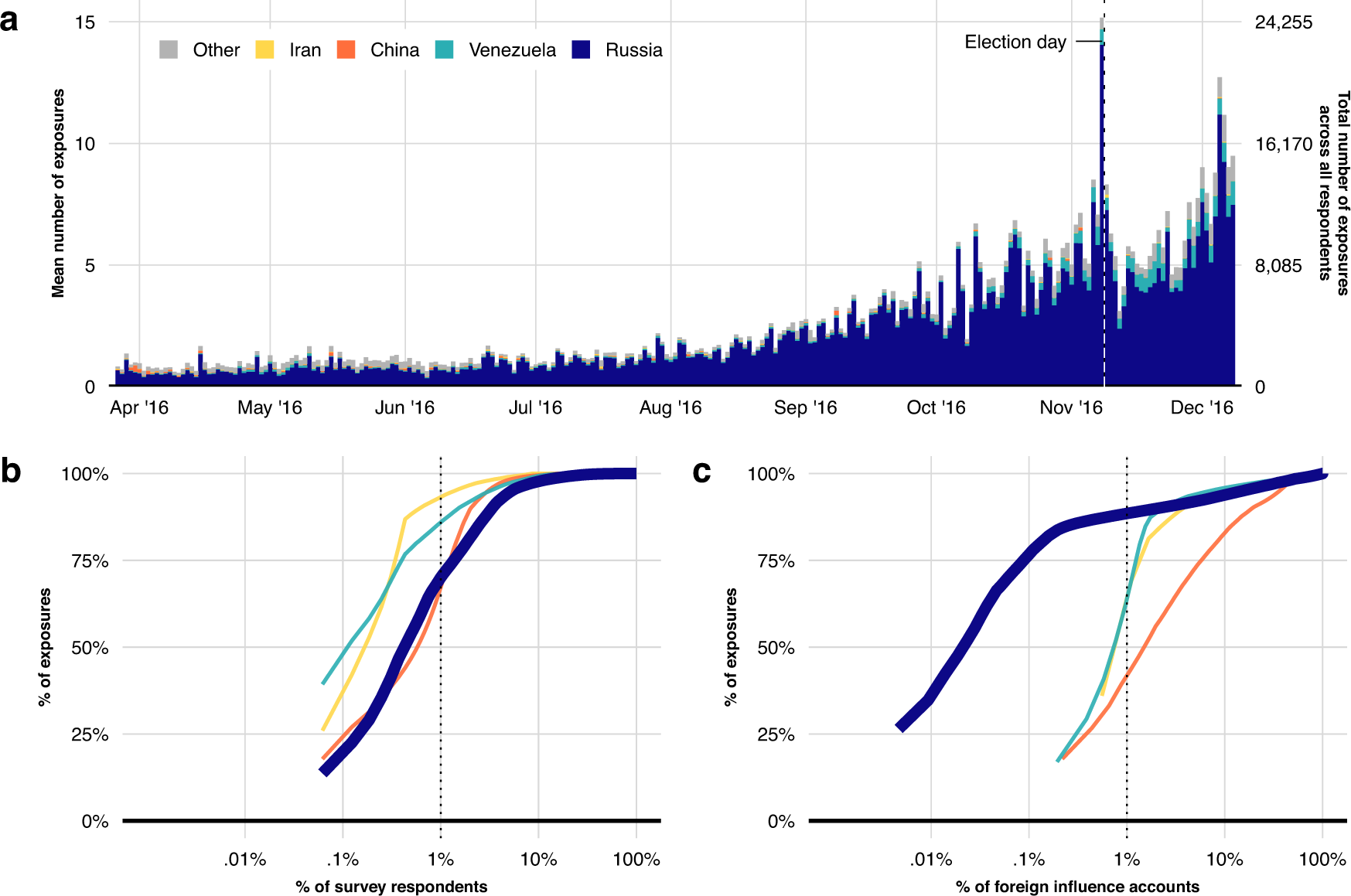
Exposure to the Russian Internet Research Agency foreign influence campaign on Twitter in the 2016 US election and its relationship to attitudes and voting behavior
There is widespread concern that foreign actors are using social media to interfere in elections worldwide. Yet data have been unavailable to investigate links between exposure to foreign influence campaigns and political behavior. Using longitudinal survey data from US respondents linked to their Twitter feeds, we quantify the relationship between exposure to the Russian foreign influence campaign and attitudes and voting behavior in the 2016 US election. We demonstrate, first, that exposure to Russian disinformation accounts was heavily concentrated: only 1% of users accounted for 70% of exposures. Second, exposure was concentrated among users who strongly identified as Republicans. Third, exposure to the Russian influence campaign was eclipsed by content from domestic news media and politicians. Finally, we find no evidence of a meaningful relationship between exposure to the Russian foreign influence campaign and changes in attitudes, polarization, or voting behavior. The results have implications for understanding the limits of election interference campaigns on social media.
On Digital Disinformation and Democratic Myths – MediaWell
For two years, from 2015 to 2017, the Russian Internet Research Agency (IRA) operated a “Blacktivist” Facebook page. The Blacktivist account posed as an organic, grassroots online activism site, amplifying and contributing to the Black Lives Matter movement. It shared news, memes, and perspectives about racial injustice in America. Blacktivist was the most prominent of the IRA-generated Facebook pages, with over 6.18 million “interactions” recorded across its top 500 posts. The page had 360,000 likes, more than the verified Black Lives Matter account on Facebook (O’Sullivan and Byers 2017). In congressional hearings about Russian online disinformation and propaganda campaigns, poster-sized versions of Blacktivist posts and memes were on prominent display. Blacktivist stands as a warning sign of the sheer volume of online disinformation activities by foreign actors in US politics.

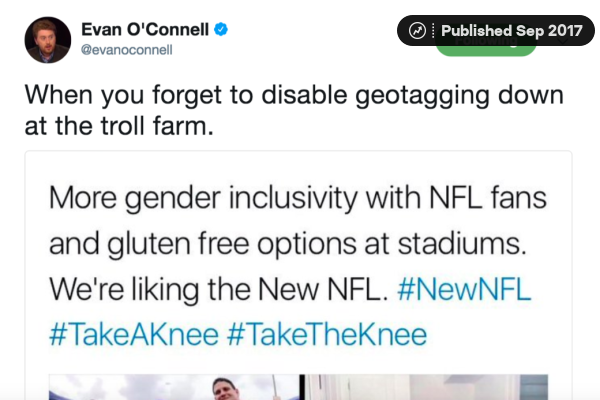
Was This Banned Fake Antifa Twitter Account Actually Troll Tweeting From Russia?
Some say the geotag is fake, but others disagree, arguing a true troll wouldn’t try to seem like a Russian troll slipping up. Welcome to 2017.
Ukrainian strikes on data centres and Russian bot activity in freefall
Ukrainian President Volodymyr Zelenskyy said social media had become less hostile following Kyiv's strikes on Russian technology giant Yandex's data centres, as web users report plummeting bot activity.

Did “Russian bot traffic” really disappear after Ukrainian strikes on Yandex servers?
Despite multiple Ukrainian strikes hitting Yandex servers in Russia, a thread by antibot4navalny, which has long tracked state-sponsored social media campaigns and troll farms, explains that the Cloudflare “Bot Traffic” chart many people have cited is really about automated web crawlers operated by Yandex accessing the web. It’s not connected to “bots” posting on social media, and Russian bot/crawler traffic overall continues to be about the same as normal. Still, are you noticing any difference in the posts and comments you’ve seen online? [Media: https://bsky.app/profile/antibot4navalny.bsky.social/post/3mxmv7t6nxc27]

What It's Like to Be a Popular 'Weird Twitter' Personality
Is it strange going from tweeting jokes to 30 followers to suddenly having a captive audience of thousands?

Scam!
64K votes, 1.2K comments. 719K subscribers in the NonPoliticalTwitter community. Twitter and Bluesky without the politics. Come vibe with us as we…
Auditing Political Exposure Bias: Algorithmic Amplification on Twitter/X During the 2024 U.S. Presidential Election
Approximately 50% of tweets in X's user timelines are personalized recommendations from accounts they do not follow. This raises a critical question: What political content are users exposed to beyond their established networks, and what implications does this have for democratic discourse online? In this paper, we present a six-week audit of X's algorithmic content recommendations during the 2024 U.S. Presidential Election by deploying 120 sock-puppet monitoring accounts to capture tweets from their personalized "For You" timelines. Our objective is to quantify out-of-network content exposure for right- and left-leaning user profiles and assess any potential inequalities and biases in political exposure. Our findings indicate that X's algorithm skews exposure toward a few high-popularity accounts across all users, with right-leaning users experiencing the highest level of exposure inequality. Both left- and right-leaning users encounter amplified exposure to accounts aligned with their own political views and reduced exposure to opposing viewpoints. Additionally, we observe that new accounts experience a right-leaning bias in exposure within their default timelines. Our work contributes to understanding how content recommendation systems may induce and reinforce biases while exacerbating vulnerabilities among politically polarized user groups. We underscore the importance of transparency-aware algorithms in addressing critical issues such as safeguarding election integrity and fostering a more informed digital public sphere.

Zelensky: Social media feels easier to breathe in after attacks on Yandex
Ukrainian strikes on Yandex data centers in response to Russian attacks on data centers in Ukraine have led to a decrease in the presence of malicious bots on social media. — Ukrinform.
Did Ukrainian strikes on Russian datacentres reduce online disinformation?
While some viral online graphs suggest less bot activity, Zelenskyy’s claims of improved social media discourse do not entirely pass muster
Evaluating Twitter’s algorithmic amplification of low-credibility content: an observational study
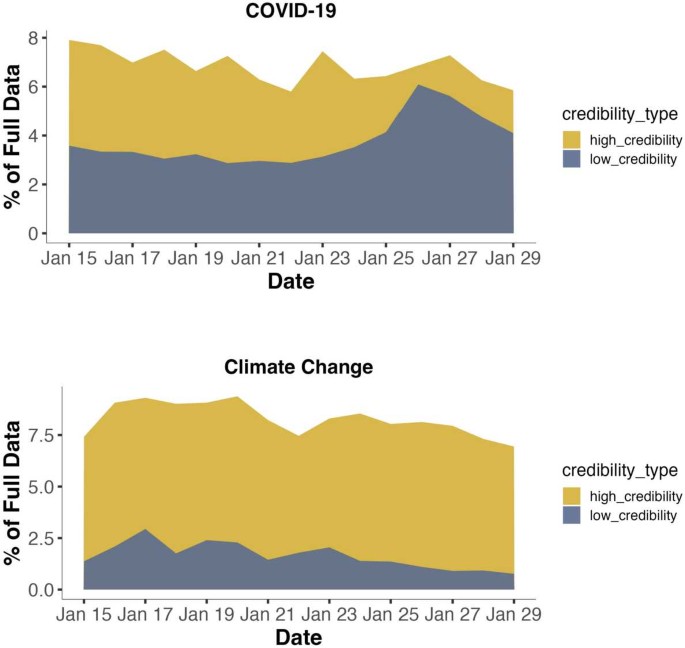
Artificial intelligence (AI)-powered recommender systems play a crucial role in determining the content that users are exposed to on social media platforms. However, the behavioural patterns of these systems are often opaque, complicating the evaluation of their impact on the dissemination and consumption of disinformation and misinformation. To begin addressing this evidence gap, this study presents a measurement approach that uses observed digital traces to infer the status of algorithmic amplification of low-credibility content on Twitter over a 14-day period in January 2023. Using an original dataset of ≈ 2.7 million posts on COVID-19 and climate change published on the platform, this study identifies tweets sharing information from low-credibility domains, and uses a bootstrapping model with two stratifications, a tweet’s engagement level and a user’s followers level, to compare any differences in impressions generated between low-credibility and high-credibility samples. Additional stratification variables of toxicity, political bias, and verified status are also examined. This analysis provides valuable observational evidence on whether the Twitter algorithm favours the visibility of low-credibility content, with results indicating that, on aggregate, tweets containing low-credibility URL domains perform better than tweets that do not across both datasets. However, this effect is largely attributable to a difference in high-engagement, high-followers tweets, which are very impactful in terms of impressions generation, and are more likely receive amplified visibility when containing low-credibility content. Furthermore, high toxicity tweets and those with right-leaning bias see heightened amplification, as do low-credibility tweets from verified accounts. Ultimately, this suggests that Twitter’s recommender system may have facilitated the diffusion of false content by amplifying the visibility of low-credibility content with high-engagement generated by very influential users.
Evaluating Twitter’s algorithmic amplification of low-credibility content: an observational study
Artificial intelligence (AI)-powered recommender systems play a crucial role in determining the content that users are exposed to on social media platforms. However, the behavioural patterns of these systems are often opaque, complicating the evaluation of their impact on the dissemination and consumption of disinformation and misinformation. To begin addressing this evidence gap, this study presents a measurement approach that uses observed digital traces to infer the status of algorithmic amplification of low-credibility content on Twitter over a 14-day period in January 2023. Using an original dataset of ≈ 2.7 million posts on COVID-19 and climate change published on the platform, this study identifies tweets sharing information from low-credibility domains, and uses a bootstrapping model with two stratifications, a tweet’s engagement level and a user’s followers level, to compare any differences in impressions generated between low-credibility and high-credibility samples. Additional stratification variables of toxicity, political bias, and verified status are also examined. This analysis provides valuable observational evidence on whether the Twitter algorithm favours the visibility of low-credibility content, with results indicating that, on aggregate, tweets containing low-credibility URL domains perform better than tweets that do not across both datasets. However, this effect is largely attributable to a difference in high-engagement, high-followers tweets, which are very impactful in terms of impressions generation, and are more likely receive amplified visibility when containing low-credibility content. Furthermore, high toxicity tweets and those with right-leaning bias see heightened amplification, as do low-credibility tweets from verified accounts. Ultimately, this suggests that Twitter’s recommender system may have facilitated the diffusion of false content by amplifying the visibility of low-credibility content with high-engagement generated by very influential users.
By popular demand: A follow-up thread on Russian bots, Yandex, Cloudflare, MAGA, AfD and "breathing easier" on social media. 1️⃣ We see no "dramatic drop" in traffic of Kremlin-aligned human trolls-for-hire targeting Russian domestic users (which we have been tracking for years).
