

A little historical baggage can be a dangerous thing when multiplied by a few hundred million individuals
The Four Big Risks | Silicon Valley Product Group
In the first edition of my book, INSPIRED, I discussed how successful products are valuable, usable and feasible, where I defined “valuable” as both valuable to customers and valuable to your business. While it’s easy to remember these three attributes, over the years I’ve come to believe that it was obscuring some pretty serious risks and...

The Fediverse of Things
One of the most frustrating things in modern technology is the effort spent trying to artificially restrict abundance. Take, for example, this tale from museum-worker Aaron Cope: I was out with a friend who worked for Twitter and I asked them whether it would be possible for the museum to “create 200,000 Twitter accounts, one for each object in the Cooper Hewitt’s collection”. My friend looked a…

The Fediverse of Things
One of the most frustrating things in modern technology is the effort spent trying to artificially restrict abundance. Take, for example, this tale from museum-worker Aaron Cope: I was out with a friend who worked for Twitter and I asked them whether it would be possible for the museum to “create 200,000 Twitter accounts, one for each object in the Cooper Hewitt’s collection”. My friend looked a…
Dangerous Technology For Americans Only
AI nationalism, safety and European weakness.

Systems of Wealth Hoarding Hide in Your Mind
The internet is exploding with conversations about the Panama Papers — the largest data dump in history of secret files about rich people…

This Is How Your Fear and Outrage Are Being Sold for Profit
The story of how one metric has changed the way you see the world

The people paid to spot risks see high chance of ‘global catastrophe’ within 10 years | CNN Business
Humanity faces a perilous future, marked by an explosion of disinformation turbocharged by artificial intelligence and the devastating effects of climate change.

banteg (@banteg)
>be me >discover effective altruism >apparently normal charity is inefficient >why donate to random sad thing when spreadsheet can tell you optimal sad thing >fair enough >buy mosquito nets >save lives >numbers look good >feel powerful >couple years later >someone asks an innocent question >why only count people alive today >huh >future people matter too >obviously >my grandchildren shouldn't matter less just because they haven't spawned yet >reasonable.jpg >keep following logic >what about their grandchildren >also yes >what about people in 500 years >sure >5000 years >why not >500 million years >starting to get weird but morality is morality >open calculator >humanity could survive for an astronomically long time >could colonize galaxy >could have trillions upon trillions of descendants >maybe digital people too >maybe simulated civilizations >maybe dyson spheres full of happy uploaded minds >calculator starts smoking >realize currently living humans are rounding error >8 billion people suddenly looking extremely beta >future contains potentially 10^something people >can't even fit beneficiaries in google sheets >new moral priority unlocked >protect the long-term future >stop thinking in units of "people helped" >start thinking in "fraction of cosmic endowment preserved" >malaria? >terrible >but only kills existing humans >AI extinction could delete the entire light cone >nuclear war could permanently derail civilization >bad institutions could lock in terrible values for ten million years >someone invents wrong constitution in 2140 >quadrillions suffer >better fund governance workshop now >friend says maybe we should improve hospitals >explain opportunity cost >friend says hospitals are full of actual sick people >explain scope sensitivity >friend stops inviting me to dinner >need to decide what to fund >easy >expected value >suppose project has one in a million chance of preventing extinction >sounds tiny >but extinction destroys 10^50 future lives >multiply >mother of god >$10 million project has expected value of several galaxies >charity evaluation complete >someone asks where the one-in-a-million number came from >expert judgement >which expert >us >how calibrated >extremely thoughtfully >reduce estimate to one in ten million to be conservative >still beats curing cancer by 38 orders of magnitude >epistemic robustness achieved >someone says maybe project doesn't work >assign 20% chance >still astronomical >maybe project makes problem worse >assign 5% chance >still astronomical >why 5 >because 30 felt pessimistic >publish 46-page report >contains seventeen sensitivity analyses >every sensitivity analysis begins after assuming intervention has positive sign >critic says you're multiplying enormous hypothetical stakes by extremely uncertain probabilities >yes >that's literally why it's important >critic says the uncertainty might be structural rather than numerical >make probability smaller >critic says no, I mean maybe your model is wrong >make probability smaller again >critic begins rubbing temples >discover AI safety >perfect longtermist cause >AI might kill everyone >or create utopia >or seize galaxy >or tile universe with paperclips >or create billions of conscious software minds >finally a problem with numbers big enough for me >start AI safety nonprofit >mission: prevent dangerous AI >hire smartest people available >smartest people immediately start building better AI to understand dangerous AI >interesting >we must understand capabilities to understand safety >we must scale models to study alignment >we must race ahead so less responsible actors don't get there first >we must deploy systems to learn how deployment can go wrong >we must build the thing quickly because building the thing quickly is dangerous >outsider asks why the people most worried about AI apocalypse all work at AI companies >complicated field >company releases stronger model >very concerned >company begins training even stronger model >extremely concerned >company raises $14 billion >concern reaches unprecedented levels >need to influence government >future is at stake >normal democratic process too slow >politicians don't understand exponential curves >public doesn't understand x-risk >experts must guide them >who counts as expert >people who understand x-risk >who understands x-risk >our friends >someone objects that this seems politically convenient >explain we're representing future generations >future generations unavailable for comment >develop concept of value lock-in >terrifying possibility that one ideology controls civilization forever >therefore extremely important that civilization adopts correct values before lock-in >whose values >let's circle back >begin with impartial morality >end with small group of people deciding what quadrillions of hypothetical beings would want >beautiful arc >meanwhile actual humans keep doing annoying things >voting wrong >having parochial attachments >loving family more than strangers >caring about local community >getting upset when told their suffering is cosmically negligible >evolutionary biases everywhere >explain that moral intuition cannot be trusted >except intuition that future digital people count >and intuition that extinction is uniquely bad >and intuition that our probability estimates are sane >and intuition that our institutional choices improve the future >those intuitions survived peer review >someone donates $5k to local homeless shelter >inefficient >could have funded 0.0000000000003% of an AI governance researcher >think of all the simulated people you just killed >okay maybe don't phrase it that way publicly >PR team says "future generations deserve a voice" >much better >journalist asks what longtermism means >say "future people matter" >everyone agrees >great >journalist asks what follows from that >well technically we should redirect enormous resources toward low-probability interventions affecting astronomical futures >journalist raises eyebrow >return to "future people matter" >motte has entered the chat >critic: of course future people matter >me: glad we agree >critic: I don't agree that your institute knows how to help them >me: why do you hate our grandchildren >eventually notice uncomfortable implication >if future value dominates everything >then helping people today mostly matters through effects on future >education matters because future institutions >health matters because future productivity >democracy matters because future trajectory >human beings slowly become instrumental variables in their own moral philosophy >see starving child >feel compassion >check spreadsheet >child's direct welfare contribution negligible >but perhaps childhood nutrition improves national institutional quality >compassion restored >tell myself this is impartial altruism >one day assistant asks obvious question >"how do you know your intervention actually improves the far future?" >silence >open spreadsheet >increase column width >add confidence interval >assistant asks again >"no, I mean how do you know the sign is positive?" >stare into cosmic light cone >10^50 people staring back >none of them exist >none of them can tell me >none of them can falsify my assumptions >realize I have invented the perfect constituency >infinitely important >completely silent >and always represented by me
Ledger of Harms
Under immense pressure to prioritize engagement and growth, technology platforms have created a race for human attention that’s unleashed invisible harms to society. Here are some of the costs that aren't showing up on their balance sheets.
Effective Altruism Is Pushing a Dangerous Brand of ‘AI Safety’
This philosophy—supported by tech figures like Sam Bankman-Fried—fuels the AI research agenda, creating a harmful system in the name of saving humanity
You’ve Been Played
How games are being harnessed as instruments of exploitation—and what we can do about it Warehouse workers pack boxes while a virtual dragon races across...

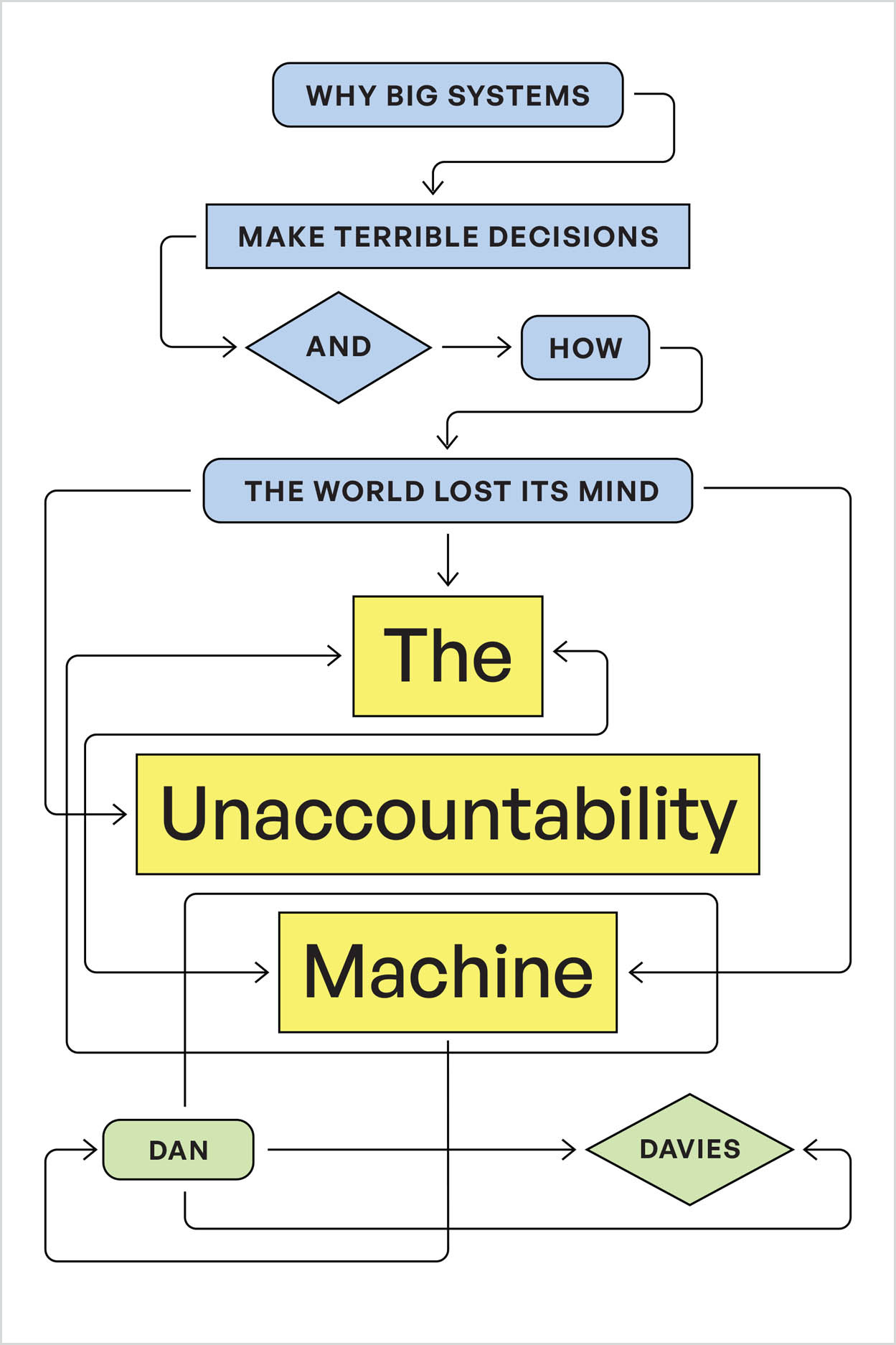
The Unaccountability Machine: Why Big Systems Make Terrible Decisions—and How the World Lost Its Mind
Longlisted for the 2024 Financial Times Book of the Year. How life and the economy became a black box—a collection of systems no one understands, producing outcomes no one likes. Passengers get bumped from flights. Phone menus disconnect. Automated financial trades produce market collapse. Of all the challenges in modern life, some of the most vexing come from our relationships with automation: a large system does us wrong, and there’s nothing we can do about it. The problem, economist Dan Davies shows, is accountability sinks: systems in which decisions are delegated to a complex rule book or set of standard procedures, making it impossible to identify the source of mistakes when they happen. In our increasingly unhuman world—lives dominated by algorithms, artificial intelligence, and large organizations—these accountability sinks produce more than just aggravation. They make life and economy unknowable—a black box for no reason. In The Unaccountability Machine, Davies lays bare how markets, institutions, and even governments systematically generate outcomes that no one—not even those involved in making them—seems to want. Since the earliest days of the computer age, theorists have foreseen the dangers of complex systems without personal accountability. In response, British business scholar Stafford Beer developed an accountability-first approach to management called “cybernetics,” which might have taken off had his biggest client (the Chilean government) not fallen to a bloody coup in 1973. With his signature blend of economic and journalistic rigor, Davies examines what’s gone wrong since Beer, including what might have been had the world embraced cybernetics when it had the chance. The Unaccountability Machine is a revelatory and resonant account of how modern life became predisposed to dysfunction.
Safety Co-Option and Compromised National Security: The Self-Fulfilling Prophecy of Weakened AI Risk Thresholds
Risk thresholds provide a measure of the level of risk exposure that a society or individual is willing to withstand, ultimately shaping how we determine the safety of technological systems. Against the backdrop of the Cold War, the first risk analyses, such as those devised for nuclear systems, cemented societally accepted risk thresholds against which safety-critical and defense systems are now evaluated. But today, the appropriate risk tolerances for AI systems have yet to be agreed on by global governing efforts, despite the need for democratic deliberation regarding the acceptable levels of harm to human life. Absent such AI risk thresholds, AI technologists-primarily industry labs, as well as "AI safety" focused organizations-have instead advocated for risk tolerances skewed by a purported AI arms race and speculative "existential" risks, taking over the arbitration of risk determinations with life-or-death consequences, subverting democratic processes. In this paper, we demonstrate how such approaches have allowed AI technologists to engage in "safety revisionism," substituting traditional safety methods and terminology with ill-defined alternatives that vie for the accelerated adoption of military AI uses at the cost of lowered safety and security thresholds. We explore how the current trajectory for AI risk determination and evaluation for foundation model use within national security is poised for a race to the bottom, to the detriment of the US's national security interests. Safety-critical and defense systems must comply with assurance frameworks that are aligned with established risk thresholds, and foundation models are no exception. As such, development of evaluation frameworks for AI-based military systems must preserve the safety and security of US critical and defense infrastructure, and remain in alignment with international humanitarian law.

And it's too politically convenient to be accidental. 'Oops, we somehow invented a machine that makes it nearly impossible to teach our young people history, law, literature, or moral & political philosophy, exactly the type of machine that every tyrant of the last 1000 years would have killed for'

Josh Shepperd
Every reason that I became an academic is disappearing.

