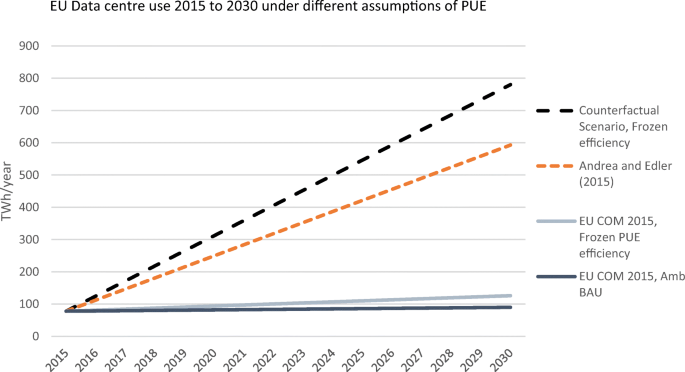
End-use efficiency, demand response and coupling of different energy vectors are important aspects of future renewable energy systems. Growth in the number of data centres is leading to an increase in electricity demand and the emergence of a new electricity-intensive industry. Studies on data centres and energy use have so far focused mainly on energy efficiency. This paper contributes with an assessment of the potential for energy system integration of data centres via demand response and waste heat utilization, and with a review of EU policies relevant to this. Waste heat utilization is mainly an option for data centres that are close to district heating systems. Flexible electricity demand can be achieved through temporal and spatial scheduling of data centre operations. This could provide more than 10 GW of demand response in the European electricity system in 2030. Most data centres also have auxiliary power systems employing batteries and stand-by diesel generators, which could potentially be used in power system balancing. These potentials have received little attention so far and have not yet been considered in policies concerning energy or data centres. Policies are needed to capture the potential societal benefits of energy system integration of data centres. In the EU, such policies are in their nascent phase and mainly focused on energy efficiency through the voluntary Code of Conduct and criteria under the EU Ecodesign Directive. Some research and development in the field of energy efficiency and integration is also supported through the EU Horizon 2020 programme. Our analysis shows that there is considerable potential for demand response and energy system integration. This motivates greater efforts in developing future policies, policy coordination, and changes in regulation, taxation and electricity market design.
Energy performance of data centres
The Commission’s energy efficiency package for data centres will complement existing EU rules for data centres under the Energy Efficiency Directive.

Assessment of the energy performance and sustainability of data centres in EU: first technical report.
This document represents the deliverable ‘First Technical Report’ for the project Study on Technical Assistance in support of implementing Article 12(5) of Directive 2023/1791 on the energy performance and sustainability of data centres, and has been produced by EY, AIT and Borderstep for the European Commission. The technical report assesses data centre energy efficiency and sustainability, and the reporting scheme of the Delegated Regulation 2024/1364. It uses reported data, supplemented where necessary, and evaluates energy performance via sustainability and key performance indicators. The report also addresses data quality and completeness and proposes improvements for the reporting scheme, including in terms of the reported information and indicators and user experience.
Assessment of next steps to promote the energy performance and sustainability of data centres in EU, including the establishment of an EU-wide rating scheme
This document represents the deliverable 'Second Technical Report' for the project Study on Technical Assistance in support of implementing Article 12(5) of Directive 2023/1791 on the energy performance and sustainability of data centres, and has been produced by EY, AIT and Borderstep for the European Commission. The technical report assesses data centre energy efficiency and sustainability, and the reporting scheme of the Delegated Regulation 2024/1364. It uses reported data, supplemented where necessary, and evaluates energy performance via sustainability and key performance indicators. The report also addresses data quality/completeness and proposes reporting scheme improvements, including information/indicators and user experience.
Decoding Europe’s Data Centre Landscape: An Analysis based on the EU EED DC Dashboard
The rapid expansion of digital infrastructure has made data centres a focal point of European energy and climate policy. Under the recast Energy Efficiency Directive (EED), the European Union established a public Data Centre Registry and Dashboard to enforce unprecedented transparency on energy and environmental related performance. However, initial releases of these official datasets present substantial challenges regarding data completeness and reporting anomalies, limiting their immediate usability for empirical policy assessment. This paper presents a comprehensive analysis and systematic refinement of the initial published dataset. We developed an automated data-processing workstream to validate registry disclosures, filter statistical outliers, and resolve data gaps by recalculating core metrics, including calculated average Power Usage Effectiveness (PUE), utilization rates, and data centre capacity relative to national economic indicators. Our findings uncover significant regional variations in energy efficiency and infrastructure density and utilisation across Europe, characterized by a sharp geographic efficiency gradient favoring northern member states. Furthermore, evaluating the framework's effectiveness reveals structural data quality issues, yielding an estimated overall EU data centre coverage rate of just 38 % alongside critical reporting anomalies, such as theoretical utilization rates exceeding 100 % in select member states. Ultimately, this study establishes a highly curated baseline of the current European digital infrastructure landscape and provides a refined, reliable dataset to track the sector's trajectory toward net-zero goals.
US data centers’ energy use amid the artificial intelligence boom
Data centers accounted for 4% of total U.S. electricity use in 2024. Their energy demand is expected to more than double by 2030.

What Happens When Data Centers Come to Town?
The rapid growth of data centers, with their enormous energy and water demands, necessitates targeted policy interventions to mitigate environmental impacts and protect local communities. To address these issues, states with existing data center tax breaks should adopt sustainable growth policies for data centers, mandating energy audits, strict performance standards, and renewable energy integration, while also requiring transparency in energy usage reporting. “Renewable energy additionality” clauses should ensure data centers contribute to new renewable capacity rather than relying on existing resources.

The Impact of Digital Business on Energy Efficiency in EU Countries
Digital business plays a crucial role in driving energy efficiency and sustainability by enabling innovative solutions such as smart grid technologies, data analytics for energy optimization, and remote monitoring and control systems. Through digitalization, businesses can streamline processes, minimize energy waste, and make informed decisions that lead to more efficient resource utilization and reduced environmental impact. This paper aims at analyzing the character of digital business� impact on energy efficiency to outline the relevant instruments to unleash EU countries� potential for attaining sustainable development. The study applies the panel-corrected standard errors technique to check the effect of digital business on energy efficiency for the EU countries in 2011�2020. The findings show that digital business has a significant negative effect on energy intensity, implying that increased digital business leads to decreased energy intensity. Additionally, digital business practices positively contribute to reducing CO2 emissions and promoting renewable energy, although the impact on final energy consumption varies across different indicators. The findings underscore the significance of integrating digital business practices to improve energy efficiency, lower energy intensity, and advance the adoption of renewable energy sources within the EU. Policymakers and businesses should prioritize the adoption of digital technologies and e-commerce strategies to facilitate sustainable energy transitions and accomplish environmental objectives.

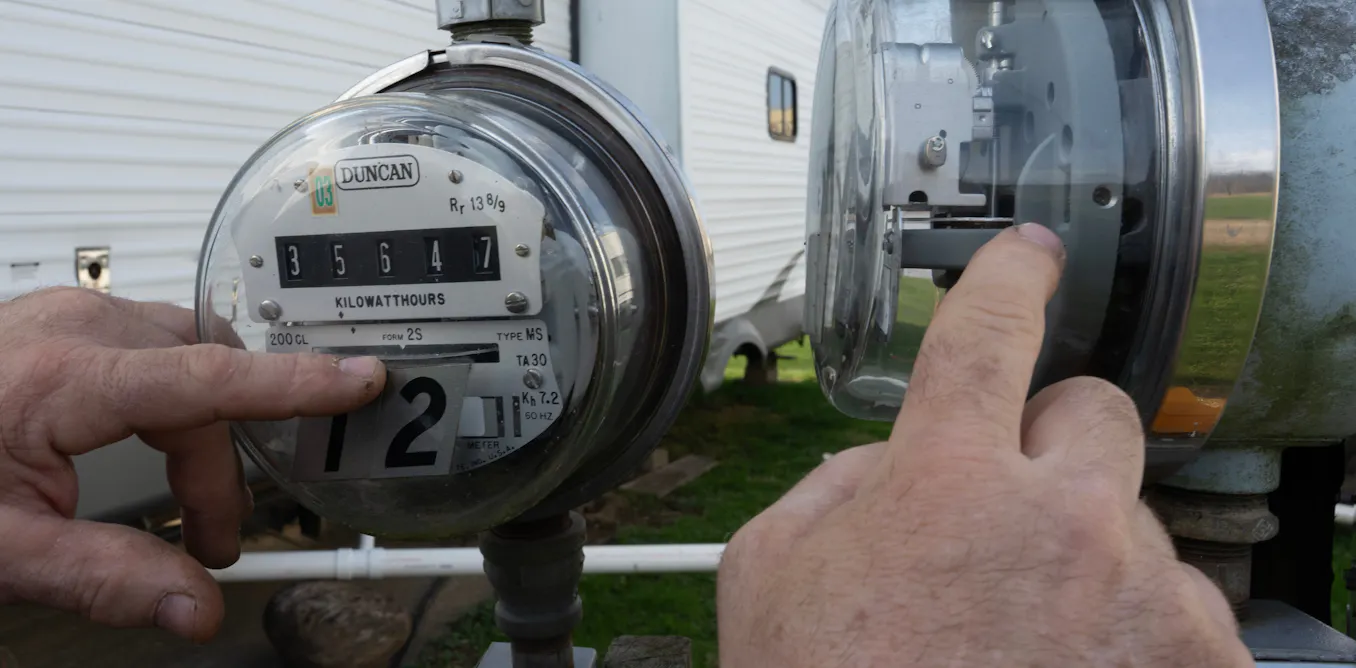
It may be almost impossible to make data centers pay their ‘fair share’ of electricity costs
Setting a price for power might seem straightforward, but in reality it’s extremely complicated – and residential customers have very little influence in the decision.
It may be almost impossible to make data centers pay their ‘fair share’ of electricity costs
Setting a price for power might seem straightforward, but in reality it’s extremely complicated – and residential customers have very little influence in the decision.
The Race to Rethink Data Centers for AI’s Power Surge
With energy demand already straining infrastructure, AI players are reimagining the data center from the ground up.

The UK tech energy grab: how AI data centres are delaying the building of homes
Artificial intelligence infrastructure is being handed priority access to Britain's overwhelmed electricity grid, pushing housing down the list. But as the US shows, there's an alternative: make Big Tech pay for the power it needs. Report by Nicole Kobie

Health-Informed Computing: Estimating and Addressing the Public Health Impact of Data Centers
The surging demand for artificial intelligence (AI) has led to a rapid expansion of energy-intensive data centers, contributing to criteria air pollutant emissions and raising public health concerns that have received comparatively limited attention in sustainability assessments. This paper introduces a principled methodology to model air pollutant emissions for data centers and estimate the public health impacts. Our findings reveal that the growing demand for AI and computing technologies is projected to push the total annual public health burden of U.S. data centers up to more than $20 billion in 2028. Although national-level impacts remain modest, data center health costs are unevenly distributed: in the most affected counties, the estimated per-household health burden can reach about seven times the national average. Next, we propose a health-informed computing framework that explicitly incorporates public health impacts into data center resource management across space and time, mitigating public health costs while supporting environmental sustainability. More broadly, we recommend extended energy reporting to include public health impact of data centers and paying attention to all impacted communities.

Health-Informed Computing: Estimating and Addressing the Public Health Impact of Data Centers
The surging demand for artificial intelligence (AI) has led to a rapid expansion of energy-intensive data centers, contributing to criteria air pollutant emissions and raising public health concerns that have received comparatively limited attention in sustainability assessments. This paper introduces a principled methodology to model air pollutant emissions for data centers and estimate the public health impacts. Our findings reveal that the growing demand for AI and computing technologies is projected to push the total annual public health burden of U.S. data centers up to more than $20 billion in 2028. Although national-level impacts remain modest, data center health costs are unevenly distributed: in the most affected counties, the estimated per-household health burden can reach about seven times the national average. Next, we propose a health-informed computing framework that explicitly incorporates public health impacts into data center resource management across space and time, mitigating public health costs while supporting environmental sustainability. More broadly, we recommend extended energy reporting to include public health impact of data centers and paying attention to all impacted communities.
US views of how data centers affect the environment, energy costs, jobs and more
A broad majority of Americans have heard about data centers – the often-sprawling computing facilities that are popping up nationwide. But the public has mixed opinions about data centers’ impact…

Are Africa’s power grids ready for the AI data centre boom?
African countries should plan for the AI economy by developing power and digital systems together, and treating data centres as strategic infrastructure.
Data Centers - Database
Data Centers in Worldwide - List of Colocation and Cloud data facilities in Worldwide. Get Quotes and find Specs, Photos, Videos etc.