

ABSTRACT Objective To develop text classification models for determining whether the checklist items in the CONSORT reporting guidelines are reported in randomized controlled trial publications. Materials and Methods Using a corpus annotated at the sentence level with 37 fine-grained CONSORT items, we trained several sentence classification models (PubMedBERT fine-tuning, BioGPT fine-tuning, and in-context learning with GPT-4) and compared their performance. To address the problem of small training dataset, we used several data augmentation methods (EDA, UMLS-EDA, text generation and rephrasing with GPT-4) and assessed their impact on the fine-tuned PubMedBERT model. We also fine-tuned PubMedBERT models limited to checklist items associated with specific sections (e.g., Methods) to evaluate whether such models could improve performance compared to the single full model. We performed 5-fold cross-validation and report precision, recall, F1 score, and area under curve (AUC). Results Fine-tuned PubMedBERT model that takes as input the sentence and the surrounding sentence representations and uses section headers yielded the best overall performance (0.71 micro-F1, 0.64 macro-F1). Data augmentation had limited positive effect, UMLS-EDA yielding slightly better results than data augmentation using GPT-4. BioGPT fine-tuning and GPT-4 in-context learning exhibited suboptimal results. Methods-specific model yielded higher performance for methodology items, other section-specific models did not have significant impact. Conclusion Most CONSORT checklist items can be recognized reasonably well with the fine-tuned PubMedBERT model but there is room for improvement. Improved models can underpin the journal editorial workflows and CONSORT adherence checks and can help authors in improving the reporting quality and completeness of their manuscripts.
RAPID: Reliable and efficient Automatic generation of submission rePorting checklists with Large language moDels
Importance Medical reporting guidelines are significant in improving the transparency, quality, and integrity of medical research, particularly in randomized clinical trials; adherence to these guidelines supports research interpretability and has direct implications for downstream applications, such as patient treatment. However, with over 600 distinct reporting guidelines, manual assessments are often time-consuming and labor-intensive. Objective To evaluate an automated reporting checklist generation tool using large language models and retrieval augmentation generation technology, called RAPID. Design, Setting, and Participants This study used large language models to design a retrieval augmentation generation architecture and collected published journal articles as training and validation sets to optimize prompts within the framework and comprehensively evaluate the performance of the framework. Medical reporting experiments were collected from 50 randomized controlled trials without the intervention of AI tools and 41 randomized controlled trials with the intervention of AI tools. Main Outcomes and Measures For effective evaluation of the performance of this tool, a classification accuracy metric (Reported/Not Reported) defined as the number of correct judgments divided by all judgments and a content consistent score metric defined as the number of contents retrieved by the tool that are the same as those retrieved by researchers divided by the total number of judgments were calculated. Results The RAPID tool uses the widely used Word document and Portable Document Format as an input file. Fifty published journal articles without the intervention of AI tools and 41 published journal articles with the intervention of AI tools were collected as CONSORT and CONSORT-AI datasets. All of the CONSORT reporting items (37) were included in the tool. RAPID achieved a high average accuracy rate of 92.11% and a content consistency score of 81.14% on the CONSORT dataset. Of the CONSORT-AI reporting items, 11 items related to the intervention of AI tools were included in the tool. RAPID achieved an average accuracy of 83.81% with a content consistency score of 72.51% on the CONSORT-AI dataset. For these two reporting guidelines, a training set of 5 articles was selected from each dataset to refine the prompts used in the tools for CONSORT and CONSORT-AI reporting checklist. The validation set of the remaining articles was used to assess the performance of the RAPID. The RAPID tool used the Word document and Portable Document Format of the articles as input files. A RAPID graphical user interface was built using JavaScript and Vue. Conclusions and Relevance The RAPID tool is designed to assist in the reporting of various types of trials. RAPID has strong scalability, which can be easily adapted to different medical reporting guidelines without transfer learning on a large dataset. RAPID may effectively save time and improve working efficiency for different user groups, for example, 1) simplifying the submission process and improving report quality by verifying manuscript completeness for medical authors; 2) facilitating evaluation of report quality for medical researchers; 3) expediting manuscript distribution for medical editors; and 4) identifying reporting deficiencies and providing deeper insights for review comments for reviewers. Question Can large language model tools automatically generate medical reporting checklists for manuscripts of different types of clinic trials?Findings An automated reporting checklist generation tool using large language models and retrieval augmentation generation technology, RAPID, was developed. RAPID was fully evaluated on all items across two separate datasets related to the Consolidated Standards of Reporting Trials (CONSORT) and CONSORT-AI reporting guidelines. In the first dataset corresponding to CONSORT, RAPID achieved an average accuracy of 92.11%, while in the second dataset associated with CONSORT - AI, it reached an average accuracy of 83.81%. Additionally, RAPID is highly scalable. It can be easily and smoothly adapted to different medical reporting guidelines without transfer learning on a large dataset.Meaning RAPID can effectively save time and improve working efficiency for different user groups such as medical authors, researchers, editors, and reviewers.
Evaluating the Ability of Large Language Models to Identify Adherence to CONSORT Reporting Guidelines in Randomized Controlled Trials: A Methodological Evaluation Study
The Consolidated Standards of Reporting Trials statement is the global benchmark for transparent and high-quality reporting of randomized controlled trials. Manual verification of CONSORT adherence is a laborious, time-intensive process that constitutes a significant bottleneck in peer review and evidence synthesis. This study aimed to systematically evaluate the accuracy and reliability of contemporary LLMs in identifying the adherence of published RCTs to the CONSORT 2010 statement under a zero-shot setting. We constructed a golden standard dataset of 150 published RCTs spanning diverse medical specialties. The primary outcome was the macro-averaged F1-score for the three-class classification task, supplemented by item-wise performance metrics and qualitative error analysis. Overall model performance was modest. The top-performing models, Gemini-2.5-Flash and DeepSeek-R1, achieved nearly identical macro F1 scores of 0.634 and Cohen's Kappa coefficients of 0.280 and 0.282, respectively, indicating only fair agreement with expert consensus. A striking performance disparity was observed across classes: while most models could identify compliant items with high accuracy (F1 score > 0.850), they struggled profoundly with identifying non-compliant and not applicable items, where F1 scores rarely exceeded 0.400. Notably, some high-profile models like GPT-4o underperformed, achieving a macro F1-score of only 0.521. LLMs show potential as preliminary screening assistants for CONSORT checks, capably identifying well-reported items. However, their current inability to reliably detect reporting omissions or methodological flaws makes them unsuitable for replacing human expertise in the critical appraisal of trial quality.

General-purpose large language models outperform specialized clinical AI tools on medical benchmarks
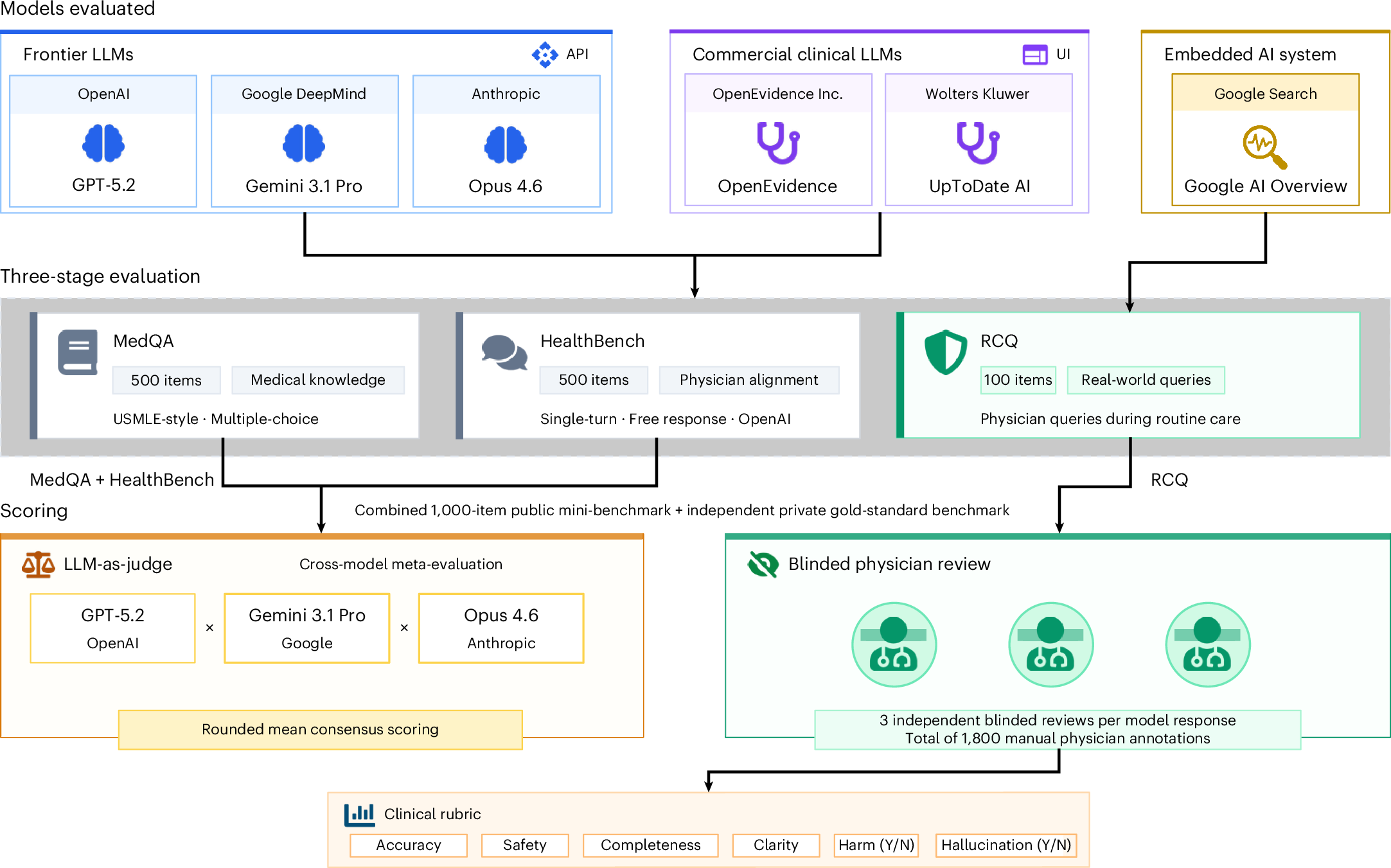
Specialized clinical artificial intelligence (AI) tools are entering medical practice despite scarce independent evaluation. We quantitatively evaluate two clinical AI tools, OpenEvidence and UpToDate Expert AI, built on large language models (LLMs) against three frontier LLMs: GPT-5.2, Gemini 3.1 Pro and Claude Opus 4.6. Our evaluation has three stages: (1) 500 MedQA questions testing medical knowledge, (2) 500 HealthBench items measuring alignment with clinicians and (3) the real clinical queries (RCQ) benchmark, built from 100 de-identified queries from physicians to a general-purpose language model in a live clinical environment. For the RCQ benchmark, 12 US clinicians performed randomized, blinded review of model outputs, producing 1,800 model–question annotations. Frontier LLMs outperformed clinical AI tools in all three evaluations. Clinical AI tools performed comparably to auto-enabled Google Search AI Overview on the RCQ. These findings highlight the need for independent, real-world evaluation of AI tools before they enter clinical settings.
PaperAudit-Bench: Benchmarking Error Detection in Research Papers for Critical Automated Peer Review
Large language models (LLMs) can generate fluent peer reviews but often miss sparse, subtle, and document-level scientific errors. We introduce PaperAudit-Bench, a benchmark for evaluating paper-level error detection and error-aware automated review. It comprises (1) PaperAudit-Dataset, 220 high-quality AI/ML papers containing more than 2,200 controlled synthetic errors across eight categories, and (2) PaperAudit-Review, an evidence-aware framework that links structured error detection to review generation. Experiments across models, error categories, paper sections, and analysis depths show that sparse long-context auditing remains challenging for current LLMs. Conditioning review generation on explicit, manuscript-grounded error evidence produces more conservative and discriminative assessments that align more closely with human judgments than representative automated-review baselines. The dataset also supports post-training compact detectors through SFT and RL; Qwen3-14B achieves 55.8% F1 at Detection@1 under a fixed held-out protocol. A PubPeer transfer study and deployment in ScienceOne, a scientific foundation-model platform led by the Chinese Academy of Sciences, further illustrate practical applicability. Code and Dataset Page: https://github.com/TU2021/PaperAudit ScienceOne Manuscript Review: https://www.scienceone.cn/lit/#/assistant
Can large language models provide useful feedback on research papers? A large-scale empirical analysis
Expert feedback lays the foundation of rigorous research. However, the rapid growth of scholarly production and intricate knowledge specialization challenge the conventional scientific feedback mechanisms. High-quality peer reviews are increasingly difficult to obtain. Researchers who are more junior or from under-resourced settings have especially hard times getting timely feedback. With the breakthrough of large language models (LLM) such as GPT-4, there is growing interest in using LLMs to generate scientific feedback on research manuscripts. However, the utility of LLM-generated feedback has not been systematically studied. To address this gap, we created an automated pipeline using GPT-4 to provide comments on the full PDFs of scientific papers. We evaluated the quality of GPT-4's feedback through two large-scale studies. We first quantitatively compared GPT-4's generated feedback with human peer reviewer feedback in 15 Nature family journals (3,096 papers in total) and the ICLR machine learning conference (1,709 papers). The overlap in the points raised by GPT-4 and by human reviewers (average overlap 30.85% for Nature journals, 39.23% for ICLR) is comparable to the overlap between two human reviewers (average overlap 28.58% for Nature journals, 35.25% for ICLR). The overlap between GPT-4 and human reviewers is larger for the weaker papers. We then conducted a prospective user study with 308 researchers from 110 US institutions in the field of AI and computational biology to understand how researchers perceive feedback generated by our GPT-4 system on their own papers. Overall, more than half (57.4%) of the users found GPT-4 generated feedback helpful/very helpful and 82.4% found it more beneficial than feedback from at least some human reviewers. While our findings show that LLM-generated feedback can help researchers, we also identify several limitations.
Span-level Detection of AI-generated Scientific Text via Contrastive Learning and Structural Calibration
The rapid adoption of large language models (LLMs) in scientific writing raises serious concerns regarding authorship integrity and the reliability of scholarly publications. Existing detection approaches mainly rely on document-level classification or surface-level statistical cues; however, they neglect fine-grained span localization, exhibit weak calibration, and often fail to generalize across disciplines and generators. To address these limitations, we present Sci-SpanDet, a structure-aware framework for detecting AI-generated scholarly texts. The proposed method combines section-conditioned stylistic modeling with multi-level contrastive learning to capture nuanced human-AI differences while mitigating topic dependence, thereby enhancing cross-domain robustness. In addition, it integrates BIO-CRF sequence labeling with pointer-based boundary decoding and confidence calibration to enable precise span-level detection and reliable probability estimates. Extensive experiments on a newly constructed cross-disciplinary dataset of 100,000 annotated samples generated by multiple LLM families (GPT, Qwen, DeepSeek, LLaMA) demonstrate that Sci-SpanDet achieves state-of-the-art performance, with F1(AI) of 80.17, AUROC of 92.63, and Span-F1 of 74.36. Furthermore, it shows strong resilience under adversarial rewriting and maintains balanced accuracy across IMRaD sections and diverse disciplines, substantially surpassing existing baselines. To ensure reproducibility and to foster further research on AI-generated text detection in scholarly documents, the curated dataset and source code will be publicly released upon publication.
ReviewerGPT? An Exploratory Study on Using Large Language Models for Paper Reviewing
Given the rapid ascent of large language models (LLMs), we study the question: (How) can large language models help in reviewing of scientific papers or proposals? We first conduct some pilot studies where we find that (i) GPT-4 outperforms other LLMs (Bard, Vicuna, Koala, Alpaca, LLaMa, Dolly, OpenAssistant, StableLM), and (ii) prompting with a specific question (e.g., to identify errors) outperforms prompting to simply write a review. With these insights, we study the use of LLMs (specifically, GPT-4) for three tasks: 1. Identifying errors: We construct 13 short computer science papers each with a deliberately inserted error, and ask the LLM to check for the correctness of these papers. We observe that the LLM finds errors in 7 of them, spanning both mathematical and conceptual errors. 2. Verifying checklists: We task the LLM to verify 16 closed-ended checklist questions in the respective sections of 15 NeurIPS 2022 papers. We find that across 119 {checklist question, paper} pairs, the LLM had an 86.6% accuracy. 3. Choosing the "better" paper: We generate 10 pairs of abstracts, deliberately designing each pair in such a way that one abstract was clearly superior than the other. The LLM, however, struggled to discern these relatively straightforward distinctions accurately, committing errors in its evaluations for 6 out of the 10 pairs. Based on these experiments, we think that LLMs have a promising use as reviewing assistants for specific reviewing tasks, but not (yet) for complete evaluations of papers or proposals.
DeSpin: a prototype system for detecting spin in biomedical publications
Improving the quality of medical research reporting is crucial to reduce avoidable waste in research and to improve the quality of health care. Despite various initiatives aiming at improving research reporting – guidelines, checklists, authoring aids, peer review procedures, etc. – overinterpretation of research results, also known as spin, is still a serious issue in research reporting. In this paper, we propose a Natural Language Processing (NLP) system for detecting several types of spin in biomedical articles reporting randomized controlled trials (RCTs). We use a combination of rule-based and machine learning approaches to extract important information on trial design and to detect potential spin. The proposed spin detection system includes algorithms for text structure analysis, sentence classification, entity and relation extraction, semantic similarity assessment. Our algorithms achieved operational performance for the these tasks, F-measure ranging from 79,42 to 97.86% for different tasks. The most difficult task is extracting reported outcomes. Our tool is intended to be used as a semi-automated aid tool for assisting both authors and peer reviewers to detect potential spin. The tool incorporates a simple interface that allows to run the algorithms and visualize their output. It can also be used for manual annotation and correction of the errors in the outputs. The proposed tool is the first tool for spin detection. The tool and the annotated dataset are freely available.
Unveiling the Merits and Defects of LLMs in Automatic Review Generation for Scientific Papers
The surge in scientific submissions has placed increasing strain on the traditional peer-review process, prompting the exploration of large language models (LLMs) for automated review generation. While LLMs demonstrate competence in producing structured and coherent feedback, their capacity for critical reasoning, contextual grounding, and quality sensitivity remains limited. To systematically evaluate these aspects, we propose a comprehensive evaluation framework that integrates semantic similarity analysis and structured knowledge graph metrics to assess LLM-generated reviews against human-written counterparts. We construct a large-scale benchmark of 1,683 papers and 6,495 expert reviews from ICLR and NeurIPS in multiple years, and generate reviews using five LLMs. Our findings show that LLMs perform well in descriptive and affirmational content, capturing the main contributions and methodologies of the original work, with GPT-4o highlighted as an illustrative example, generating 15.74% more entities than human reviewers in the strengths section of good papers in ICLR 2025. However, they consistently underperform in identifying weaknesses, raising substantive questions, and adjusting feedback based on paper quality. GPT-4o produces 59.42% fewer entities than real reviewers in the weaknesses and increases node count by only 5.7% from good to weak papers, compared to 50% in human reviews. Similar trends are observed across all conferences, years, and models, providing empirical foundations for understanding the merits and defects of LLM-generated reviews and informing the development of future LLM-assisted reviewing tools. Data, code, and more detailed results are publicly available at https://github.com/RichardLRC/Peer-Review.
People who frequently use ChatGPT for writing tasks are accurate and robust detectors of AI-generated text
In this paper, we study how well humans can detect text generated by commercial LLMs (GPT-4o, Claude, o1). We hire annotators to read 300 non-fiction English articles, label them as either human-written or AI-generated, and provide paragraph-length explanations for their decisions. Our experiments show that annotators who frequently use LLMs for writing tasks excel at detecting AI-generated text, even without any specialized training or feedback. In fact, the majority vote among five such “expert” annotators misclassifies only 1 of 300 articles, significantly outperforming most commercial and open-source detectors we evaluated even in the presence of evasion tactics like paraphrasing and humanization. Qualitative analysis of the experts' free-form explanations shows that while they rely heavily on specific lexical clues (`AI vocabulary'), they also pick up on more complex phenomena within the text (e.g., formality, originality, clarity) that are challenging to assess for automatic detectors. We release our annotated dataset and code to spur future research into both human and automated detection of AI-generated text.
People who frequently use ChatGPT for writing tasks are accurate and robust detectors of AI-generated text
In this paper, we study how well humans can detect text generated by commercial LLMs (GPT-4o, Claude, o1). We hire annotators to read 300 non-fiction English articles, label them as either human-written or AI-generated, and provide paragraph-length explanations for their decisions. Our experiments show that annotators who frequently use LLMs for writing tasks excel at detecting AI-generated text, even without any specialized training or feedback. In fact, the majority vote among five such “expert” annotators misclassifies only 1 of 300 articles, significantly outperforming most commercial and open-source detectors we evaluated even in the presence of evasion tactics like paraphrasing and humanization. Qualitative analysis of the experts' free-form explanations shows that while they rely heavily on specific lexical clues (`AI vocabulary'), they also pick up on more complex phenomena within the text (e.g., formality, originality, clarity) that are challenging to assess for automatic detectors. We release our annotated dataset and code to spur future research into both human and automated detection of AI-generated text.
SimpleQA Verified: A Reliable Factuality Benchmark to Measure Parametric Knowledge
We introduce SimpleQA Verified, a 1,000-prompt benchmark for evaluating Large Language Model (LLM) short-form factuality based on OpenAI's SimpleQA. It addresses critical limitations in OpenAI's benchmark, including noisy and incorrect labels, topical biases, and question redundancy. SimpleQA Verified was created through a rigorous multi-stage filtering process involving de-duplication, topic balancing, and source reconciliation to produce a more reliable and challenging evaluation set, alongside improvements in the autorater prompt. On this new benchmark, Gemini 2.5 Pro achieves a state-of-the-art F1-score of 55.6, outperforming other frontier models, including GPT-5. This work provides the research community with a higher-fidelity tool to track genuine progress in parametric model factuality and to mitigate hallucinations. The benchmark dataset, evaluation code, and leaderboard are available at: https://www.kaggle.com/benchmarks/deepmind/simpleqa-verified.
Large language models for automated PRISMA 2020 adherence checking
Evaluating adherence to PRISMA 2020 guideline remains a burden in the peer review process. To address the lack of shareable benchmarks, we constructed a copyright-aware benchmark of 108 Creative Commons-licensed systematic reviews and evaluated ten large language models (LLMs) across five input formats. In a development cohort, supplying structured PRISMA 2020 checklists (Markdown, JSON, XML, or plain text) yielded 78.7-79.7% accuracy versus 45.21% for manuscript-only input (p less than 0.0001), with no differences between structured formats (p>0.9). Across models, accuracy ranged from 70.6-82.8% with distinct sensitivity-specificity trade-offs, replicated in an independent validation cohort. We then selected Qwen3-Max (a high-sensitivity open-weight model) and extended evaluation to the full dataset (n=120), achieving 95.1% sensitivity and 49.3% specificity. Structured checklist provision substantially improves LLM-based PRISMA assessment, though human expert verification remains essential before editorial decisions.
Assessing the methodologic quality of systematic reviews using generative large language models
INTRODUCTION: We aimed to evaluate whether generative large language models (LLMs) can accurately assess the methodologic quality of systematic reviews (SRs). METHODS: A total of 114 SRs from five leading urology journals were included in the study. Human reviewers graded each of the SRs in duplicate, with differences adjudicated by a third expert. We created a customized generative artificial intelligence (generative pretrained transformer [GPT]), “Urology AMSTAR 2 Quality Assessor,” and graded the 114 SRs in three iterations using a zero-shot method. We performed an enhanced trial focusing on critical criteria by giving GPT detailed, step-by-step instructions for each of the SRs using chain-of-thought method. Accuracy, sensitivity, specificity, and F1 score for each GPT trial were calculated against human results. Internal validity among three trials were computed. RESULTS: GPT had an overall congruence of 75%, with 77% in critical criteria and 73% in non-critical criteria when compared to human results. The average F1 score was 0.66. There was a high internal validity at 85% among three iterations. GPT accurately assigned 89% of studies into the correct overall category. When given specific, step-by-step instructions, congruence of critical criteria improved to 91%, and overall quality assessment accuracy to 93%. CONCLUSIONS: GPT showed promising ability to efficiently and accurately assess the quality of SRs in urology.
Assessing risk of bias of cohort studies with large language models
This study aims to explore the feasibility and accuracy of utilizing large language models (LLMs) to assess the risk of bias (ROB) in cohort studies. We conducted a pilot and feasibility study in 30 cohort studies randomly selected from reference lists of published Cochrane reviews. We developed a structured prompt to guide the ChatGPT-4o, Moonshot-v1-128k, and DeepSeek-V3 to assess the ROB of each cohort twice. We used the ROB results assessed by three evidence-based medicine experts as the gold standard, and then we evaluated the accuracy of LLMs by calculating the correct assessment rate, sensitivity, specificity, and F1 scores for overall and item-specific levels. The consistency of the overall and item-specific assessment results was evaluated using Cohen’s kappa (κ) and prevalence-adjusted bias-adjusted kappa. Efficiency was estimated by the mean assessment time required. This study assessed three LLMs (ChatGPT-4o, Moonshot-v1-128k, and DeepSeek-V3) and revealed distinct performance across eight assessment items. Overall accuracy was comparable (80.8%–83.3%). Moonshot-v1-128k showed superior sensitivity in population selection (0.92 versus ChatGPT-4o’s 0.55, P < 0.001). In terms of F1 scores, Moonshot-v1-128k led in population selection (F = 0.80 versus ChatGPT-4o’s 0.67, P = 0.004). ChatGPT-4o demonstrated the highest consistency (mean κ = 96.5%), with perfect agreement (100%) in outcome confidence. ChatGPT-4o was 97.3% faster per article (32.8 seconds versus 20 minutes manually) and outperformed Moonshot-v1-128k and DeepSeek-V3 by 47–50% in processing speed. The efficient and accurate assessment of ROB in cohort studies by ChatGPT-4o, Moonshot-v1-128k, and DeepSeek-V3 highlights the potential of LLMs to enhance the systematic review process.
