

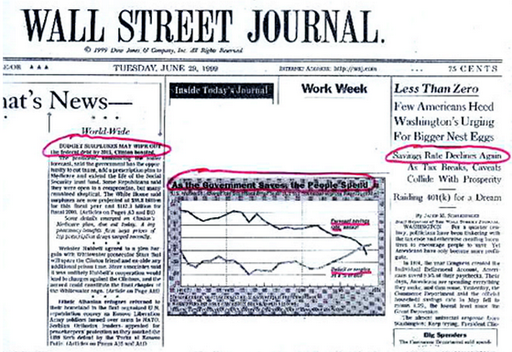
In the previous blog, we did some heavy lifting. Unless you are an economics or accounting nerd, you found it quite boring. This week we will take a little break from pure accounting, and apply what w
MMT, SECTORAL BALANCES AND BEHAVIOR
In Blog #2 we introduced the basics of macro accounting, and in Blog #3 we took a break from accounting to take a look at the rise and fall of the Goldilocks economy in the US. Thus, we applied our se

The Quiet Rewiring of American Finance
Stablecoins, Treasury markets, and the most significant shift in financial infrastructure that almost nobody is discussing.

The Rot Economy
At the center of everything I’ve written for the last few months (if not the last few years), sits a cancerous problem with the fabric of how capital is deployed in modern business. Public and private investors, along with the markets themselves, have become entirely decoupled from the concept of what “good” business truly is, focusing on one metric — one

Attention Is All You Need #2: This Time Is Different
What can we learn from the 2007 Global Financial Crisis and the 1990’s dot-com bubble?

Opinion | We’re Measuring the Economy All Wrong (Published 2018)
The official statistics say that the financial crisis is behind us. It's not.

The Value of Nothing: Capital versus Growth - American Affairs Journal
Throughout 2021, U.S. stock market valuations have hovered near all‑time highs. In June, the unadjusted price-to-earnings (P/E) ratio of the S&P 500 index eclipsed the tech boom record of 2000. Many other asset classes have attained, or nearly attained, record valuations as well. Stratospheric valuations may be partially attributable to the unique circumstances surrounding Covid-19...

Valuing What Counts: Framework to Progress Beyond Gross Domestic Product: Our Common Agenda Policy Brief 4
Une note sur les déficits commerciaux et l’industrie
Traduction française du billet de blog "A note on trade deficits and manufacturing. Some perspective on the eve of trade war" de Paul Krugman

The US economy is doing well. President Biden wants to know why so many Americans are still feeling bad | CNN Politics
By many metrics, the US economy is humming along. The jobs market is robust; consumers are spending again; and inflation has eased to a three-year low.

Money Bubble
I think I’m probably going to lose quite a lot of money in the next year or two. It’s partly AI’s fault, but not mostly. Nonetheless I’m mostly going to write about AI, because it intersects the technosphere, where I’ve lived for decades.

Report - Brace for Impact: Protecting People and the Economy when the AI Bubble Bursts — Open Markets Institute
Our report in partnership with Americans for Financial Reform outlines vulnerabilities in the financial system and wider economy that could intensify an AI crash into the next financial crisis, and provides steps that policymakers can take to mitigate the damage and protect everyday people from bear

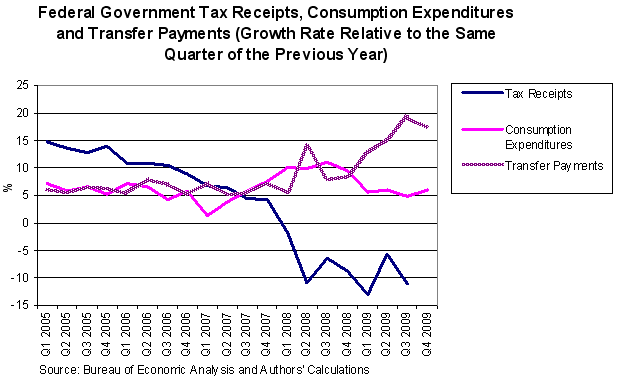
Government Budget Deficits are Largely Nondiscretionary: the Case of the Great Recession of 2007
In previous blogs we have examined the three balances identity and established that the sum of deficits and surpluses across the three sectors (domestic private, government, and foreign) must be zero.
Robust fiscal stabilisation
Recent fiscal projections for the US forecast a rising debt-GDP ratio which exceeds the peak at the end of World War II. This column shows that over the last 20 years, there is no longer evidence of a stabilising fiscal feedback, where higher projected deficits lead to more deficit reduction. It argues that the current fiscal trajectory is unstable, and adverse fiscal shocks would only worsen the prospects. However, if a gradual fiscal feedback were to be re-established, then the trajectory would be stable. This feedback would imply deficit reductions in the range of 0.5% to 1.1% of GDP over the next decade.

David Graeber: "Spotlight on the financial sector did make apparent just how bizarrely skewed our economy is in terms of who gets rewarded"
David Graeber explains why the more your job helps others, the less you get paid

Pluralistic: America and “national capitalism” (18 Feb 2025) – Pluralistic: Daily links from Cory Doctorow
Thomas Piketty's 2013 unexpected bestseller (a 750 page economics book translated from French!) Capital in the 21st Century, offers a very convincing explanation of our political decay, and it continues to serve this purpose as the decay undergoes alarming acceleration: