

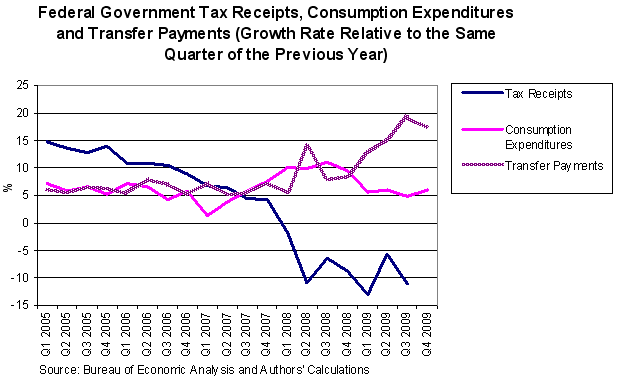
In previous blogs we have examined the three balances identity and established that the sum of deficits and surpluses across the three sectors (domestic private, government, and foreign) must be zero.
Fiscal stagnation
Public debt-to-GDP ratios have climbed to historic highs in most advanced economies. This column studies the connection between productivity growth, fiscal policy, and public debt. Using a theoretical model, it argues that a feedback loop is possible between fiscal policy and growth. Large primary surpluses are associated with fiscal distortions which depress investment and productivity growth, and lead to further pressure on public debt-to-GDP ratios. A fall into fiscal stagnation can result from hysteresis effects or pessimistic animal spirits. Meanwhile, exiting fiscal stagnation requires large policy interventions that reduce the public debt-to-GDP ratio, such as credible pro-growth strategies.

Robust fiscal stabilisation
Recent fiscal projections for the US forecast a rising debt-GDP ratio which exceeds the peak at the end of World War II. This column shows that over the last 20 years, there is no longer evidence of a stabilising fiscal feedback, where higher projected deficits lead to more deficit reduction. It argues that the current fiscal trajectory is unstable, and adverse fiscal shocks would only worsen the prospects. However, if a gradual fiscal feedback were to be re-established, then the trajectory would be stable. This feedback would imply deficit reductions in the range of 0.5% to 1.1% of GDP over the next decade.

Recent USA Sectoral Balances: Goldilocks, the Global Crash, and the Perfect Fiscal Storm
In the previous blog, we did some heavy lifting. Unless you are an economics or accounting nerd, you found it quite boring. This week we will take a little break from pure accounting, and apply what w
Harnessing naturally occurring data to measure the response of spending to income
Balancing your incomings and outgoings Economic theory predicts that when someone receives money should have little effect on their spending patterns. Gelman et al. constructed a data set of 60 million transactions made by 75,000 people to test this theory. People do seem to go on a mini–spending spree after they get their paychecks or pensions. However, closer inspection reveals that that's mostly explained by the convenience of linking regular payments, such as rent and utilities, to regular income. Unsurprisingly, cash-strapped people are more likely to increase their spending in response to receiving income. Science , this issue p. 212 , How do theoretical predictions of individual fiscal behaviors match up against real-world, real-time data? , This paper presents a new data infrastructure for measuring economic activity. The infrastructure records transactions and account balances, yielding measurements with scope and accuracy that have little precedent in economics. The data are drawn from a diverse population that overrepresents males and younger adults but contains large numbers of underrepresented groups. The data infrastructure permits evaluation of a benchmark theory in economics that predicts that individuals should use a combination of cash management, saving, and borrowing to make the timing of income irrelevant for the timing of spending. As in previous studies and in contrast to the predictions of the theory, there is a response of spending to the arrival of anticipated income. The data also show, however, that this apparent excess sensitivity of spending results largely from the coincident timing of regular income and regular spending. The remaining excess sensitivity is concentrated among individuals with less liquidity.
Qu’entend-on lorsque l’on dit que la dette publique est « insoutenable » ?
Traduction française du billet de blog « What do we mean when we say government debt is "unsustainable?" » de Jared Bernstein

Analytique des déficits commerciaux et de l'emploi manufacturier
traduction française du billet de blog "Analytics of trade deficits and manufacturing employment" de Paul Krugman

Opinion | We’re Measuring the Economy All Wrong (Published 2018)
The official statistics say that the financial crisis is behind us. It's not.

Une note sur les déficits commerciaux et l’industrie
Traduction française du billet de blog "A note on trade deficits and manufacturing. Some perspective on the eve of trade war" de Paul Krugman

Le dollar et le déficit commercial américain
traduction française du billet de blog "The dollar and the trade deficit" de Paul Krugman

One Nation’s ‘incredibly sloppy’ financial reports reveal more than $1m in missing or worthless assets
Financial returns, obtained by the Guardian, are ‘very poor and unprofessional’ and call into question party’s fitness to govern, expert says
Economists question Victorian Liberal's plan for surplus while cutting taxes
Two economists have warned Victoria's troubled budget would get worse under a Coalition government, because plans unveiled so far fail to cut enough spending while reducing taxes.
How the IRS Was Gutted — ProPublica
An eight-year campaign to slash the agency’s budget has left it understaffed, hamstrung and operating with archaic equipment. The result: billions less to fund the government. That’s good news for corporations and the wealthy.

Lower-income country debt payments hit highest level in 30 years - Debt Justice
Lower-income country debt payments have trebled in the last decade, according to figures calculated by Debt Justice based on IMF and World Bank data

annotations: La BCE doit financer les déficits publics du COVID-19
Traduction française de Paul De Grauwe (2020), « The ECB must finance COVID-19 deficits »
Lotto windfall boosts state budget amid warnings about election-year spending splurge
A surprise $1.14 billion lottery licence deal has underpinned a forecast $1 billion surplus, although Victoria’s economic outlook is at the mercy of the war in the Middle East.

This misunderstands the role of private vs. public R&D. Private R&D is great but is connected to R&D tax exemptions, & often doesn't spill out into the public domain. There's a notion we can ramp federal R&D spending down & be competitive. We can’t & we shouldn’t. whitehouse.gov/releases/2026/07/45470/

OSTP Director Releases Landmark Report and Recommendations for Renewing American Scientific Discovery
www.whitehouse.gov