

Reporters Without Borders says Yahoo gave information to China which led to the jailing of journalist Shi Tao.
China’s Top Spy Agency Recruited Woman Who Targeted Jensen Huang
A memo that circulated among U.S. policymakers cited intelligence that Alice Huang, a Chinese executive who developed a relationship with Nvidia’s leader, was an asset of Beijing’s Ministry of State Security.

Chinese officials 'create 488m bogus social media posts a year'
Harvard researchers say leaked documents show bureaucrats fabricate positive posts to distract from criticism of government
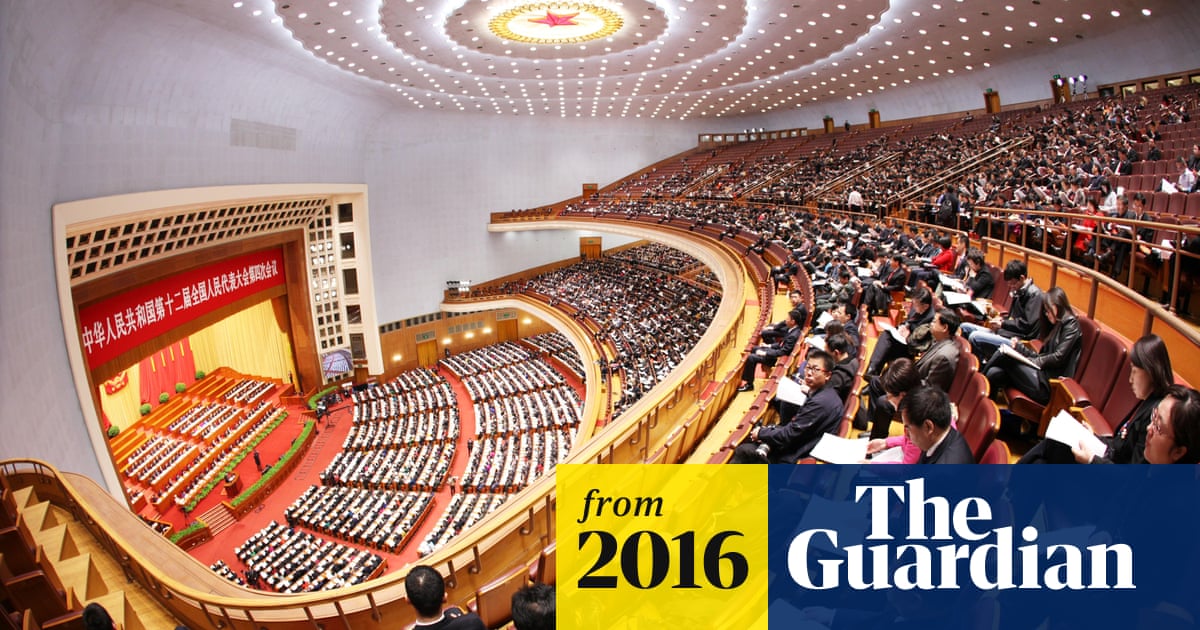
Multiple Identities Reveal Ties Between Chinese Businessman and Alleged Cambodian ‘Criminal’ Conglomerate
The U.S. sanctioned “Chen Xiao’er” for his partnership in one firm with the head of a Cambodian corporate group that allegedly ran cyber-scam operations. Reporters have now uncovered his other identities — and they show deeper connections to the conglomerate.
As Chinese AI Models Gain Popularity in the West, Their Chatbots Fail to Debunk Pro-China False Claims More Than Half the Time
To download this NewsGuard report, please fill out your details below and you will be redirected to it. If you'd like to learn more about working with NewsGuard, email [email protected].

Alleged Member of ‘Notorious’ Cambodian Scam Network Bought Luxury Dubai Properties
Zhu Zhongbiao was already wanted in China on charges related to money laundering. He’s now been sanctioned by both the U.K. and U.S. in their largest ever joint action to target a multi-billion online scam network based in Cambodia.

Who are Chen Zhi and the Prince Group, accused by the US and UK of large-scale scam operations?
US treasury department has sanctioned Chinese-born Cambodian tycoon Chen Zhi – alleged mastermind of a cyber-crime empire in south-east Asia

Facebook Said to Create Censorship Tool to Get Back Into China (Published 2016)
The social network, blocked in China since 2009, has developed software to keep posts from appearing in users’ news feeds in specific geographic areas, current and former employees said.

Data Is a Toxic Asset - Schneier on Security
Thefts of personal information aren’t unusual. Every week, thieves break into networks and steal data about people, often tens of millions at a time. Most of the time it’s information that’s needed to commit fraud, as happened in 2015 to Experian and the IRS. Sometimes it’s stolen for purposes of embarrassment or coercion, as in the 2015 cases of Ashley Madison and the US Office of Personnel Management. The latter exposed highly sensitive personal data that affects security of millions of government employees, probably to the Chinese. Always it’s personal information about us, information that we shared with the expectation that the recipients would keep it secret. And in every case, they did not...
How the Chinese Government Fabricates Social Media Posts for Strategic Distraction, Not Engaged Argument
The Chinese government has long been suspected of hiring as many as 2,000,000 people to surreptitiously insert huge numbers of pseudonymous and other deceptive writings into the stream of real social media posts, as if they were the genuine opinions of ordinary people. Many academics, and most journalists and activists, claim that these so-called "50c party" posts vociferously argue for the government's side in political and policy debates. As we show, this is also true of the vast majority of posts openly accused on social media of being 50c. Yet, almost no systematic empirical evidence exists for this claim, or, more importantly, for the Chinese regime's strategic objective in pursuing this activity. In the first large scale empirical analysis of this operation, we show how to identify the secretive authors of these posts, the posts written by them, and their content. We estimate that the government fabricates and posts about 448 million social media comments a year. In contrast to prior claims, we show that the Chinese regime's strategy is to avoid arguing with skeptics of the party and the government, and to not even discuss controversial issues. We show that the goal of this massive secretive operation is instead to distract the public and change the subject, as most of the these posts involve cheerleading for China, the revolutionary history of the Communist Party, or other symbols of the regime. We discuss how these results fit with what is known about the Chinese censorship program, and suggest how they may change our broader theoretical understanding of "common knowledge" and information control in authoritarian regimes. This paper is related to our articles in *Science,* "[Reverse-Engineering Censorship In China: Randomized Experimentation And Participant Observation](/publication/reverse-engineering-censorship-in-china-randomized-experimentation-and-participant-observation/)", and the *American Political Science Review,* "[How Censorship In China Allows Government Criticism But Silences Collective Expression](/publication/how-censorship-in-china-allows-government-criticism-but-silences-collective-expression/)". Replication data at the Harvard Dataverse: [https://doi.org/10.7910/DVN/QSZMPD](https://doi.org/10.7910/DVN/QSZMPD).
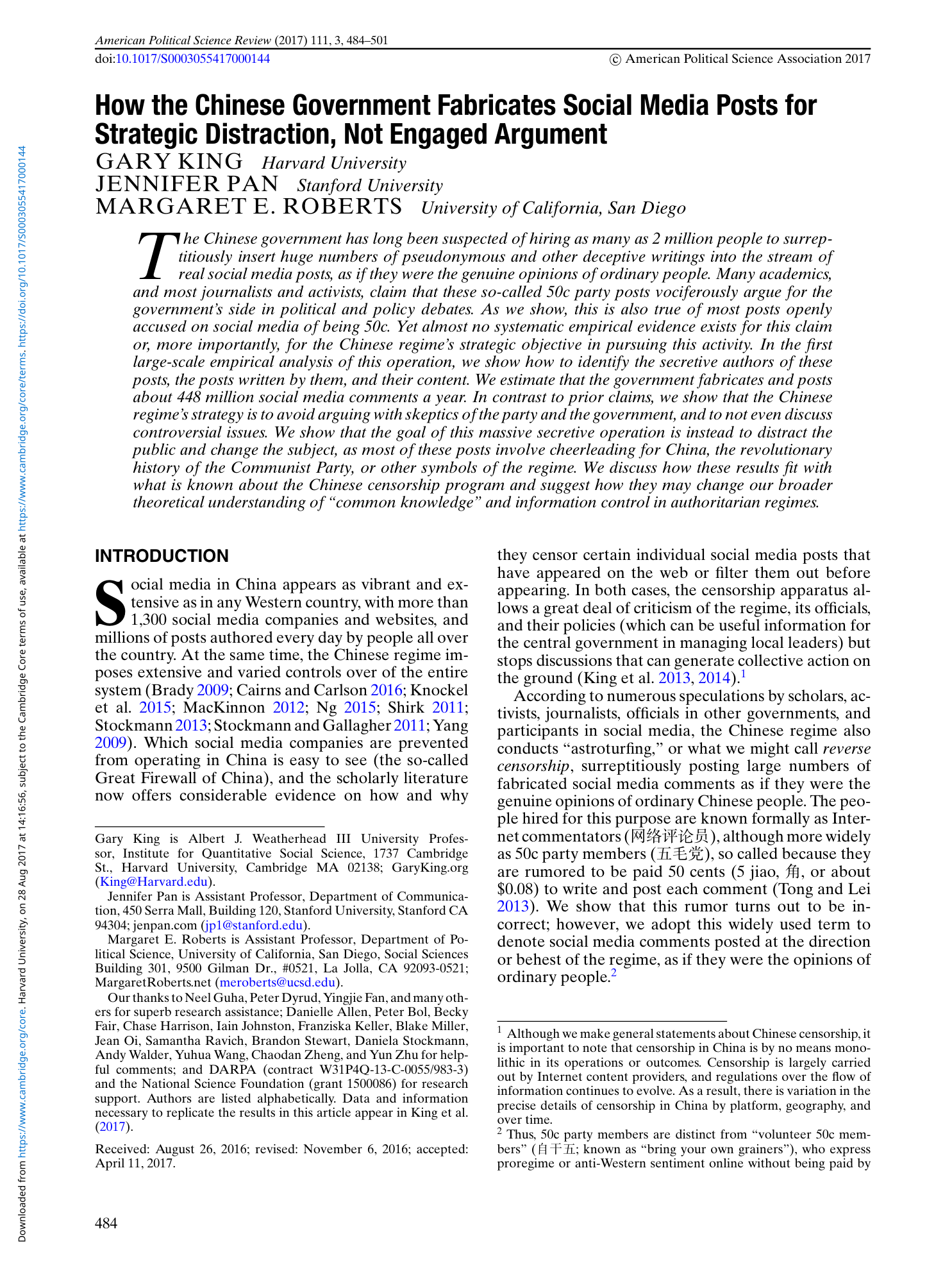
China’s scary lesson to the world: Censoring the Internet works
China is confidently promoting its vision of “Internet Sovereignty.”

'Allow no escapes': leak exposes reality of China's vast prison camp network
Documents confirm operational details of largest mass incarceration of an ethnic-religious minority since second world war

The Internet Coup: A Technical Analysis on How a Chinese Company is Exporting The Great Firewall to Autocratic Regimes | InterSecLab
This research reveals groundbreaking findings on how Geedge Networks is selling an extensive suite of next-generation digital repression tools to client governments around the world.

Nvidia CEO Jensen Huang Had an Affair With a Chinese Spy
Well, sure, it sounds bad when you put it like that.

China’s Nightmarish Citizen Scores Are a Warning For Americans | ACLU
China is launching a comprehensive “credit score” system, and the more I learn about it, the more nightmarish it seems. China appears to be leveraging all the tools of the information age—electronic purchasing data, social networks, algorithmic sorting—to construct the ultimate tool of social control. It is, as one commentator put it, “authoritarianism, gamified.” Read this piece for the full flavor—it will make your head spin. If that and the little other reporting I’ve seen is accurate, the basics are this:

Revealed: power and reach of China’s surveillance dragnet
How China uses technology to push its campaign against Muslim minorities beyond its own borders
Marriott Data Breach Is Traced to Chinese Hackers as U.S. Readies Crackdown on Beijing (Published 2018)
The Trump administration is expected to indict hackers and roll out import restrictions out of concern that Beijing will not easily change its trade, cyber and economic practices.
