

How a Belgian is rewriting the coaching rule book - by training the brain
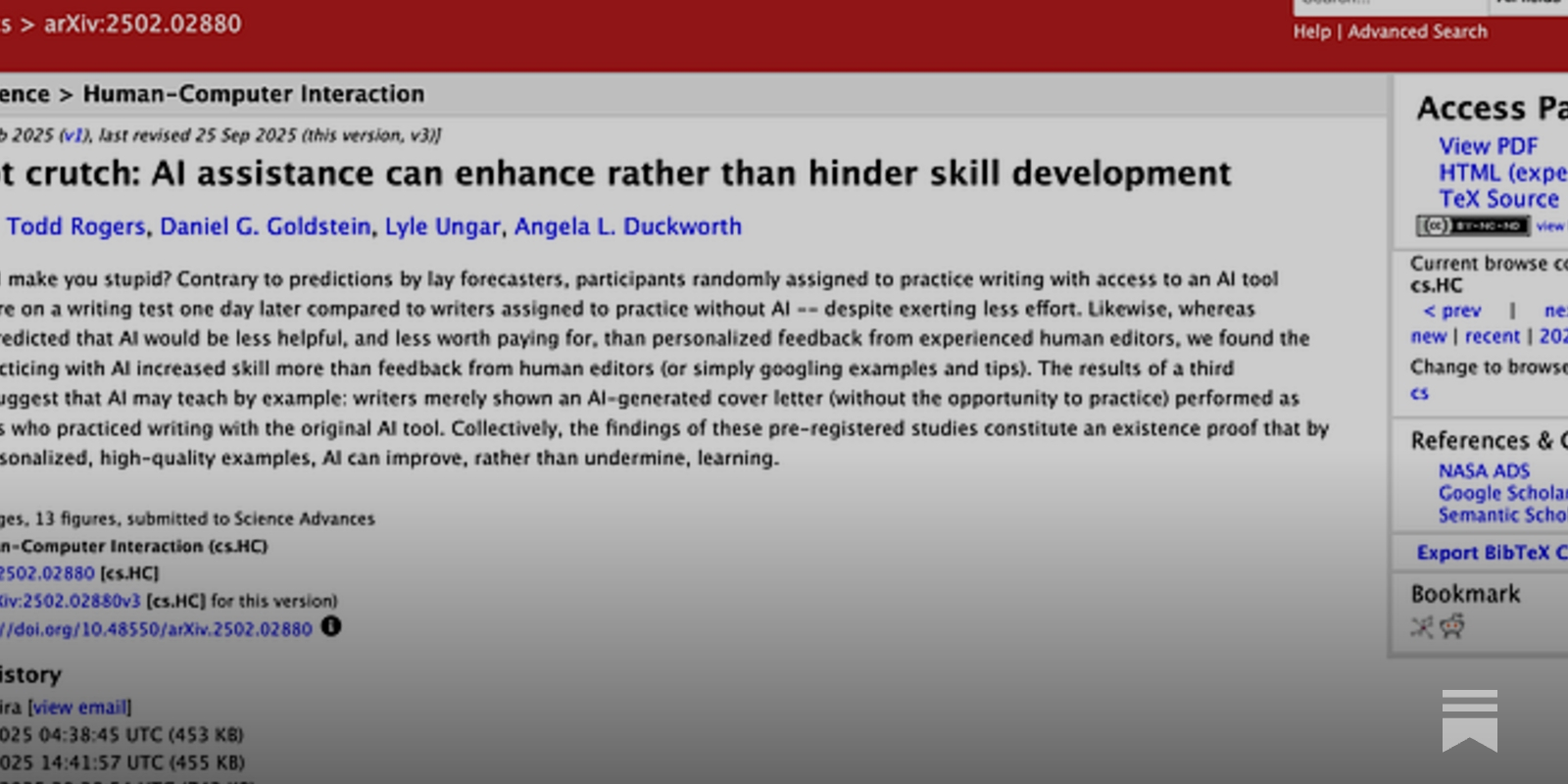
From Crutch to Coach?
What a new research study tells us about AI's impact on human learning & skills development
A Framework for Putting Mental Models to Practice
A Framework for Putting Mental Models to Practice is a series that examines the idea of putting Charlie Munger's Elementary Worldly Wisdom to practice in one's life in the pursuit of better decision making.

Teaching Claude Why
Julius Steen, Minh Le, Samuel R. Bowman, Samuel Marks, Jan Leike, Amanda Askell, Chris Olah
Expert consensus on skill acquisition in sport: A Delphi study
Skill acquisition is a rapidly evolving field in sport, but its definitions, roles and professional practices remain inconsistently articulated. Despite growing recognition of its importance, there...
Kevin A. Bryan - Eight Rules for Teaching in AI World
Eight rules for how university teaching should change because of AI.
How to Make Yourself Into a Learning Machine
Shopify’s Director of Production Engineering explains how reading broadly helps him get to the bottom of things
NeuroAI’s Next Steps: Balancing Computation and Embodiment
Deep neural networks trained at scale now predict neural activity across sensory cortices, raising a question that divides neuroscience: does the convergence between artificial and biological representations constitute understanding, or does understanding require models of biological processes grounded in the embodied, evolved character of natural intelligence? In this Dual Perspectives article, Bing Brunton and Patrick Mineault articulate two research programs—Process and Convergence—to engage this question about the future of NeuroAI research. The conversation is organized around four questions that probe what scaled model–brain alignment reveals, what the brain is coupled to and evolved to do, what success beyond the lab looks like, and where the field should invest over the coming decade. Their exchanges reveal the distance between the two programs to be primarily about the level of analysis and priorities for what to build next. The conversation converges on shared ground: measure broadly, then distill to causal principles.
How babies learn – and why robots can’t compete
The long read: If we could understand how the infant mind develops, it might help every child reach their full potential. But seeing them as learning machines is not the answer
This Is Your Brain on Podcasts (Published 2016)
Different people’s brains absorb a compelling story in the roughly the same complicated pattern, using many parts of the brain, researchers found.

A Gauge for Measuring Effective Practice - Daniel Coyle
If you distilled all the new science about talent development into two words of advice, they would be “practice better.” That’s it. Practice. Better. Forget everything else about your genes, your potential — it’s all ... keep reading

NeuroAI
Neuroscience, cognitive science, and AI are all questing for principles that help generalization. Learn more through a live, synchronous program designed for focused, hands-on learning.
Introducing TRIBE v2: A Predictive Foundation Model Trained to Understand How the Human Brain Processes Complex Stimuli | Keith Doelling
This is some very cool work by some awesome colleagues Jean-Rémi King, and Teon Brooks! Seriously not enough good things can be said about how cool it is. You should enjoy it and play with it. And kudos to Meta for open sourcing it. At the same time, I'm already seeing posts about how the model will replace fMRI experiments as researchers will simulate how the brain "really works" instead of running costly experiments. I think this goes WELL beyond what its creators intend. We are already seeing that use of AI in science allows you to explore charted ideas more thoroughly and much more rapidly but slows us down in finding novel ideas (https://lnkd.in/eMR2akqt). At the same time, there is growing concern that LLM performance will collapse as they are increasingly trained on their own output (https://lnkd.in/eavgfyuY). Leaving neuroscience to AI simulations risks following the same fate, where we generate seemingly new findings without gaining new meaning. A mechanistic understanding of how the brain works (if that is still your goal) will be found at the margins, in errors and idiosyncrasies of neural function. What TRIBE provides is a super useful and cool instantiation of our current understanding on how and where neural activity is instantiated in the brain. But it won't help us make groundbreaking new findings of how neural circuits lead to cognition and behavior. Experiments on real human brains, may be costly, but they will always be necessary!
One coach’s journey. “People learn most reliably when the environment does the honest work.” #SportsCoaching #EcologicalDynamics #coaching

Messier Sessions: A Coach’s Look Back
open.substack.com