

Explore National Geographic. A world leader in geography, cartography and exploration.
Canadian Geographic Magazine
Canadian Geographic is a publication of the Royal Canadian Geographical Society. The Society is dedicated to making Canada better known to Canadians and to the world.
Atlas Obscura - Curious and Wondrous Travel Destinations
Explore hidden wonders, unusual places, and fascinating stories from around the world.

NASA
A Beginner’s Guide to Scientific Roadmapping
Wonderful maps and how to read them
Diego Vicente
Data Scientist. I like music, keyboards and Legos. Proficient in pop culture references and xkcd.

All Projects — GLOBAÏA
Explore GLOBAÏA's portfolio of planetary visualizations, interactive tools, and science communication projects.
EARTHKIN WILD
At Earthkin Wilderness School we hold that a deep relationship with nature, community, and self is essential to discovering one’s unique gifts so that cultural transformation rooted in earth-based ways can take place. We offer ancestral skills training, immersive experiences in the wild, deep nature connection programs, and primal movement practices for those looking for land-based learning and reconnection in the coast mountains of BC.
Samuel Krug VFX
Book Review of Making All the World America
Steven T. Newcomb reviews Timothy Bowers Vasko’s Making All the World America: Native Information and the Doctrine of Discovery (University of Pennsylvania Press, 2026).
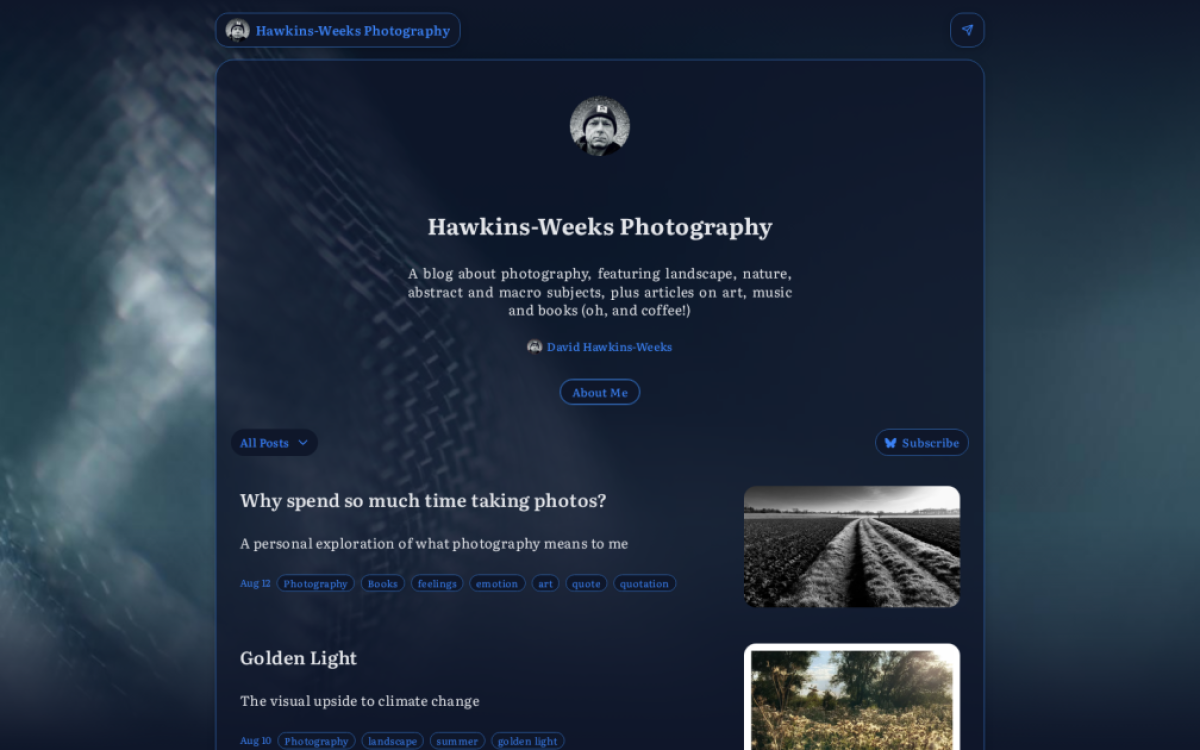
Hawkins-Weeks Photography
A blog about photography, featuring landscape, nature, abstract and macro subjects, plus articles on art, music and books (oh, and coffee!)
Daniel Yergin on "The New Map"
Pulitzer Prize-winning author and global energy expert Daniel Yergin talks with Andrew and Scott about his latest book, The New Map and the way technology revolutions in energy are influencing geopolitics, security, climate, and health.
Developing creative identity
I was a theoretical physicist from 1992 to 2007. It was a romantic activity, exploring the fundamental nature of the cosmos! I became a university professor, wrote papers and books, and got to explore some of the most beautiful ideas ever discovered. In parallel, I also developed a fascination with the social systems humanity uses to make knowledge. Systems like the university or peer review are immensely deep inventions: our discovery system is itself one of the great inventions of humanity! But I believed a radically better discovery system must be possible. I became obsessed with this idea, eventually giving up tenure to work on it1. My first big project was to write a book helping develop and spread the fundamental ideas underlying the modern open science movement.
I was born and raised in South Jersey. As a kid, I was passionately interested in music, science and nature. Within a year of entering college, I discovered neuroscience and quickly became enamored by the prospect of understanding human cognition in the context of experiment and data-driven analysis.