

October 2005(This essay is derived from a talk at the 2005 Startup School.)How do you get good ideas for startups? That's probably the number one question people ask me.I'd like to reply with another question: why do people think it's hard to come up with ideas for startups?That might seem a stupid thing to ask. Why do they think it's hard? If people can't do it, then it is hard, at least for them. Right?Well, maybe not. What people usually say is not that they can't think of ideas, but that they don't have any. That's not quite the same thing. It could be the reason they don't have any is that they haven't tried to generate them.I think this is often the case. I think people believe that coming up with ideas for startups is very hard-- that it must be very hard-- and so they don't try do to it. They assume ideas are like miracles: they either pop into your head or they don't.I also have a theory about why people think this. They overvalue ideas. They think creating a startup is just a matter of implementing some fabulous initial idea. And since a successful startup is worth millions of dollars, a good idea is therefore a million dollar idea.If coming up with an idea for a startup equals coming up with a million dollar idea, then of course it's going to seem hard. Too hard to bother trying. Our instincts tell us something so valuable would not be just lying around for anyone to discover.Actually, startup ideas are not million dollar ideas, and here's an experiment you can try to prove it: just try to sell one. Nothing evolves faster than markets. The fact that there's no market for startup ideas suggests there's no demand. Which means, in the narrow sense of the word, that startup ideas are worthless.QuestionsThe fact is, most startups end up nothing like the initial idea. It would be closer to the truth to say the main value of your initial idea is that, in the process of discovering it's broken, you'll come up with your real idea.The initial idea is just a starting point-- not a blueprint, but a question. It might help if they were expressed that way. Instead of saying that your idea is to make a collaborative, web-based spreadsheet, say: could one make a collaborative, web-based spreadsheet? A few grammatical tweaks, and a woefully incomplete idea becomes a promising question to explore.There's a real difference, because an assertion provokes objections in a way a question doesn't. If you say: I'm going to build a web-based spreadsheet, then critics-- the most dangerous of which are in your own head-- will immediately reply that you'd be competing with Microsoft, that you couldn't give people the kind of UI they expect, that users wouldn't want to have their data on your servers, and so on.A question doesn't seem so challenging. It becomes: let's try making a web-based spreadsheet and see how far we get. And everyone knows that if you tried this you'd be able to make something useful. Maybe what you'd end up with wouldn't even be a spreadsheet. Maybe it would be some kind of new spreadsheet-like collaboration tool that doesn't even have a name yet. You wouldn't have thought of something like that except by implementing your way toward it.Treating a startup idea as a question changes what you're looking for. If an idea is a blueprint, it has to be right. But if it's a question, it can be wrong, so long as it's wrong in a way that leads to more ideas.One valuable way for an idea to be wrong is to be only a partial solution. When someone's working on a problem that seems too big, I always ask: is there some way to bite off some subset of the problem, then gradually expand from there? That will generally work unless you get trapped on a local maximum, like 1980s-style AI, or C.UpwindSo far, we've reduced the problem from thinking of a million dollar idea to thinking of a mistaken question. That doesn't seem so hard, does it?To generate such questions you need two things: to be familiar with promising new technologies, and to have the right kind of friends. New technologies are the ingredients startup ideas are made of, and conversations with friends are the kitchen they're cooked in.Universities have both, and that's why so many startups grow out of them. They're filled with new technologies, because they're trying to produce research, and only things that are new count as research. And they're full of exactly the right kind of people to have ideas with: the other students, who will be not only smart but elastic-minded to a fault.The opposite extreme would be a well-paying but boring job at a big company. Big companies are biased against new technologies, and the people you'd meet there would be wrong too.In an essay I wrote for high school students, I said a good rule of thumb was to stay upwind-- to work on things that maximize your future options. The principle applies for adults too, though perhaps it has to be modified to: stay upwind for as long as you can, then cash in the potential energy you've accumulated when you need to pay for kids.I don't think people consciously realize this, but one reason downwind jobs like churning out Java for a bank pay so well is precisely that they are downwind. The market price for that kind of work is higher because it gives you fewer options for the future. A job that lets you work on exciting new stuff will tend to pay less, because part of the compensation is in the form of the new skills you'll learn.Grad school is the other end of the spectrum from a coding job at a big company: the pay's low but you spend most of your time working on new stuff. And of course, it's called "school," which makes that clear to everyone, though in fact all jobs are some percentage school.The right environment for having startup ideas need not be a university per se. It just has to be a situation with a large percentage of school.It's obvious why you want exposure to new technology, but why do you need other people? Can't you just think of new ideas yourself? The empirical answer is: no. Even Einstein needed people to bounce ideas off. Ideas get developed in the process of explaining them to the right kind of person. You need that resistance, just as a carver needs the resistance of the wood.This is one reason Y Combinator has a rule against investing in startups with only one founder. Practically every successful company has at least two. And because startup founders work under great pressure, it's critical they be friends.I didn't realize it till I was writing this, but that may help explain why there are so few female startup founders. I read on the Internet (so it must be true) that only 1.7% of VC-backed startups are founded by women. The percentage of female hackers is small, but not that small. So why the discrepancy?When you realize that successful startups tend to have multiple founders who were already friends, a possible explanation emerges. People's best friends are likely to be of the same sex, and if one group is a minority in some population, pairs of them will be a minority squared. [1]DoodlingWhat these groups of co-founders do together is more complicated than just sitting down and trying to think of ideas. I suspect the most productive setup is a kind of together-alone-together sandwich. Together you talk about some hard problem, probably getting nowhere. Then, the next morning, one of you has an idea in the shower about how to solve it. He runs eagerly to to tell the others, and together they work out the kinks.What happens in that shower? It seems to me that ideas just pop into my head. But can we say more than that?Taking a shower is like a form of meditation. You're alert, but there's nothing to distract you. It's in a situation like this, where your mind is free to roam, that it bumps into new ideas.What happens when your mind wanders? It may be like doodling. Most people have characteristic ways of doodling. This habit is unconscious, but not random: I found my doodles changed after I started studying painting. I started to make the kind of gestures I'd make if I were drawing from life. They were atoms of drawing, but arranged randomly. [2]Perhaps letting your mind wander is like doodling with ideas. You have certain mental gestures you've learned in your work, and when you're not paying attention, you keep making these same gestures, but somewhat randomly. In effect, you call the same functions on random arguments. That's what a metaphor is: a function applied to an argument of the wrong type.Conveniently, as I was writing this, my mind wandered: would it be useful to have metaphors in a programming language? I don't know; I don't have time to think about this. But it's convenient because this is an example of what I mean by habits of mind. I spend a lot of time thinking about language design, and my habit of always asking "would x be useful in a programming language" just got invoked.If new ideas arise like doodles, this would explain why you have to work at something for a while before you have any. It's not just that you can't judge ideas till you're an expert in a field. You won't even generate ideas, because you won't have any habits of mind to invoke.Of course the habits of mind you invoke on some field don't have to be derived from working in that field. In fact, it's often better if they're not. You're not just looking for good ideas, but for good new ideas, and you have a better chance of generating those if you combine stuff from distant fields. As hackers, one of our habits of mind is to ask, could one open-source x? For example, what if you made an open-source operating system? A fine idea, but not very novel. Whereas if you ask, could you make an open-source play? you might be onto something.Are some kinds of work better sources of habits of mind than others? I suspect harder fields may be better sources, because to attack hard problems you need powerful solvents. I find math is a good source of metaphors-- good enough that it's worth studying just for that. Related fields are also good sources, especially when they're related in unexpected ways. Everyone knows computer science and electrical engineering are related, but precisely because everyone knows it, importing ideas from one to the other doesn't yield great profits. It's like importing something from Wisconsin to Michigan. Whereas (I claim) hacking and painting are also related, in the sense that hackers and painters are both makers, and this source of new ideas is practically virgin territory.ProblemsIn theory you could stick together ideas at random and see what you came up with. What if you built a peer-to-peer dating site? Would it be useful to have an automatic book? Could you turn theorems into a commodity? When you assemble ideas at random like this, they may not be just stupid, but semantically ill-formed. What would it even mean to make theorems a commodity? You got me. I didn't think of that idea, just its name.You might come up with something useful this way, but I never have. It's like knowing a fabulous sculpture is hidden inside a block of marble, and all you have to do is remove the marble that isn't part of it. It's an encouraging thought, because it reminds you there is an answer, but it's not much use in practice because the search space is too big.I find that to have good ideas I need to be working on some problem. You can't start with randomness. You have to start with a problem, then let your mind wander just far enough for new ideas to form.In a way, it's harder to see problems than their solutions. Most people prefer to remain in denial about problems. It's obvious why: problems are irritating. They're problems! Imagine if people in 1700 saw their lives the way we'd see them. It would have been unbearable. This denial is such a powerful force that, even when presented with possible solutions, people often prefer to believe they wouldn't work.I saw this phenomenon when I worked on spam filters. In 2002, most people preferred to ignore spam, and most of those who didn't preferred to believe the heuristic filters then available were the best you could do.I found spam intolerable, and I felt it had to be possible to recognize it statistically. And it turns out that was all you needed to solve the problem. The algorithm I used was ridiculously simple. Anyone who'd really tried to solve the problem would have found it. It was just that no one had really tried to solve the problem. [3]Let me repeat that recipe: finding the problem intolerable and feeling it must be possible to solve it. Simple as it seems, that's the recipe for a lot of startup ideas.WealthSo far most of what I've said applies to ideas in general. What's special about startup ideas? Startup ideas are ideas for companies, and companies have to make money. And the way to make money is to make something people want.Wealth is what people want. I don't mean that as some kind of philosophical statement; I mean it as a tautology.So an idea for a startup is an idea for something people want. Wouldn't any good idea be something people want? Unfortunately not. I think new theorems are a fine thing to create, but there is no great demand for them. Whereas there appears to be great demand for celebrity gossip magazines. Wealth is defined democratically. Good ideas and valuable ideas are not quite the same thing; the difference is individual tastes.But valuable ideas are very close to good ideas, especially in technology. I think they're so close that you can get away with working as if the goal were to discover good ideas, so long as, in the final stage, you stop and ask: will people actually pay for this? Only a few ideas are likely to make it that far and then get shot down; RPN calculators might be one example.One way to make something people want is to look at stuff people use now that's broken. Dating sites are a prime example. They have millions of users, so they must be promising something people want. And yet they work horribly. Just ask anyone who uses them. It's as if they used the worse-is-better approach but stopped after the first stage and handed the thing over to marketers.Of course, the most obvious breakage in the average computer user's life is Windows itself. But this is a special case: you can't defeat a monopoly by a frontal attack. Windows can and will be overthrown, but not by giving people a better desktop OS. The way to kill it is to redefine the problem as a superset of the current one. The problem is not, what operating system should people use on desktop computers? but how should people use applications? There are answers to that question that don't even involve desktop computers.Everyone thinks Google is going to solve this problem, but it is a very subtle one, so subtle that a company as big as Google might well get it wrong. I think the odds are better than 50-50 that the Windows killer-- or more accurately, Windows transcender-- will come from some little startup.Another classic way to make something people want is to take a luxury and make it into a commmodity. People must want something if they pay a lot for it. And it is a very rare product that can't be made dramatically cheaper if you try.This was Henry Ford's plan. He made cars, which had been a luxury item, into a commodity. But the idea is much older than Henry Ford. Water mills transformed mechanical power from a luxury into a commodity, and they were used in the Roman empire. Arguably pastoralism transformed a luxury into a commodity.When you make something cheaper you can sell more of them. But if you make something dramatically cheaper you often get qualitative changes, because people start to use it in different ways. For example, once computers get so cheap that most people can have one of their own, you can use them as communication devices.Often to make something dramatically cheaper you have to redefine the problem. The Model T didn't have all the features previous cars did. It only came in black, for example. But it solved the problem people cared most about, which was getting from place to place.One of the most useful mental habits I know I learned from Michael Rabin: that the best way to solve a problem is often to redefine it. A lot of people use this technique without being consciously aware of it, but Rabin was spectacularly explicit. You need a big prime number? Those are pretty expensive. How about if I give you a big number that only has a 10 to the minus 100 chance of not being prime? Would that do? Well, probably; I mean, that's probably smaller than the chance that I'm imagining all this anyway.Redefining the problem is a particularly juicy heuristic when you have competitors, because it's so hard for rigid-minded people to follow. You can work in plain sight and they don't realize the danger. Don't worry about us. We're just working on search. Do one thing and do it well, that's our motto.Making things cheaper is actually a subset of a more general technique: making things easier. For a long time it was most of making things easier, but now that the things we build are so complicated, there's another rapidly growing subset: making things easier to use.This is an area where there's great room for improvement. What you want to be able to say about technology is: it just works. How often do you say that now?Simplicity takes effort-- genius, even. The average programmer seems to produce UI designs that are almost willfully bad. I was trying to use the stove at my mother's house a couple weeks ago. It was a new one, and instead of physical knobs it had buttons and an LED display. I tried pressing some buttons I thought would cause it to get hot, and you know what it said? "Err." Not even "Error." "Err." You can't just say "Err" to the user of a stove. You should design the UI so that errors are impossible. And the boneheads who designed this stove even had an example of such a UI to work from: the old one. You turn one knob to set the temperature and another to set the timer. What was wrong with that? It just worked.It seems that, for the average engineer, more options just means more rope to hang yourself. So if you want to start a startup, you can take almost any existing technology produced by a big company, and assume you could build something way easier to use.Design for ExitSuccess for a startup approximately equals getting bought. You need some kind of exit strategy, because you can't get the smartest people to work for you without giving them options likely to be worth something. Which means you either have to get bought or go public, and the number of startups that go public is very small.If success probably means getting bought, should you make that a conscious goal? The old answer was no: you were supposed to pretend that you wanted to create a giant, public company, and act surprised when someone made you an offer. Really, you want to buy us? Well, I suppose we'd consider it, for the right price.I think things are changing. If 98% of the time success means getting bought, why not be open about it? If 98% of the time you're doing product development on spec for some big company, why not think of that as your task? One advantage of this approach is that it gives you another source of ideas: look at big companies, think what they should be doing, and do it yourself. Even if they already know it, you'll probably be done faster.Just be sure to make something multiple acquirers will want. Don't fix Windows, because the only potential acquirer is Microsoft, and when there's only one acquirer, they don't have to hurry. They can take their time and copy you instead of buying you. If you want to get market price, work on something where there's competition.If an increasing number of startups are created to do product development on spec, it will be a natural counterweight to monopolies. Once some type of technology is captured by a monopoly, it will only evolve at big company rates instead of startup rates, whereas alternatives will evolve with especial speed. A free market interprets monopoly as damage and routes around it.The Woz RouteThe most productive way to generate startup ideas is also the most unlikely-sounding: by accident. If you look at how famous startups got started, a lot of them weren't initially supposed to be startups. Lotus began with a program Mitch Kapor wrote for a friend. Apple got started because Steve Wozniak wanted to build microcomputers, and his employer, Hewlett-Packard, wouldn't let him do it at work. Yahoo began as David Filo's personal collection of links.This is not the only way to start startups. You can sit down and consciously come up with an idea for a company; we did. But measured in total market cap, the build-stuff-for-yourself model might be more fruitful. It certainly has to be the most fun way to come up with startup ideas. And since a startup ought to have multiple founders who were already friends before they decided to start a company, the rather surprising conclusion is that the best way to generate startup ideas is to do what hackers do for fun: cook up amusing hacks with your friends.It seems like it violates some kind of conservation law, but there it is: the best way to get a "million dollar idea" is just to do what hackers enjoy doing anyway. Notes[1] This phenomenon may account for a number of discrepancies currently blamed on various forbidden isms. Never attribute to malice what can be explained by math.[2] A lot of classic abstract expressionism is doodling of this type: artists trained to paint from life using the same gestures but without using them to represent anything. This explains why such paintings are (slightly) more interesting than random marks would be.[3] Bill Yerazunis had solved the problem, but he got there by another path. He made a general-purpose file classifier so good that it also worked for spam.
12 Things I Learned from Chris Dixon about Startups | Andreessen Horowitz
#1 “If everyone loves your idea, I might be worried that it’s not forward thinking enough.” Anyone thinking about starting a business should be searching for mispriced opportunities. While markets are mostly efficient in eliminating opportunities for extraordinary profit, there are always areas of an economy in which there are significant uncertainty. These areas are...

Excuse me, is there a problem?
Many startups fail despite identifying a real problem and building a product that solves that problem. This explains why, so you can avoid their fate.
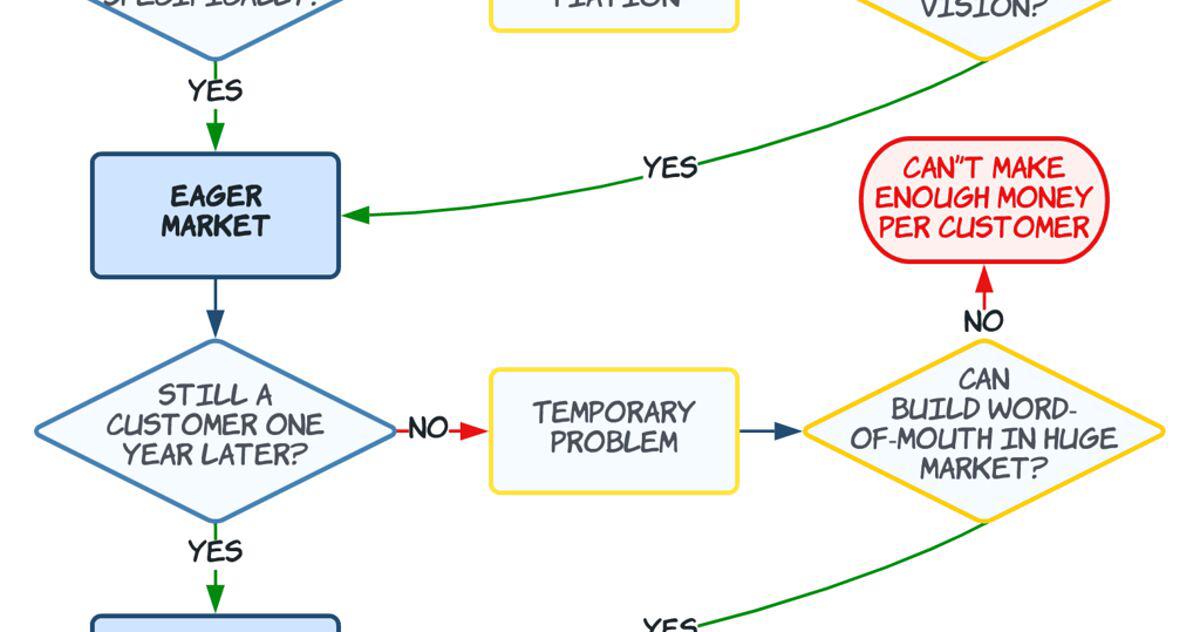
Excuse me, is there a problem?
Many startups fail despite identifying a real problem and building a product that solves that problem. This explains why, so you can avoid their fate.
Before the Startup
October 2014(This essay is derived from a guest lecture in Sam Altman's startup class at Stanford. It's intended for college students, but much of it is applicable to potential founders at other ages.)One of the advantages of having kids is that when you have to give advice, you can ask yourself "what would I tell my own kids?" My kids are little, but I can imagine what I'd tell them about startups if they were in college, and that's what I'm going to tell you.Startups are very counterintuitive. I'm not sure why. Maybe it's just because knowledge about them hasn't permeated our culture yet. But whatever the reason, starting a startup is a task where you can't always trust your instincts.It's like skiing in that way. When you first try skiing and you want to slow down, your instinct is to lean back. But if you lean back on skis you fly down the hill out of control. So part of learning to ski is learning to suppress that impulse. Eventually you get new habits, but at first it takes a conscious effort. At first there's a list of things you're trying to remember as you start down the hill.Startups are as unnatural as skiing, so there's a similar list for startups. Here I'm going to give you the first part of it — the things to remember if you want to prepare yourself to start a startup. CounterintuitiveThe first item on it is the fact I already mentioned: that startups are so weird that if you trust your instincts, you'll make a lot of mistakes. If you know nothing more than this, you may at least pause before making them.When I was running Y Combinator I used to joke that our function was to tell founders things they would ignore. It's really true. Batch after batch, the YC partners warn founders about mistakes they're about to make, and the founders ignore them, and then come back a year later and say "I wish we'd listened."Why do the founders ignore the partners' advice? Well, that's the thing about counterintuitive ideas: they contradict your intuitions. They seem wrong. So of course your first impulse is to disregard them. And in fact my joking description is not merely the curse of Y Combinator but part of its raison d'etre. If founders' instincts already gave them the right answers, they wouldn't need us. You only need other people to give you advice that surprises you. That's why there are a lot of ski instructors and not many running instructors. [1]You can, however, trust your instincts about people. And in fact one of the most common mistakes young founders make is not to do that enough. They get involved with people who seem impressive, but about whom they feel some misgivings personally. Later when things blow up they say "I knew there was something off about him, but I ignored it because he seemed so impressive."If you're thinking about getting involved with someone — as a cofounder, an employee, an investor, or an acquirer — and you have misgivings about them, trust your gut. If someone seems slippery, or bogus, or a jerk, don't ignore it.This is one case where it pays to be self-indulgent. Work with people you genuinely like, and you've known long enough to be sure. ExpertiseThe second counterintuitive point is that it's not that important to know a lot about startups. The way to succeed in a startup is not to be an expert on startups, but to be an expert on your users and the problem you're solving for them. Mark Zuckerberg didn't succeed because he was an expert on startups. He succeeded despite being a complete noob at startups, because he understood his users really well.If you don't know anything about, say, how to raise an angel round, don't feel bad on that account. That sort of thing you can learn when you need to, and forget after you've done it.In fact, I worry it's not merely unnecessary to learn in great detail about the mechanics of startups, but possibly somewhat dangerous. If I met an undergrad who knew all about convertible notes and employee agreements and (God forbid) class FF stock, I wouldn't think "here is someone who is way ahead of their peers." It would set off alarms. Because another of the characteristic mistakes of young founders is to go through the motions of starting a startup. They make up some plausible-sounding idea, raise money at a good valuation, rent a cool office, hire a bunch of people. From the outside that seems like what startups do. But the next step after rent a cool office and hire a bunch of people is: gradually realize how completely fucked they are, because while imitating all the outward forms of a startup they have neglected the one thing that's actually essential: making something people want. GameWe saw this happen so often that we made up a name for it: playing house. Eventually I realized why it was happening. The reason young founders go through the motions of starting a startup is because that's what they've been trained to do for their whole lives up to that point. Think about what you have to do to get into college, for example. Extracurricular activities, check. Even in college classes most of the work is as artificial as running laps.I'm not attacking the educational system for being this way. There will always be a certain amount of fakeness in the work you do when you're being taught something, and if you measure their performance it's inevitable that people will exploit the difference to the point where much of what you're measuring is artifacts of the fakeness.I confess I did it myself in college. I found that in a lot of classes there might only be 20 or 30 ideas that were the right shape to make good exam questions. The way I studied for exams in these classes was not (except incidentally) to master the material taught in the class, but to make a list of potential exam questions and work out the answers in advance. When I walked into the final, the main thing I'd be feeling was curiosity about which of my questions would turn up on the exam. It was like a game.It's not surprising that after being trained for their whole lives to play such games, young founders' first impulse on starting a startup is to try to figure out the tricks for winning at this new game. Since fundraising appears to be the measure of success for startups (another classic noob mistake), they always want to know what the tricks are for convincing investors. We tell them the best way to convince investors is to make a startup that's actually doing well, meaning growing fast, and then simply tell investors so. Then they want to know what the tricks are for growing fast. And we have to tell them the best way to do that is simply to make something people want.So many of the conversations YC partners have with young founders begin with the founder asking "How do we..." and the partner replying "Just..."Why do the founders always make things so complicated? The reason, I realized, is that they're looking for the trick.So this is the third counterintuitive thing to remember about startups: starting a startup is where gaming the system stops working. Gaming the system may continue to work if you go to work for a big company. Depending on how broken the company is, you can succeed by sucking up to the right people, giving the impression of productivity, and so on. [2] But that doesn't work with startups. There is no boss to trick, only users, and all users care about is whether your product does what they want. Startups are as impersonal as physics. You have to make something people want, and you prosper only to the extent you do.The dangerous thing is, faking does work to some degree on investors. If you're super good at sounding like you know what you're talking about, you can fool investors for at least one and perhaps even two rounds of funding. But it's not in your interest to. The company is ultimately doomed. All you're doing is wasting your own time riding it down.So stop looking for the trick. There are tricks in startups, as there are in any domain, but they are an order of magnitude less important than solving the real problem. A founder who knows nothing about fundraising but has made something users love will have an easier time raising money than one who knows every trick in the book but has a flat usage graph. And more importantly, the founder who has made something users love is the one who will go on to succeed after raising the money.Though in a sense it's bad news in that you're deprived of one of your most powerful weapons, I think it's exciting that gaming the system stops working when you start a startup. It's exciting that there even exist parts of the world where you win by doing good work. Imagine how depressing the world would be if it were all like school and big companies, where you either have to spend a lot of time on bullshit things or lose to people who do. [3] I would have been delighted if I'd realized in college that there were parts of the real world where gaming the system mattered less than others, and a few where it hardly mattered at all. But there are, and this variation is one of the most important things to consider when you're thinking about your future. How do you win in each type of work, and what would you like to win by doing? [4] All-ConsumingThat brings us to our fourth counterintuitive point: startups are all-consuming. If you start a startup, it will take over your life to a degree you cannot imagine. And if your startup succeeds, it will take over your life for a long time: for several years at the very least, maybe for a decade, maybe for the rest of your working life. So there is a real opportunity cost here.Larry Page may seem to have an enviable life, but there are aspects of it that are unenviable. Basically at 25 he started running as fast as he could and it must seem to him that he hasn't stopped to catch his breath since. Every day new shit happens in the Google empire that only the CEO can deal with, and he, as CEO, has to deal with it. If he goes on vacation for even a week, a whole week's backlog of shit accumulates. And he has to bear this uncomplainingly, partly because as the company's daddy he can never show fear or weakness, and partly because billionaires get less than zero sympathy if they talk about having difficult lives. Which has the strange side effect that the difficulty of being a successful startup founder is concealed from almost everyone except those who've done it.Y Combinator has now funded several companies that can be called big successes, and in every single case the founders say the same thing. It never gets any easier. The nature of the problems change. You're worrying about construction delays at your London office instead of the broken air conditioner in your studio apartment. But the total volume of worry never decreases; if anything it increases.Starting a successful startup is similar to having kids in that it's like a button you push that changes your life irrevocably. And while it's truly wonderful having kids, there are a lot of things that are easier to do before you have them than after. Many of which will make you a better parent when you do have kids. And since you can delay pushing the button for a while, most people in rich countries do.Yet when it comes to startups, a lot of people seem to think they're supposed to start them while they're still in college. Are you crazy? And what are the universities thinking? They go out of their way to ensure their students are well supplied with contraceptives, and yet they're setting up entrepreneurship programs and startup incubators left and right.To be fair, the universities have their hand forced here. A lot of incoming students are interested in startups. Universities are, at least de facto, expected to prepare them for their careers. So students who want to start startups hope universities can teach them about startups. And whether universities can do this or not, there's some pressure to claim they can, lest they lose applicants to other universities that do.Can universities teach students about startups? Yes and no. They can teach students about startups, but as I explained before, this is not what you need to know. What you need to learn about are the needs of your own users, and you can't do that until you actually start the company. [5] So starting a startup is intrinsically something you can only really learn by doing it. And it's impossible to do that in college, for the reason I just explained: startups take over your life. You can't start a startup for real as a student, because if you start a startup for real you're not a student anymore. You may be nominally a student for a bit, but you won't even be that for long. [6]Given this dichotomy, which of the two paths should you take? Be a real student and not start a startup, or start a real startup and not be a student? I can answer that one for you. Do not start a startup in college. How to start a startup is just a subset of a bigger problem you're trying to solve: how to have a good life. And though starting a startup can be part of a good life for a lot of ambitious people, age 20 is not the optimal time to do it. Starting a startup is like a brutally fast depth-first search. Most people should still be searching breadth-first at 20.You can do things in your early 20s that you can't do as well before or after, like plunge deeply into projects on a whim and travel super cheaply with no sense of a deadline. For unambitious people, this sort of thing is the dreaded "failure to launch," but for the ambitious ones it can be an incomparably valuable sort of exploration. If you start a startup at 20 and you're sufficiently successful, you'll never get to do it. [7]Mark Zuckerberg will never get to bum around a foreign country. He can do other things most people can't, like charter jets to fly him to foreign countries. But success has taken a lot of the serendipity out of his life. Facebook is running him as much as he's running Facebook. And while it can be very cool to be in the grip of a project you consider your life's work, there are advantages to serendipity too, especially early in life. Among other things it gives you more options to choose your life's work from.There's not even a tradeoff here. You're not sacrificing anything if you forgo starting a startup at 20, because you're more likely to succeed if you wait. In the unlikely case that you're 20 and one of your side projects takes off like Facebook did, you'll face a choice of running with it or not, and it may be reasonable to run with it. But the usual way startups take off is for the founders to make them take off, and it's gratuitously stupid to do that at 20. TryShould you do it at any age? I realize I've made startups sound pretty hard. If I haven't, let me try again: starting a startup is really hard. What if it's too hard? How can you tell if you're up to this challenge?The answer is the fifth counterintuitive point: you can't tell. Your life so far may have given you some idea what your prospects might be if you tried to become a mathematician, or a professional football player. But unless you've had a very strange life you haven't done much that was like being a startup founder. Starting a startup will change you a lot. So what you're trying to estimate is not just what you are, but what you could grow into, and who can do that?For the past 9 years it was my job to predict whether people would have what it took to start successful startups. It was easy to tell how smart they were, and most people reading this will be over that threshold. The hard part was predicting how tough and ambitious they would become. There may be no one who has more experience at trying to predict that, so I can tell you how much an expert can know about it, and the answer is: not much. I learned to keep a completely open mind about which of the startups in each batch would turn out to be the stars.The founders sometimes think they know. Some arrive feeling sure they will ace Y Combinator just as they've aced every one of the (few, artificial, easy) tests they've faced in life so far. Others arrive wondering how they got in, and hoping YC doesn't discover whatever mistake caused it to accept them. But there is little correlation between founders' initial attitudes and how well their companies do.I've read that the same is true in the military — that the swaggering recruits are no more likely to turn out to be really tough than the quiet ones. And probably for the same reason: that the tests involved are so different from the ones in their previous lives.If you're absolutely terrified of starting a startup, you probably shouldn't do it. But if you're merely unsure whether you're up to it, the only way to find out is to try. Just not now. IdeasSo if you want to start a startup one day, what should you do in college? There are only two things you need initially: an idea and cofounders. And the m.o. for getting both is the same. Which leads to our sixth and last counterintuitive point: that the way to get startup ideas is not to try to think of startup ideas.I've written a whole essay on this, so I won't repeat it all here. But the short version is that if you make a conscious effort to think of startup ideas, the ideas you come up with will not merely be bad, but bad and plausible-sounding, meaning you'll waste a lot of time on them before realizing they're bad.The way to come up with good startup ideas is to take a step back. Instead of making a conscious effort to think of startup ideas, turn your mind into the type that startup ideas form in without any conscious effort. In fact, so unconsciously that you don't even realize at first that they're startup ideas.This is not only possible, it's how Apple, Yahoo, Google, and Facebook all got started. None of these companies were even meant to be companies at first. They were all just side projects. The best startups almost have to start as side projects, because great ideas tend to be such outliers that your conscious mind would reject them as ideas for companies.Ok, so how do you turn your mind into the type that startup ideas form in unconsciously? (1) Learn a lot about things that matter, then (2) work on problems that interest you (3) with people you like and respect. The third part, incidentally, is how you get cofounders at the same time as the idea.The first time I wrote that paragraph, instead of "learn a lot about things that matter," I wrote "become good at some technology." But that prescription, though sufficient, is too narrow. What was special about Brian Chesky and Joe Gebbia was not that they were experts in technology. They were good at design, and perhaps even more importantly, they were good at organizing groups and making projects happen. So you don't have to work on technology per se, so long as you work on problems demanding enough to stretch you.What kind of problems are those? That is very hard to answer in the general case. History is full of examples of young people who were working on important problems that no one else at the time thought were important, and in particular that their parents didn't think were important. On the other hand, history is even fuller of examples of parents who thought their kids were wasting their time and who were right. So how do you know when you're working on real stuff? [8]I know how I know. Real problems are interesting, and I am self-indulgent in the sense that I always want to work on interesting things, even if no one else cares about them (in fact, especially if no one else cares about them), and find it very hard to make myself work on boring things, even if they're supposed to be important.My life is full of case after case where I worked on something just because it seemed interesting, and it turned out later to be useful in some worldly way. Y Combinator itself was something I only did because it seemed interesting. So I seem to have some sort of internal compass that helps me out. But I don't know what other people have in their heads. Maybe if I think more about this I can come up with heuristics for recognizing genuinely interesting problems, but for the moment the best I can offer is the hopelessly question-begging advice that if you have a taste for genuinely interesting problems, indulging it energetically is the best way to prepare yourself for a startup. And indeed, probably also the best way to live. [9]But although I can't explain in the general case what counts as an interesting problem, I can tell you about a large subset of them. If you think of technology as something that's spreading like a sort of fractal stain, every moving point on the edge represents an interesting problem. So one guaranteed way to turn your mind into the type that has good startup ideas is to get yourself to the leading edge of some technology — to cause yourself, as Paul Buchheit put it, to "live in the future." When you reach that point, ideas that will seem to other people uncannily prescient will seem obvious to you. You may not realize they're startup ideas, but you'll know they're something that ought to exist.For example, back at Harvard in the mid 90s a fellow grad student of my friends Robert and Trevor wrote his own voice over IP software. He didn't mean it to be a startup, and he never tried to turn it into one. He just wanted to talk to his girlfriend in Taiwan without paying for long distance calls, and since he was an expert on networks it seemed obvious to him that the way to do it was turn the sound into packets and ship it over the Internet. He never did any more with his software than talk to his girlfriend, but this is exactly the way the best startups get started.So strangely enough the optimal thing to do in college if you want to be a successful startup founder is not some sort of new, vocational version of college focused on "entrepreneurship." It's the classic version of college as education for its own sake. If you want to start a startup after college, what you should do in college is learn powerful things. And if you have genuine intellectual curiosity, that's what you'll naturally tend to do if you just follow your own inclinations. [10]The component of entrepreneurship that really matters is domain expertise. The way to become Larry Page was to become an expert on search. And the way to become an expert on search was to be driven by genuine curiosity, not some ulterior motive.At its best, starting a startup is merely an ulterior motive for curiosity. And you'll do it best if you introduce the ulterior motive toward the end of the process.So here is the ultimate advice for young would-be startup founders, boiled down to two words: just learn. Notes[1] Some founders listen more than others, and this tends to be a predictor of success. One of the things I remember about the Airbnbs during YC is how intently they listened.[2] In fact, this is one of the reasons startups are possible. If big companies weren't plagued by internal inefficiencies, they'd be proportionately more effective, leaving less room for startups.[3] In a startup you have to spend a lot of time on schleps, but this sort of work is merely unglamorous, not bogus.[4] What should you do if your true calling is gaming the system? Management consulting.[5] The company may not be incorporated, but if you start to get significant numbers of users, you've started it, whether you realize it yet or not.[6] It shouldn't be that surprising that colleges can't teach students how to be good startup founders, because they can't teach them how to be good employees either.The way universities "teach" students how to be employees is to hand off the task to companies via internship programs. But you couldn't do the equivalent thing for startups, because by definition if the students did well they would never come back.[7] Charles Darwin was 22 when he received an invitation to travel aboard the HMS Beagle as a naturalist. It was only because he was otherwise unoccupied, to a degree that alarmed his family, that he could accept it. And yet if he hadn't we probably would not know his name.[8] Parents can sometimes be especially conservative in this department. There are some whose definition of important problems includes only those on the critical path to med school.[9] I did manage to think of a heuristic for detecting whether you have a taste for interesting ideas: whether you find known boring ideas intolerable. Could you endure studying literary theory, or working in middle management at a large company?[10] In fact, if your goal is to start a startup, you can stick even more closely to the ideal of a liberal education than past generations have. Back when students focused mainly on getting a job after college, they thought at least a little about how the courses they took might look to an employer. And perhaps even worse, they might shy away from taking a difficult class lest they get a low grade, which would harm their all-important GPA. Good news: users don't care what your GPA was. And I've never heard of investors caring either. Y Combinator certainly never asks what classes you took in college or what grades you got in them. Thanks to Sam Altman, Paul Buchheit, John Collison, Patrick Collison, Jessica Livingston, Robert Morris, Geoff Ralston, and Fred Wilson for reading drafts of this.
Build the thing you wish to see in the world
For most of my career, I've been confusing building products with building businesses—and that confusion kept me from pursuing a lot of ideas. Two weeks off helped me realize that not everything needs to be a startup, and some of the best things we build are the ones we build just because we want them to exist.
Worst Possible Idea
There are many brainstorming methods (including bodystorming, p.30, brainwriting 6-3-5, p.32 and group passing, p.82) that are each useful in different circumstances. However, sometimes it can be difficult for people in a group setting to generate ideas. This may be because people are too stuck in current ways of thinking, or they might be concerned about being judged by others for the ideas they propose. Giving people the permission to come up with their worst possible ideas creates a playful, safe environment and helps to get a brainstorming session off to a good start. Ideas might build on each other during the process, and it is indeed possible to generate an idea or way of thinking about the problem that can be fed back into the design process. Managers that have used this method with their teams report that it outperforms by far any other brainstorming method (Dorf, 2017), largely because of its ability to energise a room and enable lateral thinking.
How To Be Successful
I’ve observed thousands of founders and thought a lot about what it takes to make a huge amount of money or to create something important. Usually, people start off wanting the former and end up...
When to Fold: The Cost of Failing Slow in a Startup
Failing Slow: Why One Founder Regretted Keeping His Startup Alive

The Startup Marketing Checklist
I tried dozens of side projects before starting Draft.dev, and now I’ve worked with hundreds of early-stage startups and established enterprises to help with growth marketing. So, a lot of founders ask me how to get started in marketing when your marketing budget is small and your product is new. I created this list to […]

When To Join A Startup
<p>Something has changed in the last few years which has made an increasing number of people want to join startups. It seemed to start around ...
How Bad Entrepreneurs Reveal Themselves in the First 5 Seconds of a Pitch
A few simple words is all it takes to figure out a founder’s odds of startup success.
The Market Curve
The market you choose to serve is one of the most important factors for an early-stage startup. And for most technologists, it’s a blind …


Reddit CTO: Stick to Boring Tech when Building Your Startup
So you have a great idea for the next great startup. What technologies and processes do you use to make

Like start-ups, most intentional communities fail – why? | Aeon Essays
Most utopian communities are, like most start-ups, short-lived. What makes the difference between failure and success?

Technology without Industry
A home for poorly researched ideas that I find myself repeating a lot anyway