

Game theory is the study of the ways in which interactingchoices of economic agents produce outcomeswith respect to the preferences (or utilities) ofthose agents, where the outcomes in question might have been intendedby none of the agents. The meaning of this statement will not be clearto the non-expert until each of the italicized words and phrases hasbeen explained and featured in some examples. Doing this will be themain business of this article. First, however, we provide somehistorical and philosophical context in order to motivate the readerfor the technical work ahead.
Game Theory | Open Yale Courses
This course is an introduction to game theory and strategic thinking. Ideas such as dominance, backward induction, Nash equilibrium, evolutionary stability, commitment, credibility, asymmetric information, adverse selection, and signaling are discussed and applied to games played in class and to examples drawn from economics, politics, the movies, and elsewhere.
17. A Value for n-Person Games
17. A Value for n-Person Games was published in Contributions to the Theory of Games, Volume II on page 307.

The Evolution of Trust
an interactive guide to the game theory of why & how we trust each other
The Game of Oligarchy | Brewster Kahle's Blog
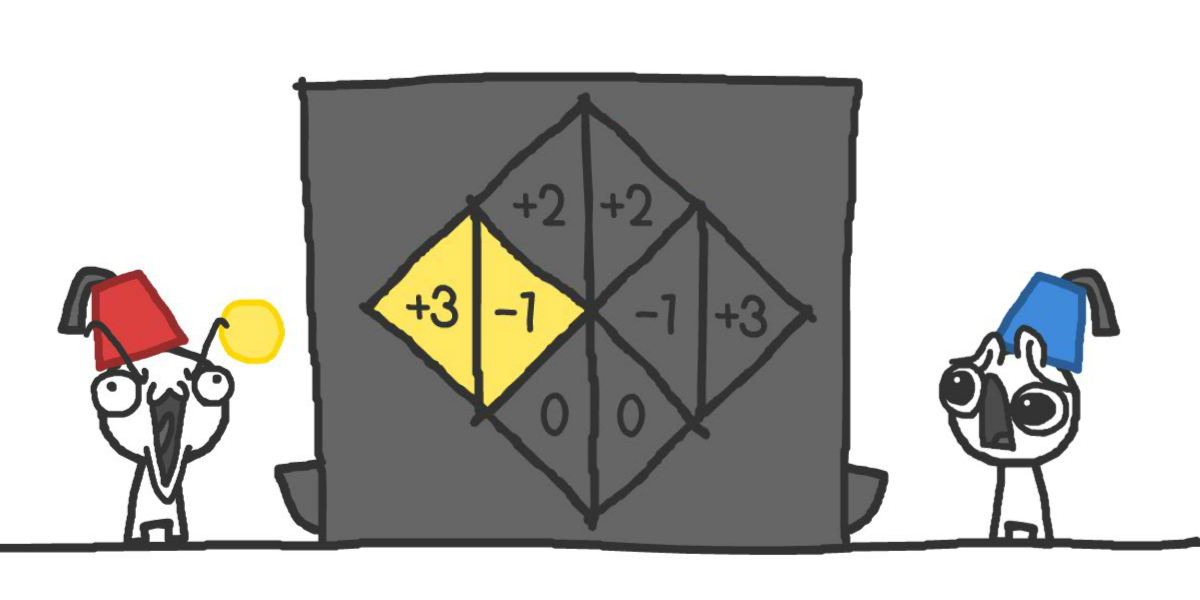
I just invented and played a game today with my family, and it worked great– it was fun and we learned an important lesson. Similar to the game “Monopoly” which shows that one person ends up monopolizing even though you think the rules are “fair,” the game of Oligarchy shows that the “free market” leads inexorably to one person getting all the money and everyone else going broke. And fast.
Finite and Infinite Games
Notes from James Carse's book 'Finite and Infinite Games'. Author unknown.
Stackelberg Mean Field Games: convergence and existence results to the problem of Principal with multiple Agents in competition
In a situation of moral hazard, this paper investigates the problem of Principal with $n$ Agents when the number of Agents $n$ goes to infinity. There is competition between the Agents expressed by the fact that they optimize their utility functions through a Nash equilibrium criterion. Each Agent is offered by the Principal a contract which is divided into a Markovian part involving the state/production of the Agent and a non--Markovian part involving the states/productions of all the other Agents. The Agents are in interactions. These interactions are characterized by common noise, the empirical distribution of states/productions and controls, and the contract which is not assumed to be a map of the empirical distribution. By the help of the mean field games theory, we are able to formulate an appropriate $limit$ problem involving a Principal with a $representative$ Agent. We start by solving the problem of both the Principal and the $representative$ Agent in this $limit$ problem. Then, when $n$ goes to infinity, we show that the problem of Principal with $n$ Agents converges to the $limit$ problem of Principal with a $representative$ Agent. A notable result is that, despite allowing a general type of contracts, it is approximately optimal for the Principal to offer contracts to the $n$ Agents that are maps of the empirical distribution of states/productions and controls of the Agents.

On the Impact of the Utility in Semivalue-based Data Valuation
Semivalue–based data valuation uses cooperative‐game theory intuitions to assign each data point a value reflecting its contribution to a downstream task. Still, those values depend on the...
Quick Summaries of Two Papers on Kant and Game Theory — LessWrong
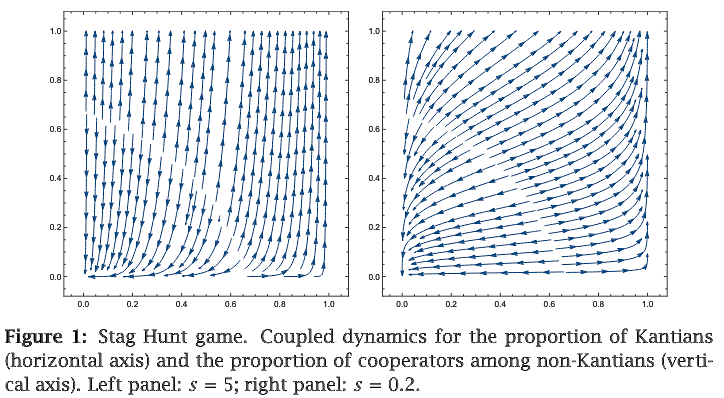
It's not obvious from a Darwinian point of view why people (even people who aren't related) often cooperate with one another. Researchers like Axelro…
Specification gaming: the flip side of AI ingenuity
Specification gaming is a behaviour that satisfies the literal specification of an objective without achieving the intended outcome. We have all had experiences with specification gaming, even if not by this name. Readers may have heard the myth of King Midas and the golden touch, in which the king asks that anything he touches be turned to gold - but soon finds that even food and drink turn to metal in his hands. In the real world, when rewarded for doing well on a homework assignment, a student might copy another student to get the right answers, rather than learning the material - and thus exploit a loophole in the task specification.

Will we have a theory for in-the-wild AI agents? - undisciplinary
Thoughts after writing a sociology-meets-physics-meets-agents paper I just put out a preprint out on a theory of role emergence in multi-agent systems (soci…
The Math of Idle Games, Part I
Originally published October 4, 2016 I’ve given a few talks in the past about the appeal and general mechanics of idle games, but what if you actually wanted to make one? Theory and patterns are nice, but there’s some complicated math running behind it. And how on earth

Integrative experiments identify how punishment affects welfare in public goods games
Despite decades of research, the conditions under which punishment promotes cooperation remain unclear. Through an integrative experiment varying 14 design parameters of public goods games across 360 experimental conditions (147,618 decisions from 7100 participants), we reveal substantial heterogeneity in punishment effectiveness: Its impact on welfare ranges from 43% improvement to 44% reduction depending on the game parameters. To characterize these patterns, we developed models that outperformed human forecasters in predicting punishment effectiveness in new experiments. Communication emerges as the most important factor, followed by contribution framing (opt out versus opt in), contribution type (variable versus all-or-nothing), game length, and outcome visibility, though these factors often interact. The results reframe the debate from whether punishment works to when it does, demonstrating how integrative experiments enable discovery of generalizable patterns in social phenomena. , Editor’s summary People face conflicts between maximizing personal gain versus supporting collective interests. If we cooperatively recycle or donate to charities, it benefits society, but it also costs us time and resources that could be selfishly preserved for ourselves. We impose penalties to deter those undesirable or selfish behaviors, but under what conditions do punishments or penalties effectively modify behavior to benefit group welfare? Alsobay et al . systematically and simultaneously varied 14 factors together instead of in isolation. Punishment was unequivocally most effective when paired with consistent communication, particularly over time. Another effective factor was “opting out” or withdrawing some, but not all, endowments already in the public fund. These methodological advances revealed when, rather than whether, punishment works. —Ekeoma Uzogara , INTRODUCTION Human societies face many situations where individual and collective interests conflict, often referred to as social dilemmas. Costly peer punishment has been studied for more than 25 years in public goods games (stylized behavioral experiments in which individuals decide how much to contribute to a shared pool that benefits everyone) as a mechanism to promote cooperation. Prior research has identified many contextual factors that moderate punishment’s effectiveness, including game length, communication, group size, punishment cost, and so on. However, the specific conditions under which punishment improves group welfare remain unclear. RATIONALE We argue that this lack of clarity derives from the dominant experimental paradigm, in which any given study manipulates only one or a few theoretically informed factors. Because such studies differ in many ways (different experimental procedures, populations), their results are often difficult to compare or integrate. Consequently, one can list many factors that have some effect, but cannot say how much each matters relative to the others, or how they work together, and as a result, cannot predict when punishment will help or harm welfare in new settings. To address this fundamental knowledge gap, we use an integrative experimental design and systematically vary 14 parameters across 360 conditions (147,618 decisions from 7100 participants) to elucidate when punishment improves versus undermines welfare in public goods games, which factors matter most, and how they interact. RESULTS The effect of punishment on welfare ranged from 43% improvement to 44% reduction depending on the specific combination of game parameters. To characterize this heterogeneity, we trained a model that outperformed all 553 human forecasters (laypeople and experts) in predicting whether punishment would help or harm welfare in new experiments. Communication emerged as roughly three times more important than any other factor, followed by contribution framing (opt in versus opt out), contribution type (variable versus all-or-nothing), game length, and peer outcome visibility (whether participants can see others’ earnings). These factors often interact. For example, longer games enhance punishment’s effectiveness only when communication is available, and contribution framing effects depend on both contribution type and outcome visibility. CONCLUSION Many phenomena in social science are shaped by many factors whose interactions are consequential, yet the dominant experimental paradigm often limits its inquiry to “does a given effect exist?” and examines hypothesized factors in isolation. As a result, research programs can accumulate many partial explanations without a clear picture of how they combine to determine outcomes across settings. Knowing that factors matter individually is fundamentally different from knowing how much each matters and how they interact. The integrative approach implemented here offers one way forward. It varies many factors simultaneously within a shared design space, evaluates models by their predictive accuracy on new experiments, and probes those models to constrain and develop theory. Our hope is that integrative experiment designs, combined with models that integrate prediction and explanation, represent a path toward more cumulative social science. Integrative experiment reveals when punishment helps versus harms. We systematically varied 14 design parameters across 360 experimental conditions. The effect of punishment on cooperation efficiency ranged from −44% to +43% depending on the specific game parameters. Communication emerged as three times more important than any other factor, followed by contribution framing, contribution type, and game length.

DIMACS :: Details
« IBM/DIMACS/DATA-INSPIRE Workshop on Bridging Game Theory and Machine Learning for Multi-party Decision Making
Agents First
Every product is getting a second customer — the human who pays, and the agent who decides. A design framework for building products that AI agents can use as primary consumers.
🚨Our new research examines agentic shopping: can you consistently predict (or, using marketing, influence) what an agent chooses? Nope. We found that even small differences (viewing order of pages, memories) changed AI preferences in unpredictable ways. papers.ssrn.com/sol3/papers.cfm?abstract_id=7…
