It’s time to hold companies to a higher standard when it comes to APIs. As software "eats the world," it seems like it’s not enough for a business to just serve its customers and hopefully make a profit, they also have to be “platforms” -- and, as any developer would respond, these days you just can’t be a platform without an API.
Why Executive Interest In APIs Is Booming
A decade ago, API awareness was limited, with evangelists educating a mostly unaware C-suite. Today, APIs are integral to business, widely embraced by executives and developers alike, reflecting a significant shift in digital transformation strategies.
Replacing Middle Management with APIs by Peter Reinhardt
There’s a trend in Silicon Valley startups to create a software layer in industries that were traditionally pure human services. Uber and Lyft have created software layers in the taxi industry, 99designs Tasks in the visual design industry, Homejoy in the cleaning industry, and so on. These new software services employ armies of human workers, optimizing their output, productivity and quality while driving price down.
Below the API
Jobs increasingly fall into one of two categories: Either you tell computers what to do for a living or they tell you what to do.
Optimised API Management for the modern business
Join us as we unveil the path to optimised API management, tailored for modern enterprises.

GGV Capital API-First Index
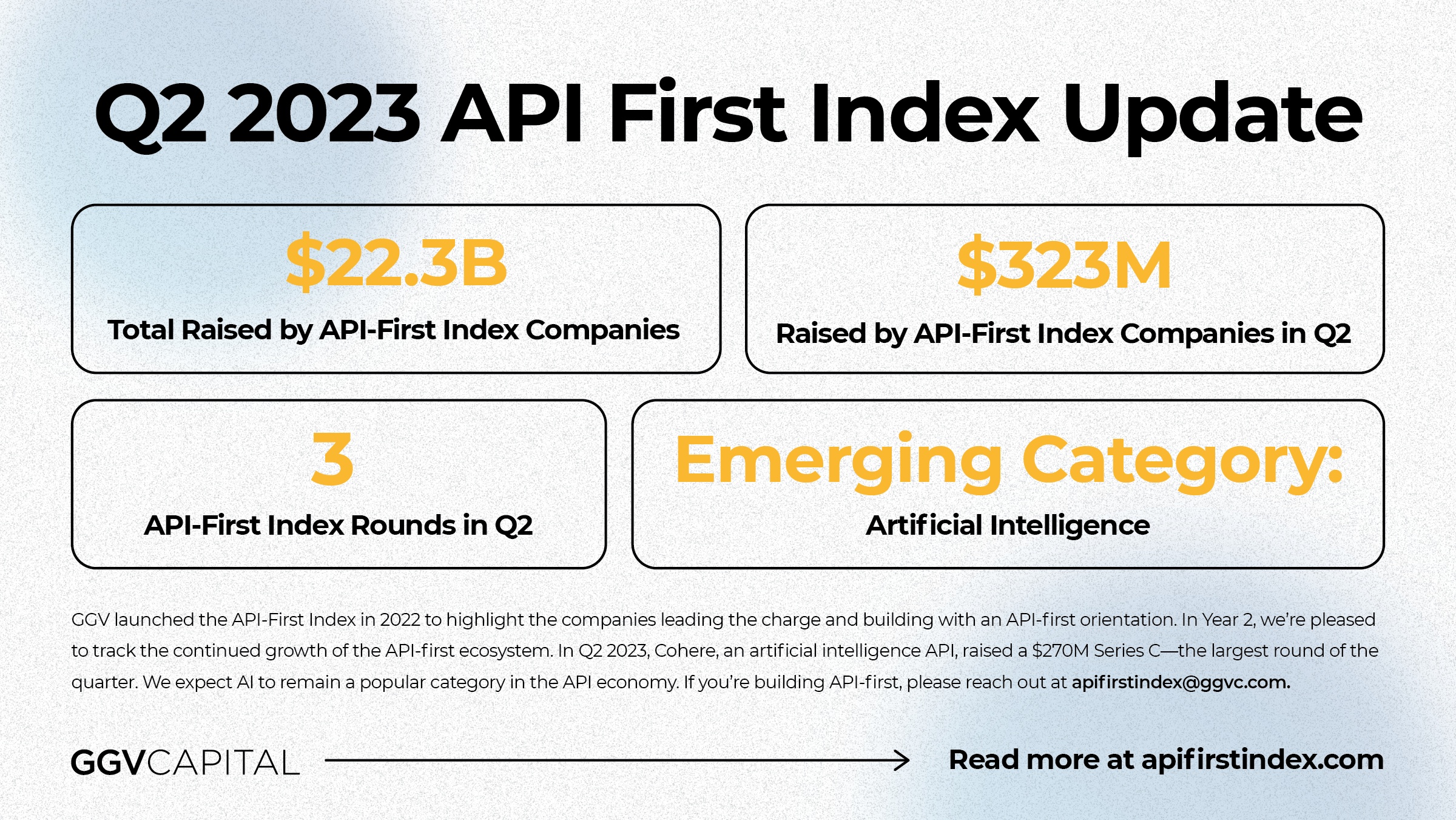
At GGV Capital, we are focused on finding the most promising developer-first software companies commercializing APIs, having already backed Agora, Authing, Pinwheel, Mindee and Stream. We are going all-in on API companies because they will fundamentally simplify software development. APIs will allow developers to offload lower-value and time-consuming components of application development so they can focus on higher-value work. For example, instead of a company asking its developers to spend months writing code to accept payments for its software, they can get up and running quickly with Stripe. For authentication, they can use Auth0. For chat, they can use Stream.We expect the use of APIs to continue growing exponentially in the next few years, and many promising companies are building with an API-first approach, including Algoia for search, Mux for video, and Commerce Layer for e-commerce. The public markets are also taking notice. Twilio and Agora are now publicly traded. Okta acquired Auth0 for $6.5B. SoFi acquired Galileo for $1.2B. We expect this trend to continue.2023 Q2 Update Highlights 1) Investment activity continues at a slower pace in Q22) Cohere raised one of the largest funding rounds of Q2 at $270M 3) Two additions to the API-First Index: Clerk & LibLab2023 Q1 Update Highlights1) Slower investment activity continues in Q1 2023 2) Stripe raised one of the largest funding rounds of 2023 at $6.5B3) Two additions to the API-First Index: Finch & SyncteraIn 2022, we tracked VC deal activity for 120+ API-first companies across categories. Find out what we learned:2022 Year in Review Report.GGV Capital is tracking 150+ API-first companies. We have now expanded the API-First Index to include the 60+ private companies that have raised $50M+ in funding. With this Index, we are focusing on API-first companies and have not included the broader and flourishing API economy (but are also very excited about this, having backed Kong and Tray.io!). If you are building API-first, we would love to meet you! Please contact us at apifirstindex@ggvc.com to be included in our list.
Reddit API controversy
In April 2023, the discussion and news aggregation website Reddit announced its intentions to charge for its application programming interface (API), a feature which had been free since 2008, causing a dispute. The move forced multiple third-party applications to shut down and threatened accessibility applications and moderation tools.

What if you never had to get an API key?

Anthropic Economic Index report: Uneven geographic and enterprise AI adoption
In this report, we document patterns of Claude usage over time, in 150+ countries, across US states, and among businesses deploying Claude through the API. Based on a privacy-preserving analysis of 1 million conversations on Claude.ai and 1 million API transcripts, we have four key findings: (1) Users increasingly entrust Claude with more autonomy, with directive task delegation rising from 27% to 39% in the past eight months. (2) Claude usage is geographically concentrated with high income countries overrepresented in global usage relative to their working age population. (3) Local economic considerations shape patterns of use both in terms of topic and in mode of collaboration with Claude. (4) API customers use Claude to automate tasks with greater specialization among use cases most amenable to programmatic access. To enable researchers and policymakers to further study the impact of AI on the economy, we additionally open-source the underlying data for this report.

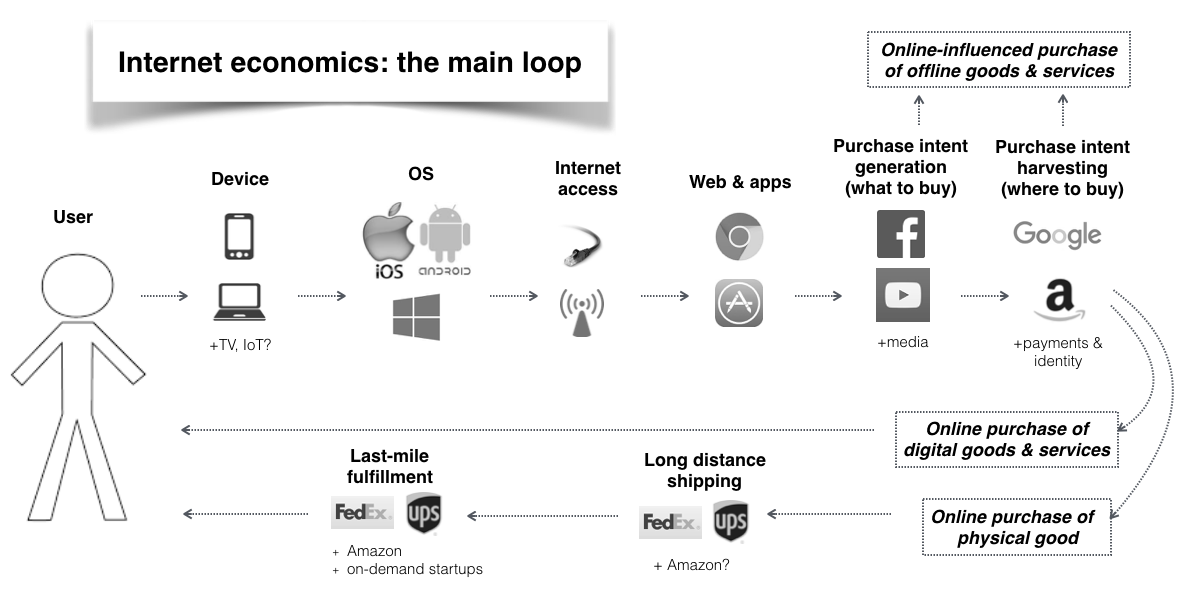
The Internet Economy
We are living in an era of bundling. The big five consumer tech companies — Google, Apple, Facebook, Amazon, and Microsoft — have moved far…
Comforting Myths - Infrequently Noted
I've been hearing confusing reports of Apple's openness to collaboration on challenging APIs so often that either my priors are invalid, or something else is at work. To find out, I needed data.

API Integration
Learn about pre-built automation tools and integrations to help your business stay ahead of the curve and deliver IT-as-a service.
Jobs below the API
Back in February, Peter Reinhardt published his fairly widely circulated blog post Replacing Middle Management with APIs. (If you haven’t read it already, do so now.)

AI Model & API Providers Analysis | Artificial Analysis
Comparison and analysis of AI models and API hosting providers. Independent benchmarks across key performance metrics including quality, price, output speed & latency.