More proof, if proof were needed, of the privacy-stripping power of metadata. A multi-year crowdsourced study, conducted by Stanford scientists and published this week, underlines how much information can be inferred from basic phone logs cross-referenced with other public datasets.
Differential Privacy | Harvard University Privacy Tools Project
Please see below for further information about differential privacy and our group's work. To get involved, please email privacytools-info@seas.harvard.edu and see our calls for summer interns, students, postdocs and visiting scholars.
Data Minimisation: a Language-Based Approach (Long Version)
Data minimisation is a privacy-enhancing principle considered as one of the pillars of personal data regulations. This principle dictates that personal data collected should be no more than...

(PDF) Understanding the Nature of Metadata: Systematic Review
PDF | Background Metadata are created to describe the corresponding data in a detailed and unambiguous way and is used for various applications in... | Find, read and cite all the research you need on ResearchGate

Stanford Researchers Find Connecting Metadata With User Names is Simple
One of the key tenets of the argument that the National Security Agency and some lawmakers have constructed to justify the agency’s collection of phone metadata is that the information it’s collecting, such as phone numbers and length of call, can’t be tied to the callers’ names. However, some quick investigation by some researchers at Stanford University who have been collecting information voluntarily from Android users found that they could correlate numbers to names with very little effort.

Data Leverage: A Framework for Empowering the Public in its Relationship with Technology Companies
Many powerful computing technologies rely on implicit and explicit data contributions from the public. In this paper, we synthesize emerging research that seeks to better understand and help people action this data leverage. Drawing on prior work in areas including machine learning, human-computer interaction, and fairness and accountability in computing, we present a framework for understanding data leverage that highlights new opportunities to change technology company behavior related to privacy, economic inequality, content moderation and other areas of societal concern.
Data Leverage: A Framework for Empowering the Public in its...
Many powerful computing technologies rely on implicit and explicit data contributions from the public. This dependency suggests a potential source of leverage for the public in its relationship...
Privacy Fundamentalism
The current privacy debate is making things worse by not considering trade-offs, the inherent nature of digital, or the far bigger problems that come with digitizing the offline world.

Unique in the Crowd: The privacy bounds of human mobility
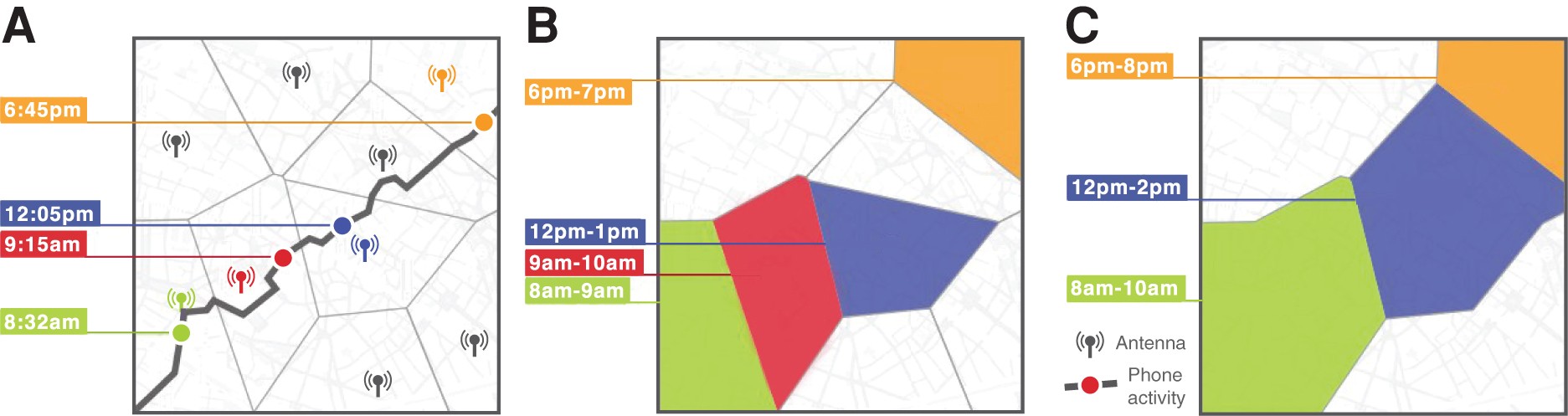
We study fifteen months of human mobility data for one and a half million individuals and find that human mobility traces are highly unique. In fact, in a dataset where the location of an individual is specified hourly and with a spatial resolution equal to that given by the carrier's antennas, four spatio-temporal points are enough to uniquely identify 95% of the individuals. We coarsen the data spatially and temporally to find a formula for the uniqueness of human mobility traces given their resolution and the available outside information. This formula shows that the uniqueness of mobility traces decays approximately as the 1/10 power of their resolution. Hence, even coarse datasets provide little anonymity. These findings represent fundamental constraints to an individual's privacy and have important implications for the design of frameworks and institutions dedicated to protect the privacy of individuals.
science.latha.org
A permissioned appview for scientific documents on AT Protocol. True data ownership with optional monetization.
Data Minimisation in Communication Protocols: A Formal Analysis...
With the growing amount of personal information exchanged over the Internet, privacy is becoming more and more a concern for users. One of the key principles in protecting privacy is data...
Beyond APIs: Collecting Web Data for Research using the National Internet Observatory
Widespread Internet use offers unprecedented opportunities to study human behavior at scale, yet researchers face significant ethical and technical barriers when attempting to collect data for academic studies.
Can “Conscious Data Contribution” Help Users to Exert “Data Leverage” Against Technology Companies?
Tech users currently have limited ability to act on concerns regarding the negative societal impacts of large tech companies. However, recent work suggests that users can exert leverage using their role in the generation of valuable data, for instance by withholding their data contributions to intelligent technologies. We propose and evaluate a new means to exert this type of leverage against tech companies: "conscious data contribution" (CDC).
FAIR | GO FAIR Foundation
The first step in (re)using data is to find them. Metadata and data should be easy to find for both humans and computers. Machine-readable metadata are essential for automatic discovery of datasets and services, so this is an essential component of the FAIRification process.
Facebook Data Privacy Scandal: A Cheat Sheet - TechRepublic
Read about the saga of Facebook's failures in ensuring privacy for user data, including how it relates to Cambridge Analytica, the GDPR, the Brexit campaign, and the 2016 US presidential election.
Measuring the Privacy Experience
How do you know that a product respects your privacy – other than by wading through the fine print? We’ve created a framework to measure the way people actually experience privacy in tech products.
Confer is bringing foundational AI privacy to Meta
I started building Confer because I saw how amazing LLMs are, and as a result, how much of our data is flowing through them. Already, AI chat apps have become some of the largest centralized data lakes in history, containing more sensitive data than anything ever before. We are using LLMs for the kind of unfiltered thinking that we might do in a private journal – except this journal is an API endpoint to a data pipeline specifically designed for extracting meaning and context.